mirror of
https://github.com/domainaware/parsedmarc.git
synced 2026-05-01 01:39:29 +00:00
 f0781c6191
* Strip invented IPinfo API behavior; keep documented-only

The IPinfo Lite API docs (https://ipinfo.io/developers/lite-api) state:
"The API has no daily or monthly limit and provides unlimited access."
Auth is documented as a ?token= query param only. The /me shown in the
docs returns geolocation for the caller's IP — it is not a documented
account/quota endpoint for Lite.

Removed everything that was speculating beyond the docs:

- The /me probe that pretended to return plan/limit/remaining fields.
- 429 rate-limit handling, 402 quota-exhausted handling, Retry-After
  parsing, cooldown state, and the rate-limit warning / recovery-info
  logging around them.
- The Authorization: Bearer header (not documented for Lite).

Kept:

- Lookups against the documented /lite/<ip>?token=<token> endpoint.
- 401/403 treated as a fatal invalid-token (reasonable defensive check).
- Network-error and non-2xx fallback to the bundled/cached MMDB.
- A simple startup probe that validates the token with a single lookup
  and logs "IPinfo API configured" at info level.

Test consolidated to cover only documented paths: success, 401 fatal,
non-2xx fallback, and that auth goes in ?token= (not Authorization).

Co-Authored-By: Claude Opus 4.7 (1M context) <noreply@anthropic.com>

* AGENTS.md: warn against speculating past external-service docs

New subsection under Configuration spelling out that third-party API
integrations must start with a direct WebFetch of the canonical docs
page, not a subagent query. Calls out the two traps that produced the
IPinfo speculation: (1) asking subagents question shapes that
presuppose the answer exists, and (2) treating feature asks as "build
this" without first checking "does this apply to this service?".

Uses the now-reverted IPinfo speculation as the cautionary tale so the
next session has a concrete example to recognize the shape of the
mistake.

Co-Authored-By: Claude Opus 4.7 (1M context) <noreply@anthropic.com>

* Bump to 9.10.1; put removal under a new CHANGELOG section

Restored the 9.10.0 entry to its as-shipped wording and moved the
speculation-removal note into its own 9.10.1 Fixed section.
Editing the 9.10.0 entry would have misrepresented what was
actually released — the shipped tag does contain the /me probe,
429/402 cooldown, Retry-After parsing, and Bearer auth, and the
changelog should say so.

Co-Authored-By: Claude Opus 4.7 (1M context) <noreply@anthropic.com>

---------

Co-authored-by: Sean Whalen <seanthegeek@users.noreply.github.com>
Co-authored-by: Claude Opus 4.7 (1M context) <noreply@anthropic.com>
parsedmarc




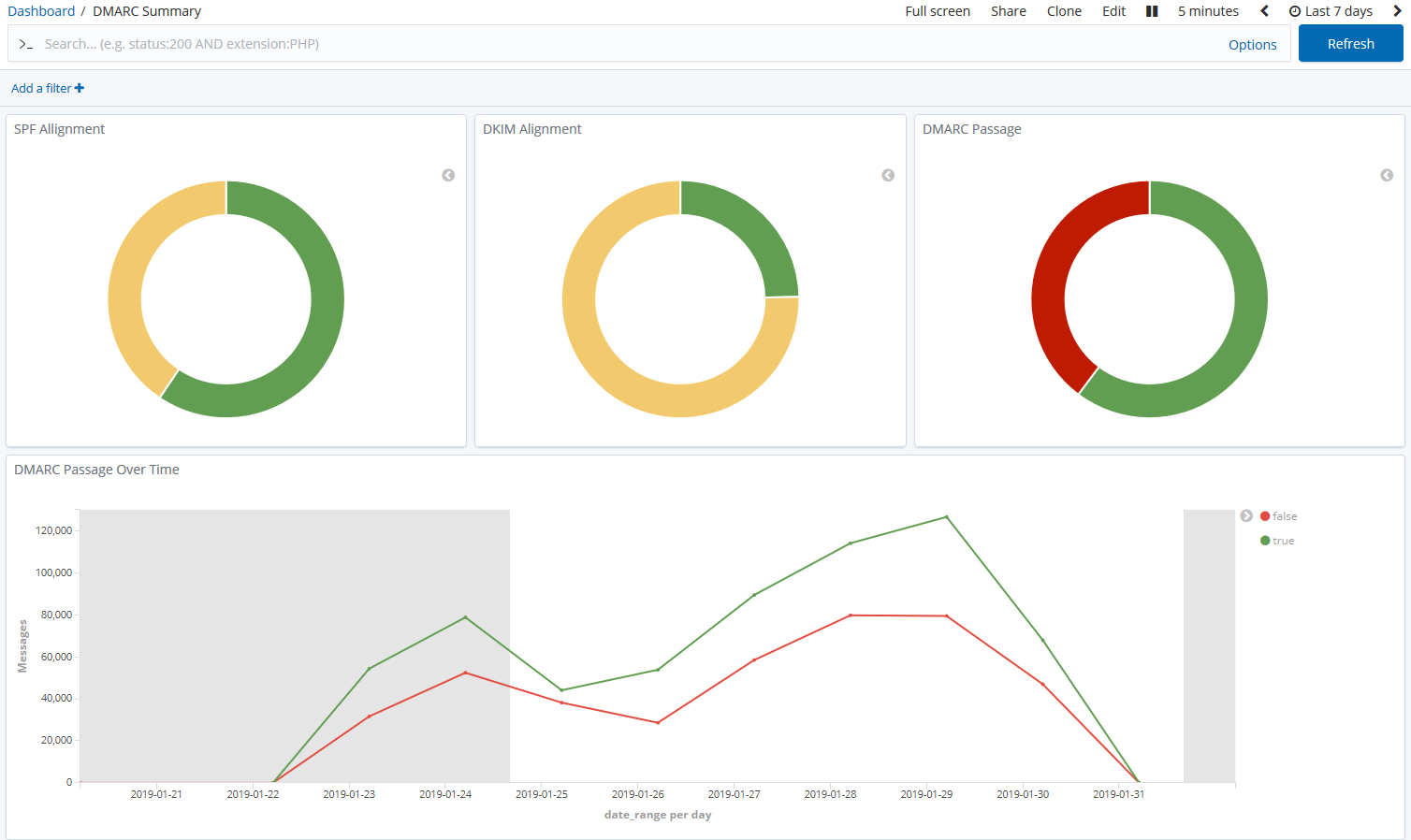
parsedmarc is a Python module and CLI utility for parsing DMARC
reports. When used with Elasticsearch and Kibana (or Splunk), it works
as a self-hosted open-source alternative to commercial DMARC report
processing services such as Agari Brand Protection, Dmarcian, OnDMARC,
ProofPoint Email Fraud Defense, and Valimail.
Note
Domain-based Message Authentication, Reporting, and Conformance (DMARC) is an email authentication protocol.
Sponsors
This is a project is maintained by one developer. Please consider sponsoring my work if you or your organization benefit from it.
Features
- Parses draft and 1.0 standard aggregate/rua DMARC reports
- Parses forensic/failure/ruf DMARC reports
- Parses reports from SMTP TLS Reporting
- Can parse reports from an inbox over IMAP, Microsoft Graph, or Gmail API
- Transparently handles gzip or zip compressed reports
- Consistent data structures
- Simple JSON and/or CSV output
- Optionally email the results
- Optionally send the results to Elasticsearch, Opensearch, and/or Splunk, for use with premade dashboards
- Optionally send reports to Apache Kafka
Python Compatibility
This project supports the following Python versions, which are either actively maintained or are the default versions for RHEL or Debian.
| Version | Supported | Reason |
|---|---|---|
| < 3.6 | ❌ | End of Life (EOL) |
| 3.6 | ❌ | Used in RHEL 8, but not supported by project dependencies |
| 3.7 | ❌ | End of Life (EOL) |
| 3.8 | ❌ | End of Life (EOL) |
| 3.9 | ❌ | Used in Debian 11 and RHEL 9, but not supported by project dependencies |
| 3.10 | ✅ | Actively maintained |
| 3.11 | ✅ | Actively maintained; supported until June 2028 (Debian 12) |
| 3.12 | ✅ | Actively maintained; supported until May 2035 (RHEL 10) |
| 3.13 | ✅ | Actively maintained; supported until June 2030 (Debian 13) |
| 3.14 | ✅ | Supported (requires imapclient>=3.1.0) |