mirror of
https://github.com/domainaware/parsedmarc.git
synced 2026-06-10 12:39:44 +00:00
 Sean Whalen
b869235224
Sean Whalen
b869235224
* Build multi-arch Docker images with PostgreSQL support

The prebuilt image now installs the `[postgresql]` extra, so the optional
PostgreSQL output backend (psycopg) works out of the box in the container
without a separate `pip install` (#792). The wheel path is resolved into a
variable before appending the extra so the shell doesn't treat
`*.whl[postgresql]` as a bracket glob.

The build workflow now sets up QEMU + Buildx and builds a multi-arch
manifest for `linux/amd64` and `linux/arm64`, so the image runs natively on
64-bit ARM hosts such as a Raspberry Pi (#789). Every compiled dependency
(psycopg[binary], lxml, maxminddb, cryptography) ships prebuilt aarch64
manylinux wheels, so the arm64 build adds no source-compilation step.

A `pull_request` trigger (scoped to the build inputs) and `workflow_dispatch`
are added so the multi-arch build can be validated on PRs and rebuilt on
demand; pushes are still gated on the release event, so neither pushes images.

Closes #789
Closes #792

Co-Authored-By: Claude Opus 4.8 (1M context) <noreply@anthropic.com>

* Bump version to 10.0.4 to publish the new images

The docker workflow only pushes to the registry on a `release` event, so
shipping the multi-arch + PostgreSQL-enabled image requires cutting a
release. 10.0.3 is already tagged, so bump to 10.0.4 and document the
Docker changes in the changelog.

Co-Authored-By: Claude Opus 4.8 (1M context) <noreply@anthropic.com>

* Don't run the docker build on pull requests

The pull_request trigger (added to validate the multi-arch build) re-ran the
full ~10-minute amd64+arm64 build on every commit pushed to a docker-touching
PR, because the pull_request `paths` filter matches against the PR's entire
diff, not just the newest commit. That is wasteful once the build has been
validated.

Drop the pull_request trigger and rely on workflow_dispatch for on-demand
validation (plus the existing master-push and release triggers). Also gate the
registry login on the release event so that no non-release run authenticates
to ghcr at all — a build can only ever be pushed from a published release.

Co-Authored-By: Claude Opus 4.8 (1M context) <noreply@anthropic.com>

---------

Co-authored-by: Claude Opus 4.8 (1M context) <noreply@anthropic.com>
parsedmarc




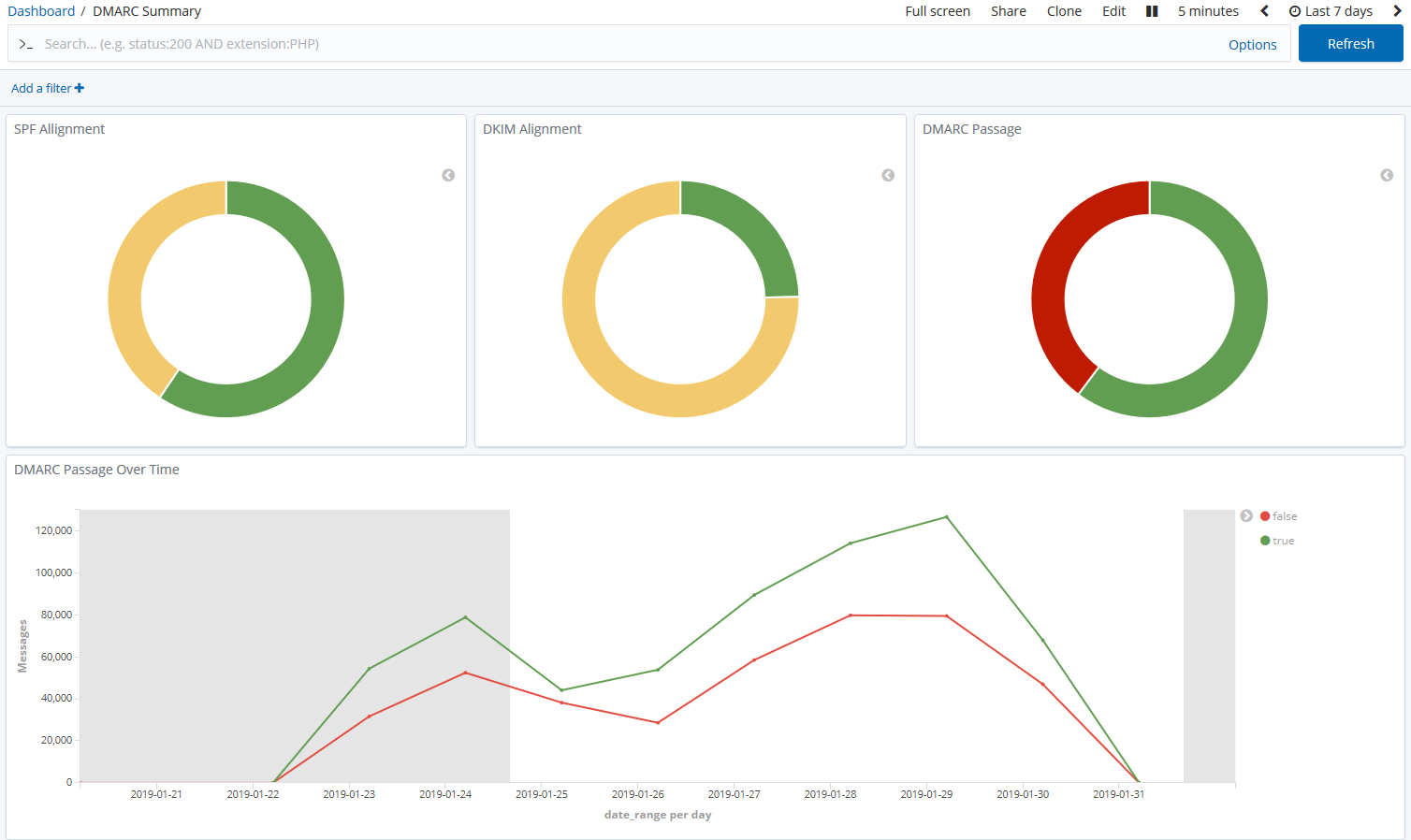
parsedmarc is a Python module and CLI utility for parsing DMARC
reports. When used with Elasticsearch and Kibana (or Splunk), it works
as a self-hosted open-source alternative to commercial DMARC report
processing services such as Agari Brand Protection, Dmarcian, OnDMARC,
ProofPoint Email Fraud Defense, and Valimail.
Note
Domain-based Message Authentication, Reporting, and Conformance (DMARC) is an email authentication protocol.
Sponsors
This is a project is maintained by one developer. Please consider sponsoring my work if you or your organization benefit from it.
Features
- Parses aggregate/rua DMARC reports: the legacy draft and 1.0 schemas (RFC 7489) and the new RFC 9990 schema for the final DMARC standard (RFC 9989)
- Parses failure/ruf DMARC reports (RFC 6591 and RFC 9991; formerly called forensic reports)
- Parses reports from SMTP TLS Reporting (TLS-RPT, RFC 8460)
- Can parse reports from an inbox over IMAP, Microsoft Graph, or Gmail API
- Transparently handles gzip or zip compressed reports
- Consistent data structures
- Simple JSON and/or CSV output
- Optionally email the results
- Optionally send the results to Elasticsearch, OpenSearch, Splunk, or PostgreSQL, for use with premade dashboards
- Optionally send the results to Apache Kafka, Amazon S3, Azure Log Analytics (Microsoft Sentinel), a Graylog (GELF) endpoint, a syslog server, or an HTTP webhook
Python Compatibility
This project supports the following Python versions, which are either actively maintained or are the default versions for RHEL or Debian.
| Version | Supported | Reason |
|---|---|---|
| < 3.6 | ❌ | End of Life (EOL) |
| 3.6 | ❌ | Used in RHEL 8, but not supported by project dependencies |
| 3.7 | ❌ | End of Life (EOL) |
| 3.8 | ❌ | End of Life (EOL) |
| 3.9 | ❌ | Used in Debian 11 and RHEL 9, but not supported by project dependencies |
| 3.10 | ✅ | Actively maintained |
| 3.11 | ✅ | Actively maintained; supported until June 2028 (Debian 12) |
| 3.12 | ✅ | Actively maintained; supported until May 2035 (RHEL 10) |
| 3.13 | ✅ | Actively maintained; supported until June 2030 (Debian 13) |
| 3.14 | ✅ | Supported (requires imapclient>=3.1.0) |