mirror of
https://github.com/domainaware/parsedmarc.git
synced 2026-10-20 01:58:11 +00:00

 Sean WhalenandClaude Fable 5
df9bf82e04
Sean WhalenandClaude Fable 5
df9bf82e04
Follow-ups from the review of PR #825 (whose implementation had already
landed on master via #826's stacked merge):

- Honor the documented [smtp] attachment and [smtp] message options.
  Both were parsed into opts but never passed to either summary-email
  transport (also broken in released 10.2.2), so a configured custom
  attachment filename or message body was silently ignored. Both the
  SMTP and Microsoft Graph transports now receive them, and the missing
  smtp_attachment Namespace default is added (also covers SIGHUP
  reload, which rebuilds opts from the CLI Namespace).
- Don't mislabel non-Graph mailbox errors as Microsoft Graph failures:
  the shared mailbox-fetch and watch handlers now log a generic
  "Mailbox Error" with traceback when the connection isn't Graph.
- Declare microsoft-kiota-abstractions as a direct dependency (imported
  directly in cli.py for Graph error handling; previously transitive).

Migrate all runtime HTTP from requests to httpx (webhook client, Splunk
HEC client, and the PSL-overrides / IP-database / reverse-DNS-map /
IPinfo-API fetches in utils.py):

- follow_redirects=True everywhere to preserve requests' default
  redirect-following; httpx does not follow redirects by default.
- The PSL-overrides and reverse-DNS-map fetches gain a 60s timeout
  (previously none), matching the IP-database fetch.
- response.ok -> response.is_success; requests.RequestException ->
  httpx.HTTPError; raw string bodies use content= (httpx's data= is
  form-encoding only); Splunk HEC verification moves to client
  construction (httpx has no per-request verify).
- requests drops out of [project] dependencies and moves to the [build]
  extra for the out-of-wheel maintainer script collect_domain_info.py,
  which deliberately stays on requests/urllib3 for its permissive-TLS
  adapter.
- Remove the requests-era module-level
  urllib3.disable_warnings(InsecureRequestWarning) in splunk.py; httpx
  doesn't route through urllib3, so its only remaining effect was
  globally silencing insecure-TLS warnings from other urllib3-based
  components as an import side effect. Nothing imports urllib3 directly
  anymore, so it also leaves [project] dependencies.

Tests: config-to-transport wiring for attachment/message on both
transports (including defaults), non-Graph errors keep the generic log
line, webhook/Splunk payload assertions moved to content=, and Splunk
verify asserted at httpx.Client construction. 736 passed; ruff and
pyright clean.

Co-authored-by: Claude Fable 5 <noreply@anthropic.com>
parsedmarc




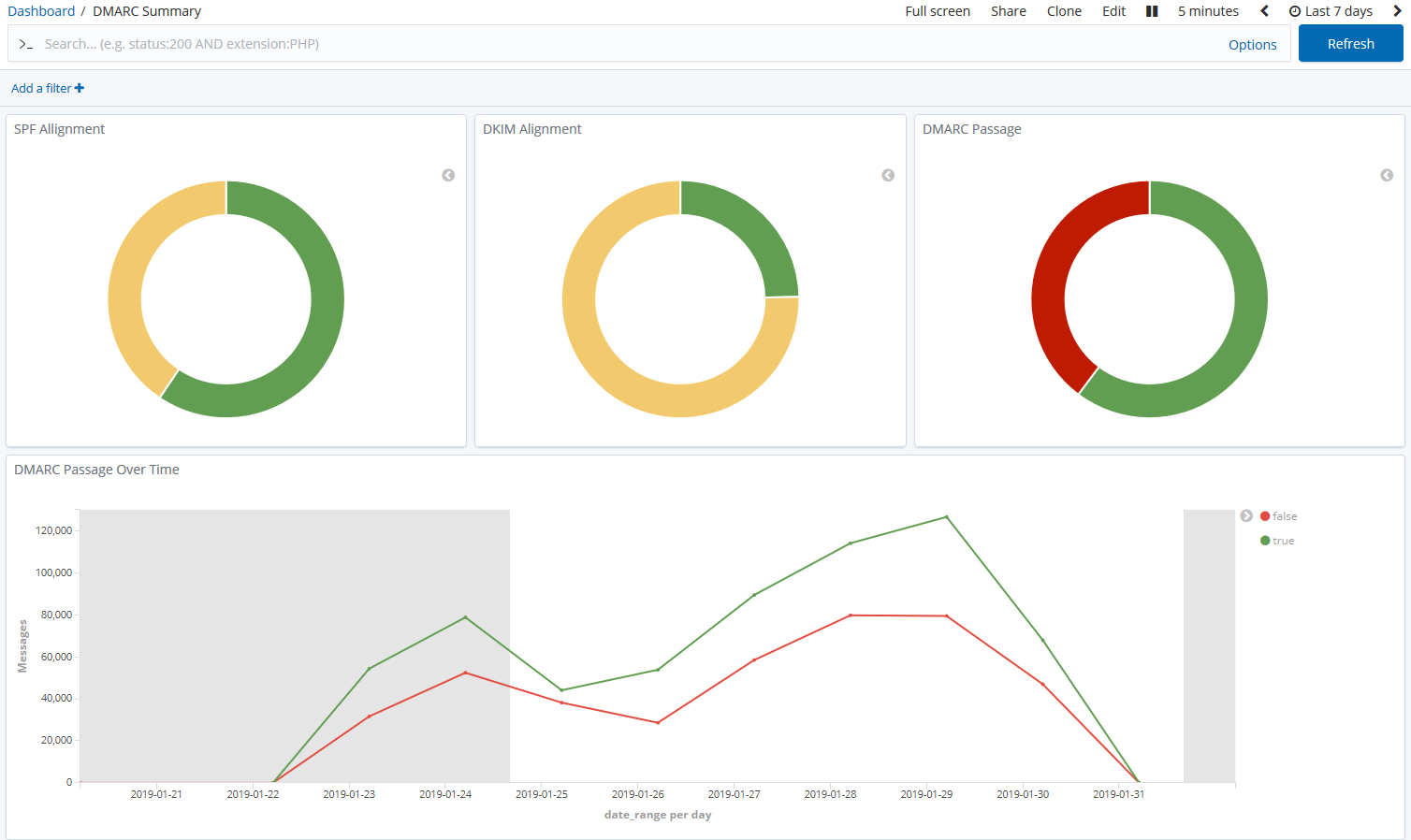
parsedmarc is a Python module and CLI utility for parsing DMARC
reports. When used with Elasticsearch and Kibana (or Splunk), it works
as a self-hosted open-source alternative to commercial DMARC report
processing services such as Agari Brand Protection, Dmarcian, OnDMARC,
ProofPoint Email Fraud Defense, and Valimail.
Note
Domain-based Message Authentication, Reporting, and Conformance (DMARC) is an email authentication protocol.
Sponsors
This project is maintained by one developer. Please consider sponsoring my work if you or your organization benefit from it.
Features
- Parses aggregate/rua DMARC reports: the legacy draft and 1.0 schemas (RFC 7489) and the new RFC 9990 schema for the final DMARC standard (RFC 9989)
- Parses failure/ruf DMARC reports (RFC 6591 and RFC 9991; formerly called forensic reports)
- Parses reports from SMTP TLS Reporting (TLS-RPT, RFC 8460)
- Can parse reports from an inbox over IMAP, Microsoft Graph, or Gmail API
- Transparently handles gzip or zip compressed reports
- Consistent data structures
- Simple JSON and/or CSV output
- Optionally email the results
- Optionally send the results to Elasticsearch, OpenSearch, Splunk, or PostgreSQL, for use with premade dashboards
- Optionally send the results to Apache Kafka, Amazon S3, Azure Log Analytics (Microsoft Sentinel), a Graylog (GELF) endpoint, a syslog server, or an HTTP webhook
Python Compatibility
This project supports the following Python versions, which are either actively maintained or are the default versions for RHEL or Debian.
| Version | Supported | Reason |
|---|---|---|
| < 3.6 | ❌ | End of Life (EOL) |
| 3.6 | ❌ | Used in RHEL 8, but not supported by project dependencies |
| 3.7 | ❌ | End of Life (EOL) |
| 3.8 | ❌ | End of Life (EOL) |
| 3.9 | ❌ | Used in Debian 11 and RHEL 9, but not supported by project dependencies |
| 3.10 | ✅ | Actively maintained |
| 3.11 | ✅ | Actively maintained; supported until June 2028 (Debian 12) |
| 3.12 | ✅ | Actively maintained; supported until May 2035 (RHEL 10) |
| 3.13 | ✅ | Actively maintained; supported until June 2030 (Debian 13) |
| 3.14 | ✅ | Supported (requires imapclient>=3.1.0) |