mirror of
https://github.com/domainaware/parsedmarc.git
synced 2026-09-16 19:07:59 +00:00


 d3510da3a6
* feat: graceful SIGTERM/SIGINT shutdown for watch mode and one-shot CLI

Previously SIGTERM (systemctl stop, docker stop, Kubernetes pod termination)
killed parsedmarc mid-batch, tearing output writes and silently dropping
buffered Kafka records. Shutdown is now cooperative:

- SIGTERM/SIGINT set a flag that is polled at safe boundaries. The one-shot
  CLI checks it between batches; watch mode passes it as `config_reloading` so
  the mailbox backend -- including the IMAP IDLE loop -- returns once the
  current batch is fully processed. Either way the in-flight batch and its
  output writes finish before the process exits 0.
- Ctrl-C is a double-tap: the first press is graceful, the second
  short-circuits to os._exit(130).
- Output clients are now closed on every exit path (atexit plus a trailing
  close in _main), fixing a long-standing leak where one-shot runs and
  graceful shutdowns never flushed Kafka / closed Elasticsearch / S3 / etc.

Docs: the example systemd unit gains KillSignal=SIGTERM and TimeoutStopSec=60
(keep it above mailbox_check_timeout). Tests cover watch shutdown, the one-shot
between-batch stop, the SIGINT double-tap, and the output-client-close leak.

* test: cover the one-shot mbox-loop shutdown break

Extend the one-shot SIGTERM test to also pass an .mbox path so a single
run exercises both shutdown checkpoints: the file-batch loop break and the
subsequent mbox loop break (which Codecov flagged as the only uncovered
lines on PR #794). is_mbox is keyed by suffix and get_dmarc_reports_from_mbox
is asserted not called, since the mbox loop breaks before reaching it.

* test: narrow signal.getsignal() return before invoking in SIGINT test

signal.getsignal() is typed Callable | int | Handlers | None; calling it
directly fails pyright's callable check. Assert callable() first.

Co-Authored-By: Claude Fable 5 <noreply@anthropic.com>

---------

Co-authored-by: Sean Whalen <44679+seanthegeek@users.noreply.github.com>
Co-authored-by: Claude Fable 5 <noreply@anthropic.com>
parsedmarc




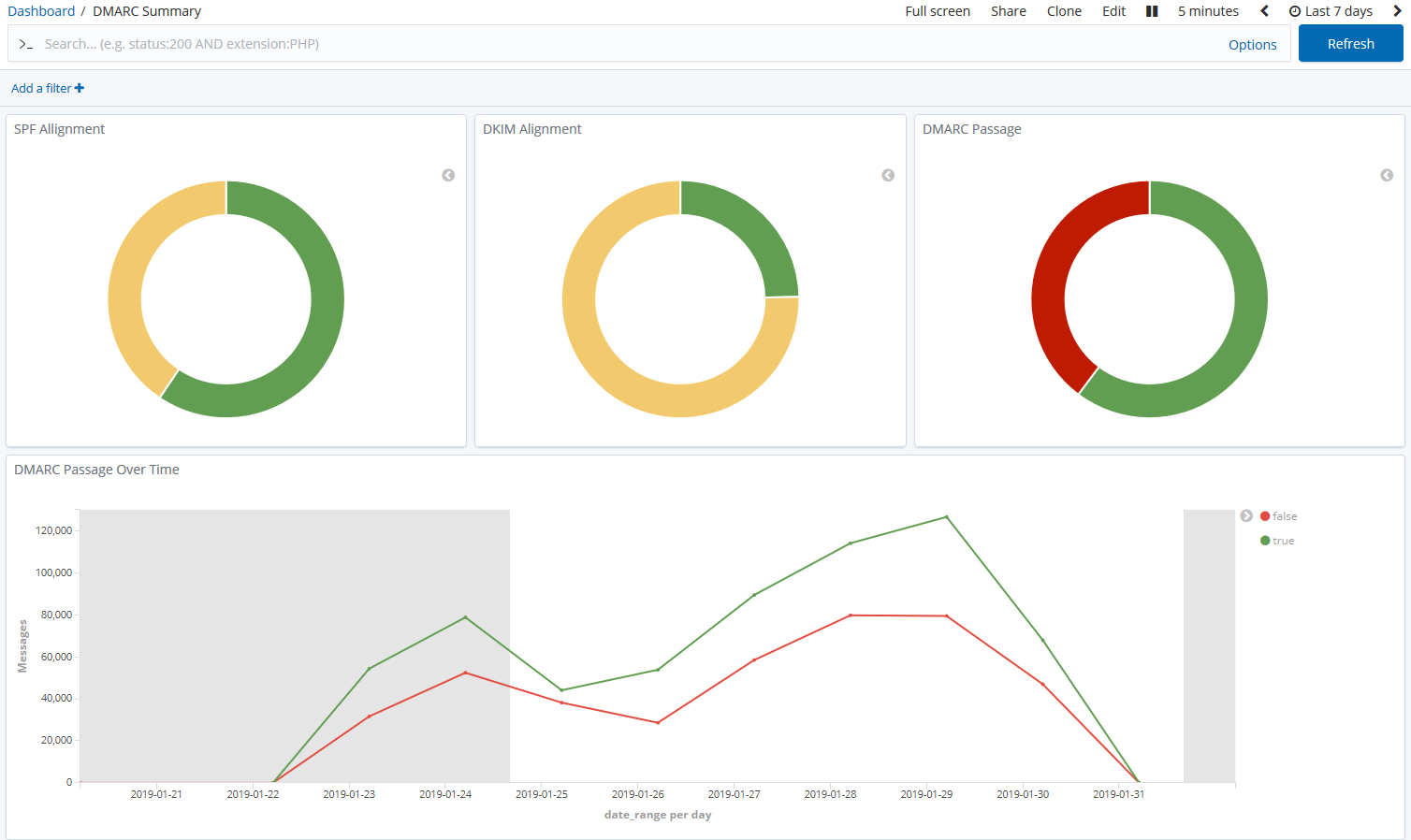
parsedmarc is a Python module and CLI utility for parsing DMARC
reports. When used with Elasticsearch and Kibana (or Splunk), it works
as a self-hosted open-source alternative to commercial DMARC report
processing services such as Agari Brand Protection, Dmarcian, OnDMARC,
ProofPoint Email Fraud Defense, and Valimail.
Note
Domain-based Message Authentication, Reporting, and Conformance (DMARC) is an email authentication protocol.
Sponsors
This is a project is maintained by one developer. Please consider sponsoring my work if you or your organization benefit from it.
Features
- Parses aggregate/rua DMARC reports: the legacy draft and 1.0 schemas (RFC 7489) and the new RFC 9990 schema for the final DMARC standard (RFC 9989)
- Parses failure/ruf DMARC reports (RFC 6591 and RFC 9991; formerly called forensic reports)
- Parses reports from SMTP TLS Reporting (TLS-RPT, RFC 8460)
- Can parse reports from an inbox over IMAP, Microsoft Graph, or Gmail API
- Transparently handles gzip or zip compressed reports
- Consistent data structures
- Simple JSON and/or CSV output
- Optionally email the results
- Optionally send the results to Elasticsearch, OpenSearch, Splunk, or PostgreSQL, for use with premade dashboards
- Optionally send the results to Apache Kafka, Amazon S3, Azure Log Analytics (Microsoft Sentinel), a Graylog (GELF) endpoint, a syslog server, or an HTTP webhook
Python Compatibility
This project supports the following Python versions, which are either actively maintained or are the default versions for RHEL or Debian.
| Version | Supported | Reason |
|---|---|---|
| < 3.6 | ❌ | End of Life (EOL) |
| 3.6 | ❌ | Used in RHEL 8, but not supported by project dependencies |
| 3.7 | ❌ | End of Life (EOL) |
| 3.8 | ❌ | End of Life (EOL) |
| 3.9 | ❌ | Used in Debian 11 and RHEL 9, but not supported by project dependencies |
| 3.10 | ✅ | Actively maintained |
| 3.11 | ✅ | Actively maintained; supported until June 2028 (Debian 12) |
| 3.12 | ✅ | Actively maintained; supported until May 2035 (RHEL 10) |
| 3.13 | ✅ | Actively maintained; supported until June 2030 (Debian 13) |
| 3.14 | ✅ | Supported (requires imapclient>=3.1.0) |