mirror of
https://github.com/domainaware/parsedmarc.git
synced 2026-10-20 17:58:14 +00:00


 cdda5dae62
* Fix failure-report timestamp skew on non-UTC hosts in ES/OS/Splunk sinks

arrival_date_utc is a UTC wall-clock string (generated in
parse_failure_report via an aware-UTC strftime), but elastic.py,
opensearch.py, and splunk.py parsed it back into a naive datetime and
called .timestamp(), which per the Python docs interprets naive values
as local time (https://docs.python.org/3/library/datetime.html#datetime.datetime.timestamp).
On any non-UTC host the epoch stored as the ES/OpenSearch arrival_date
field, used in the failure-report dedup match query, and sent as the
Splunk HEC event time was therefore off by the host's UTC offset
(verified -3600 s under TZ=Europe/Warsaw in January).

Add an assume_utc keyword to human_timestamp_to_datetime() /
human_timestamp_to_unix_timestamp() that attaches timezone.utc to naive
parses, and use it at the three arrival_date_utc call sites. Aware
inputs (explicit offsets) are unaffected; all other callers keep the
existing local-time semantics, whose round-trip with timestamp_to_human
is self-consistent on a single host (the broader local-time output
question is tracked separately in issue #811 bug 2).

The three new sink regression tests fail on the unfixed code
(verified by stashing the source changes) and force TZ=Europe/Warsaw
via time.tzset() so they catch the skew even on UTC CI runners.

Fixes half of https://github.com/domainaware/parsedmarc/issues/811.

Co-Authored-By: Claude Fable 5 <noreply@anthropic.com>

* Deduplicate TZ-forcing test boilerplate; fix unix-timestamp docstring

Extract the repeated TZ=Europe/Warsaw + time.tzset() setup/cleanup from
the four timestamp regression tests into a shared tests/tzutil.py
force_tz() helper, and correct human_timestamp_to_unix_timestamp()'s
docstring, which said the return type was float while the function
returns int.

Co-Authored-By: Claude Fable 5 <noreply@anthropic.com>

---------

Co-authored-by: MISAPOR LAB <misapor@lab.misapor.pl>
Co-authored-by: Claude Fable 5 <noreply@anthropic.com>
Co-authored-by: Sean Whalen <44679+seanthegeek@users.noreply.github.com>
parsedmarc




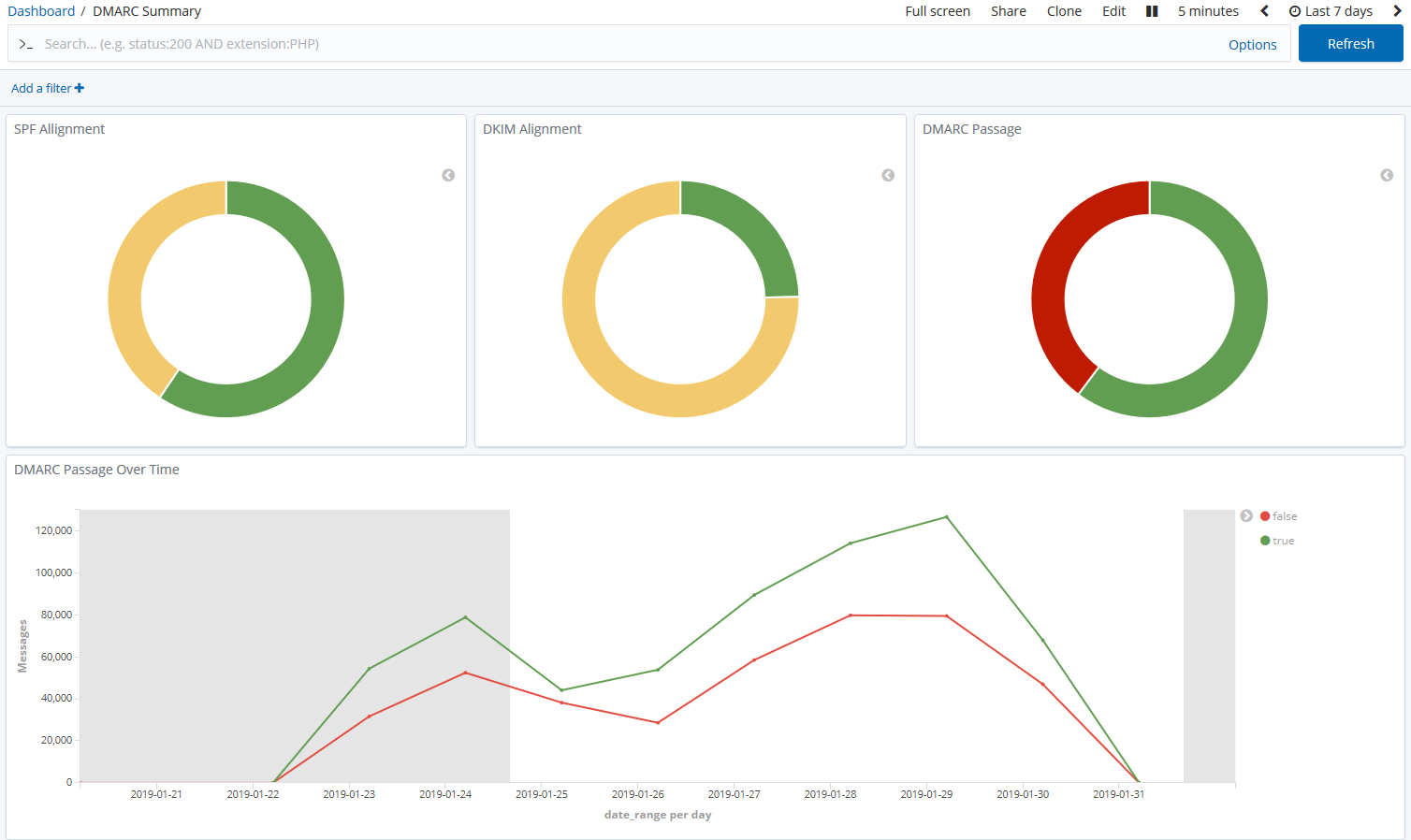
parsedmarc is a Python module and CLI utility for parsing DMARC
reports. When used with Elasticsearch and Kibana (or Splunk), it works
as a self-hosted open-source alternative to commercial DMARC report
processing services such as Agari Brand Protection, Dmarcian, OnDMARC,
ProofPoint Email Fraud Defense, and Valimail.
Note
Domain-based Message Authentication, Reporting, and Conformance (DMARC) is an email authentication protocol.
Sponsors
This project is maintained by one developer. Please consider sponsoring my work if you or your organization benefit from it.
Features
- Parses aggregate/rua DMARC reports: the legacy draft and 1.0 schemas (RFC 7489) and the new RFC 9990 schema for the final DMARC standard (RFC 9989)
- Parses failure/ruf DMARC reports (RFC 6591 and RFC 9991; formerly called forensic reports)
- Parses reports from SMTP TLS Reporting (TLS-RPT, RFC 8460)
- Can parse reports from an inbox over IMAP, Microsoft Graph, or Gmail API
- Transparently handles gzip or zip compressed reports
- Consistent data structures
- Simple JSON and/or CSV output
- Optionally email the results
- Optionally send the results to Elasticsearch, OpenSearch, Splunk, or PostgreSQL, for use with premade dashboards
- Optionally send the results to Apache Kafka, Amazon S3, Azure Log Analytics (Microsoft Sentinel), a Graylog (GELF) endpoint, a syslog server, or an HTTP webhook
Python Compatibility
This project supports the following Python versions, which are either actively maintained or are the default versions for RHEL or Debian.
| Version | Supported | Reason |
|---|---|---|
| < 3.6 | ❌ | End of Life (EOL) |
| 3.6 | ❌ | Used in RHEL 8, but not supported by project dependencies |
| 3.7 | ❌ | End of Life (EOL) |
| 3.8 | ❌ | End of Life (EOL) |
| 3.9 | ❌ | Used in Debian 11 and RHEL 9, but not supported by project dependencies |
| 3.10 | ✅ | Actively maintained |
| 3.11 | ✅ | Actively maintained; supported until June 2028 (Debian 12) |
| 3.12 | ✅ | Actively maintained; supported until May 2035 (RHEL 10) |
| 3.13 | ✅ | Actively maintained; supported until June 2030 (Debian 13) |
| 3.14 | ✅ | Supported (requires imapclient>=3.1.0) |