mirror of
https://github.com/domainaware/parsedmarc.git
synced 2026-09-13 01:18:01 +00:00

 Sean WhalenandClaude Fable 5
cdd7870984
Sean WhalenandClaude Fable 5
cdd7870984
* Grow the viewport so Grafana full-dashboard captures render every panel

Grafana only runs a panel's queries once the panel enters the viewport,
so the full-page screenshot taken at a fixed 1720x1200 viewport captured
everything below the fold as an empty placeholder — the tables in the
bottom two-thirds of the DMARC dashboard came out blank. Scroll-through
approaches are unreliable in headless Chromium (Grafana's custom scroll
container ignores synthetic wheel events), so instead measure the
dashboard's full scroll height and grow the viewport to cover it before
capturing, then restore the normal viewport for the per-panel viewPanel
captures (which fill the viewport and would otherwise be distorted).

Verified against the live dashboard-dev stack: all panels, including the
bottom alignment-detail tables, now render in the capture.

Co-Authored-By: Claude Fable 5 <noreply@anthropic.com>

* Pin ruff exactly, matching the existing pyright pin rationale

CI installs the [build] extra fresh on every run, and ruff was the one
lint tool left unpinned. ruff 0.16.0 (released this week) began
flagging this codebase's str.format() house style, so every PR started
failing lint on lines it never touched. Pin to 0.15.21 — the version
the codebase is clean under — with the same bump-deliberately comment
pyright carries. Upgrading to 0.16 and converting to f-strings can be
its own PR.

Co-Authored-By: Claude Fable 5 <noreply@anthropic.com>

* Capture the grown viewport, not the full page (Copilot finding)

full_page=True screenshots the entire scrollable page, so a dashboard
taller than the 12000px viewport cap would still include unrendered
blank panels below the cap. Capture the viewport exactly instead — a
taller-than-cap dashboard now yields a truncated-but-fully-rendered
image, with a printed note about the truncation instead of silence.

Verified against the live dashboard-dev stack: capture is 1720x6241,
matching the measured dashboard height plus buffer, all panels
rendered.

Co-Authored-By: Claude Fable 5 <noreply@anthropic.com>

---------

Co-authored-by: Claude Fable 5 <noreply@anthropic.com>
parsedmarc




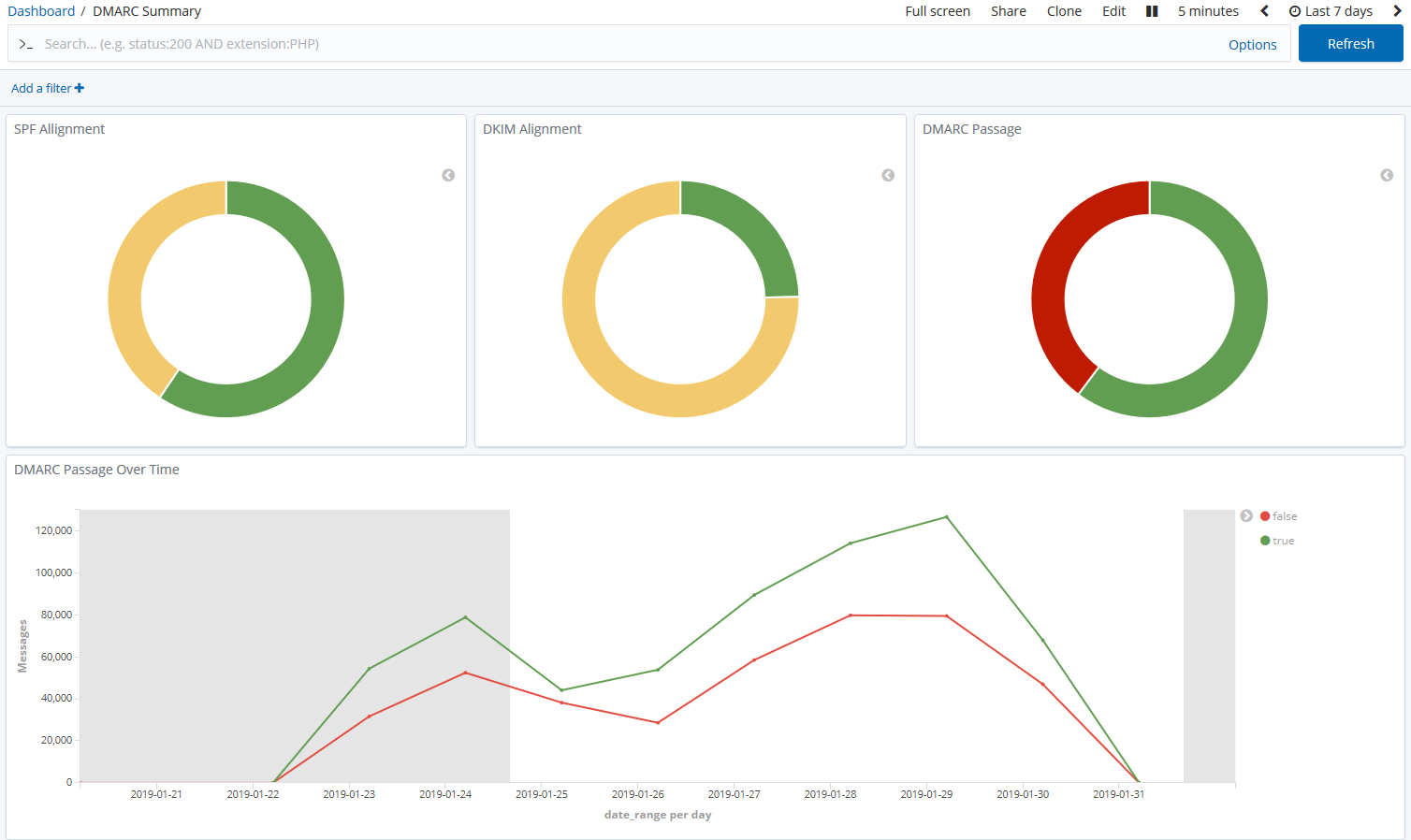
parsedmarc is a Python module and CLI utility for parsing DMARC
reports. When used with Elasticsearch and Kibana (or Splunk), it works
as a self-hosted open-source alternative to commercial DMARC report
processing services such as Agari Brand Protection, Dmarcian, OnDMARC,
ProofPoint Email Fraud Defense, and Valimail.
Note
Domain-based Message Authentication, Reporting, and Conformance (DMARC) is an email authentication protocol.
Sponsors
This project is maintained by one developer. Please consider sponsoring my work if you or your organization benefit from it.
Features
- Parses aggregate/rua DMARC reports: the legacy draft and 1.0 schemas (RFC 7489) and the new RFC 9990 schema for the final DMARC standard (RFC 9989)
- Parses failure/ruf DMARC reports (RFC 6591 and RFC 9991; formerly called forensic reports)
- Parses reports from SMTP TLS Reporting (TLS-RPT, RFC 8460)
- Can parse reports from an inbox over IMAP, Microsoft Graph, or Gmail API
- Transparently handles gzip or zip compressed reports
- Consistent data structures
- Simple JSON and/or CSV output
- Optionally email the results
- Optionally send the results to Elasticsearch, OpenSearch, Splunk, or PostgreSQL, for use with premade dashboards
- Optionally send the results to Apache Kafka, Amazon S3, Azure Log Analytics (Microsoft Sentinel), a Graylog (GELF) endpoint, a syslog server, or an HTTP webhook
Python Compatibility
This project supports the following Python versions, which are either actively maintained or are the default versions for RHEL or Debian.
| Version | Supported | Reason |
|---|---|---|
| < 3.6 | ❌ | End of Life (EOL) |
| 3.6 | ❌ | Used in RHEL 8, but not supported by project dependencies |
| 3.7 | ❌ | End of Life (EOL) |
| 3.8 | ❌ | End of Life (EOL) |
| 3.9 | ❌ | Used in Debian 11 and RHEL 9, but not supported by project dependencies |
| 3.10 | ✅ | Actively maintained |
| 3.11 | ✅ | Actively maintained; supported until June 2028 (Debian 12) |
| 3.12 | ✅ | Actively maintained; supported until May 2035 (RHEL 10) |
| 3.13 | ✅ | Actively maintained; supported until June 2030 (Debian 13) |
| 3.14 | ✅ | Supported (requires imapclient>=3.1.0) |