mirror of
https://github.com/domainaware/parsedmarc.git
synced 2026-11-06 16:59:23 +00:00


 c7a9d294b5
* fix: restore parent IP-lookup state in pool workers under spawn/forkserver

parsedmarc.utils keeps the IPinfo Lite REST API token
(_IPINFO_API_TOKEN, configure_ipinfo_api) and the selected IP database
path (_IP_DB_PATH, load_ip_db) in process-global variables, and only
the parent process sets them. Under the fork start method a pool worker
inherits them ("All resources of the parent are inherited by the child
process", https://docs.python.org/3/library/multiprocessing.html), but
under spawn (macOS/Windows default) and forkserver (the Linux default
from Python 3.14) it does not ("The child process will only inherit
those resources necessary to run the process object's run() method").
A worker there started from scratch: its IPinfo API lookups were
silently skipped, and _get_ip_database_path() fell back to the bundled
MMDB instead of the downloaded or cached copy the parent selected, so
enrichment differed from the operator's configuration and from the same
run under fork. The CLI parses file inputs through the process pool
even with -n 1, so every file-based CLI run on such platforms was
affected.

parallel_map() now snapshots both globals in the parent and restores
them in every worker via its pool initializer, so IP enrichment matches
the parent's configuration under every start method. The initializer
previously only reconstructed logging and is renamed _init_worker
accordingly.

Fixes #928

Co-authored-by: ZCode Scout <noreply@zcode.local>
Signed-off-by: NefelibateLG <3453510037@qq.com>

* Maintainer edits: Unreleased changelog, PSL overrides, forkserver coverage

- CHANGELOG: move the entry under "## Unreleased" (feature/fix PRs never
  pick a version number) and describe the psl_overrides gap.
- Restore parsedmarc.utils.psl_overrides in pool workers as a separate
  initarg, in place ([:] =), never rebound. A fresh spawn/forkserver
  worker loads the bundled psl_overrides.txt at import and only switches
  to the operator's path/URL on its first reverse DNS map load, so
  get_base_domain() calls before that load (the first aggregate report's
  org_name, the first source IP's reverse DNS name) used the bundled list.
- Cross-reference _init_worker and cli._utils_globals_snapshot(), which
  enumerate the same three utils globals.
- Extend TestWorkerIPState to forkserver (where available) and to the
  PSL overrides list; without the restore, both subtests fail with the
  worker reporting the bundled list.

Co-Authored-By: Claude Fable 5.1 <noreply@anthropic.com>

---------

Signed-off-by: NefelibateLG <3453510037@qq.com>
Co-authored-by: ZCode Scout <noreply@zcode.local>
Co-authored-by: Sean Whalen <44679+seanthegeek@users.noreply.github.com>
Co-authored-by: Claude Fable 5.1 <noreply@anthropic.com>
parsedmarc


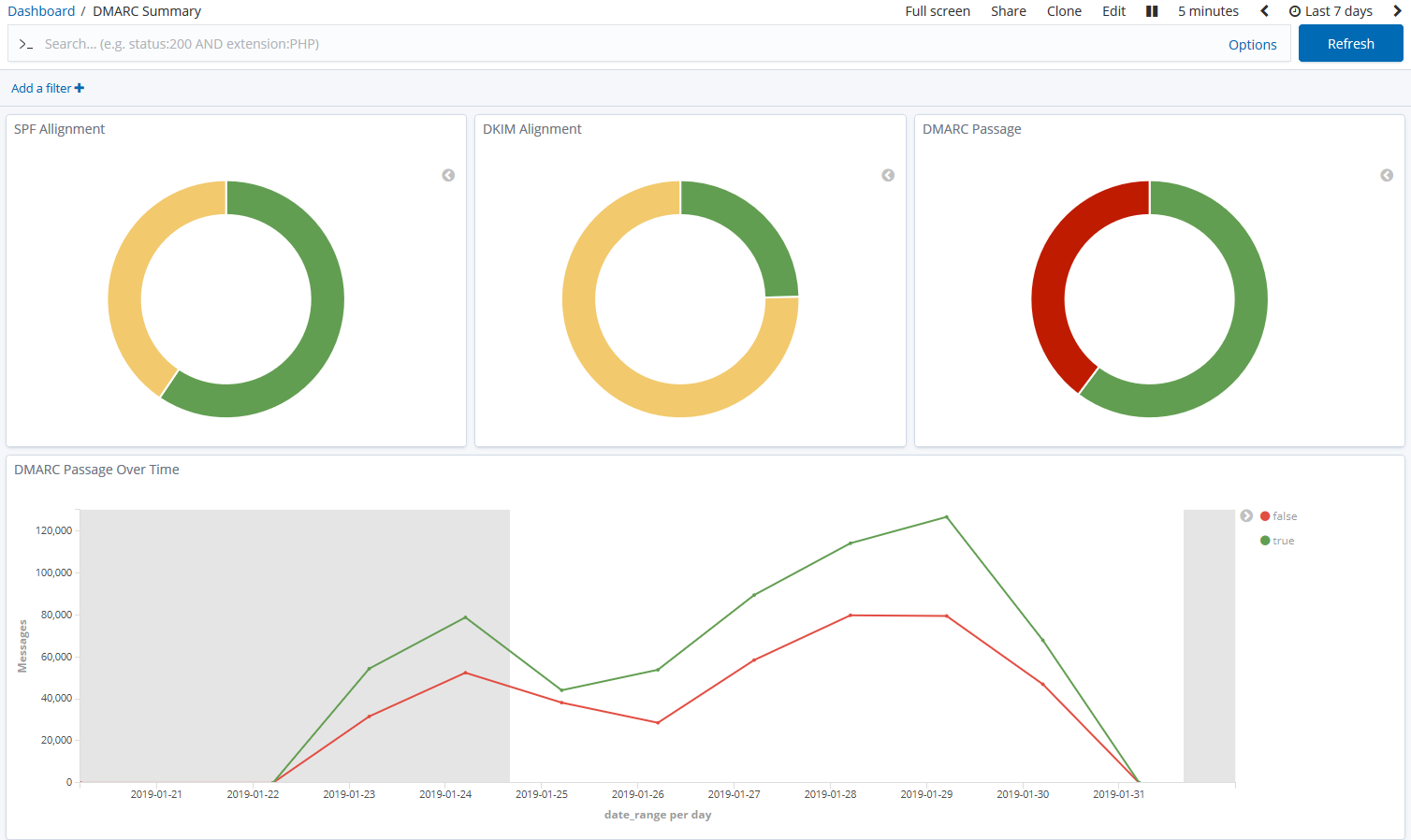
parsedmarc is a Python module and CLI utility for parsing DMARC
reports. When used with Elasticsearch and Kibana (or Splunk), or with
OpenSearch and Grafana, it works as a self-hosted open-source
alternative to commercial DMARC report processing services such as
Agari Brand Protection, Dmarcian, OnDMARC, ProofPoint Email Fraud
Defense, and Valimail.
Note
Domain-based Message Authentication, Reporting, and Conformance (DMARC) is an email authentication protocol.
Sponsors
This project is maintained by one developer. Please consider sponsoring my work if you or your organization benefit from it.
Features
- Parses aggregate/rua DMARC reports: the legacy draft and 1.0 schemas (RFC 7489) and the new RFC 9990 schema for the final DMARC standard (RFC 9989)
- Parses failure/ruf DMARC reports (RFC 6591 and RFC 9991; formerly called forensic reports)
- Parses reports from SMTP TLS Reporting (TLS-RPT, RFC 8460)
- Can parse reports from an inbox over IMAP, Microsoft Graph, or Gmail API
- Transparently handles gzip or zip compressed reports
- Consistent data structures
- Simple JSON and/or CSV output
- Optionally email the results
- Optionally send the results to Elasticsearch, OpenSearch, Splunk, or PostgreSQL, for use with premade dashboards
- Optionally send the results to Apache Kafka, Amazon S3, Azure Log Analytics (Microsoft Sentinel), a Graylog (GELF) endpoint, a syslog server, or an HTTP webhook
Python Compatibility
This project supports the following Python versions, which are either actively maintained or are the default versions for RHEL or Debian.
| Version | Supported | Reason |
|---|---|---|
| < 3.6 | ❌ | End of Life (EOL) |
| 3.6 | ❌ | Used in RHEL 8, but not supported by project dependencies |
| 3.7 | ❌ | End of Life (EOL) |
| 3.8 | ❌ | End of Life (EOL) |
| 3.9 | ❌ | Used in Debian 11 and RHEL 9, but not supported by project dependencies |
| 3.10 | ✅ | Actively maintained |
| 3.11 | ✅ | Actively maintained; supported until June 2028 (Debian 12) |
| 3.12 | ✅ | Actively maintained; supported until May 2035 (RHEL 10) |
| 3.13 | ✅ | Actively maintained; supported until June 2030 (Debian 13) |
| 3.14 | ✅ | Supported (requires imapclient>=3.1.0) |