mirror of
https://github.com/domainaware/parsedmarc.git
synced 2026-09-17 19:37:59 +00:00

 Sean WhalenandClaude Fable 5
b99d363a6d
Sean WhalenandClaude Fable 5
b99d363a6d
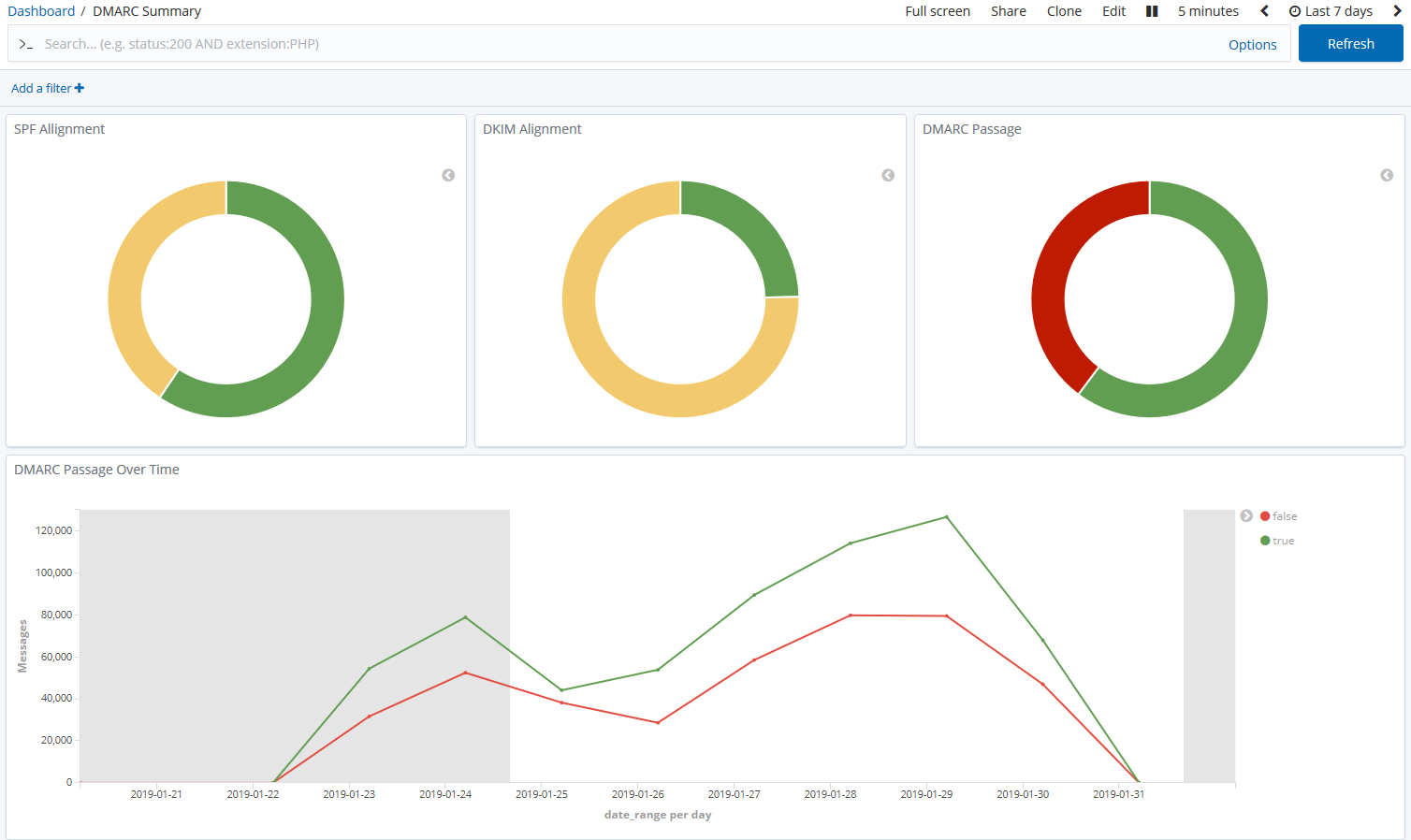
date_range on ES/OpenSearch aggregate and SMTP TLS documents is a
two-element array [begin, end]. A date histogram buckets a document once
per value, so every over-time chart bucketing on date_range counted a
report twice whenever its begin and end dates fell in different buckets.
Range filtering on it was also wrong: a report spanning the whole window
matches neither endpoint.

Measured on the dev-stack sample data: a 1d histogram on date_range
returns doc_count 4592 / message sum 4724 against true totals of
2300 / 2427; the same histogram on date_begin returns exactly
2300 / 2427.

All date histograms (2 OSD/Kibana visualizations, 10 Grafana ES panels
including the summary pies) and all time-range filters (24 Grafana
target timeFields, the dmarc_aggregate* and smtp_tls* index-pattern
timeFieldName, the dev-stack dmarc-ag datasource) now use the
single-valued date_begin, matching the report-begin semantics of the
PostgreSQL (begin_date) and Splunk (_time = interval begin) dashboards.
Failure-report panels already used the single-valued arrival_date and
are unchanged.

Dev stack: installing the Elasticsearch datasource plugin via
GF_INSTALL_PLUGINS crash-loops Grafana >= 13 (the image ships a
root-owned plugins-bundled/elasticsearch remnant the background
installer cannot replace), so the bootstrap script now installs it via
grafana cli and restarts Grafana instead.

Co-Authored-By: Claude Fable 5 <noreply@anthropic.com>
parsedmarc




parsedmarc is a Python module and CLI utility for parsing DMARC
reports. When used with Elasticsearch and Kibana (or Splunk), it works
as a self-hosted open-source alternative to commercial DMARC report
processing services such as Agari Brand Protection, Dmarcian, OnDMARC,
ProofPoint Email Fraud Defense, and Valimail.
Note
Domain-based Message Authentication, Reporting, and Conformance (DMARC) is an email authentication protocol.
Sponsors
This project is maintained by one developer. Please consider sponsoring my work if you or your organization benefit from it.
Features
- Parses aggregate/rua DMARC reports: the legacy draft and 1.0 schemas (RFC 7489) and the new RFC 9990 schema for the final DMARC standard (RFC 9989)
- Parses failure/ruf DMARC reports (RFC 6591 and RFC 9991; formerly called forensic reports)
- Parses reports from SMTP TLS Reporting (TLS-RPT, RFC 8460)
- Can parse reports from an inbox over IMAP, Microsoft Graph, or Gmail API
- Transparently handles gzip or zip compressed reports
- Consistent data structures
- Simple JSON and/or CSV output
- Optionally email the results
- Optionally send the results to Elasticsearch, OpenSearch, Splunk, or PostgreSQL, for use with premade dashboards
- Optionally send the results to Apache Kafka, Amazon S3, Azure Log Analytics (Microsoft Sentinel), a Graylog (GELF) endpoint, a syslog server, or an HTTP webhook
Python Compatibility
This project supports the following Python versions, which are either actively maintained or are the default versions for RHEL or Debian.
| Version | Supported | Reason |
|---|---|---|
| < 3.6 | ❌ | End of Life (EOL) |
| 3.6 | ❌ | Used in RHEL 8, but not supported by project dependencies |
| 3.7 | ❌ | End of Life (EOL) |
| 3.8 | ❌ | End of Life (EOL) |
| 3.9 | ❌ | Used in Debian 11 and RHEL 9, but not supported by project dependencies |
| 3.10 | ✅ | Actively maintained |
| 3.11 | ✅ | Actively maintained; supported until June 2028 (Debian 12) |
| 3.12 | ✅ | Actively maintained; supported until May 2035 (RHEL 10) |
| 3.13 | ✅ | Actively maintained; supported until June 2030 (Debian 13) |
| 3.14 | ✅ | Supported (requires imapclient>=3.1.0) |