mirror of
https://github.com/domainaware/parsedmarc.git
synced 2026-09-13 17:38:00 +00:00

 Sean WhalenandClaude Fable 5.1
b41230dc07
Sean WhalenandClaude Fable 5.1
b41230dc07
* fix: make the SIGHUP configuration reload atomic

The reload built the replacement output clients, then immediately closed
the old ones and swapped them in -- and only afterwards ran seven more
fallible steps: load_reverse_dns_map() (which reloads the PSL overrides
first), load_ip_db(), configure_ipinfo_api(), the setattr loop onto opts,
_build_parser_config(), the watch-parameter int() conversions, and the
log-level/FileHandler refresh. An exception in any of them was caught and
logged as "Config reload failed, continuing with previous config", which
was false: the new clients were already live and receiving reports, the
old ones were closed and unrecoverable, opts could be half-applied, and
both loaders empty their target before reading anything -- so a bad map
path emptied REVERSE_DNS_MAP until some later uncached lookup happened to
refill it from the previous configuration's paths (both
get_service_from_reverse_dns_base_domain() and get_ip_address_info()
reload a map they find empty), and a bad PSL overrides path emptied
parsedmarc.utils.psl_overrides without touching the map, so nothing
triggered that lazy reload and base domains were folded without the
overrides until a restart.

The reload is now three phases. Phase 1 stages every fallible step off to
the side, in this order: _load_config/_parse_config, _init_output_clients,
the derived values (_build_parser_config and the three watch-parameter
int()s), load_reverse_dns_map into a fresh dict, load_ip_db,
configure_ipinfo_api. The derived values run early because they write
nothing at all, and the two loaders that write process-wide state run
last, so as little as possible can fail behind them -- load_ip_db()'s
download in particular rewrites the shared MMDB cache file before it
assigns _IP_DB_PATH, and that is the one phase-1 side effect no snapshot
can undo (what it leaves is the same refresh startup performs).

The parsedmarc.utils globals the loaders assign are snapshotted by a new
_utils_globals_snapshot(). Enumerated from the loaders' bodies, those are
psl_overrides (cleared and repopulated in place, no `global` statement --
the list object itself is the state), _IP_DB_PATH (the only global
load_ip_db assigns) and _IPINFO_API_TOKEN (the only one
configure_ipinfo_api assigns, and assigned before the probe that can
fail). _LAST_LOGGED_IP_DB_PATH is deliberately not covered: it is
assigned by _get_ip_database_path(), which no loader the reload calls
reaches, and it only decides whether the database path is logged again.

Phase 2 commits with assignments only, REVERSE_DNS_MAP in place -- cli.py
imports that name from parsedmarc, so rebinding it here would desync this
module from parsedmarc.REVERSE_DNS_MAP and from the config.REVERSE_DNS_MAP
that ParserConfig.__setstate__ rebinds to in a worker, and the
ParserConfig staged in phase 1 already holds the pre-reload object. Phase
3 closes the replaced clients last and best effort, so a dying connection
cannot undo the commit.

On failure the replacement clients are closed, then the search backends'
default alias is restored -- that order, because a fully built
_ElasticsearchHandle releases the alias as it closes (see #906 and #902)
-- and then the utils globals are put back. REVERSE_DNS_MAP, opts,
clients, parser_config and the three watch parameters are never written
before the commit, so there is nothing to undo for them; the per-step end
state is traced in a comment at the rollback site, including which
restores are load-bearing at which depth and which are defensive.
configure_ipinfo_api's sys.exit(1) on an invalid token still bypasses all
of this: SystemExit is not an Exception, and the process is leaving.

Closing the replaced log file was the one statement in the commit block
that could still raise (a full disk, a stale mount); it is now caught and
reported after the handler is detached, since by that point the reloaded
configuration is live and rolling back to report a failed reload would be
a lie.

Nothing runs concurrently with the swap: the reload happens in the main
thread between watch_inbox() calls, after the mailbox backend has returned
at a batch boundary, so no save callback is in flight, and parallel.py
creates and tears down its ProcessPoolExecutor inside a single
parallel_map() call -- its workers are separate processes with their own
copies of REVERSE_DNS_MAP and the utils globals either way. The previous
code mutated the same state at the same point, so this is not a change in
exposure.

#906 made _init_output_clients() itself all-or-nothing; this does the same
for the whole reload. The docs already promised that a failed reload
leaves "the previous configuration fully active"; that promise is now
true, and usage.md spells out what it covers and the one thing it does
not.

Co-Authored-By: Claude Fable 5.1 <noreply@anthropic.com>

* fix: open the replacement log file during reload staging, not after commit

The logging refresh was the one fallible step left after the commit:
phase 2 closed and removed the old FileHandler, then tried to open the
new log_file inside a try/except that only warned. On an unwritable
path the old handler was already gone, file logging was dead,
opts.active_log_file was set to the new path anyway, and the reload was
logged as successful. Because the old-versus-new comparison uses
active_log_file, a later SIGHUP with the same path -- after the operator
fixed permissions -- was a no-op, so only a restart recovered file
logging.

The replacement FileHandler is now constructed in phase 1, after the
watch-parameter conversions and before the loaders (constructing it
opens the file immediately, and that is the only thing in the refresh
that can fail on a bad path). The rollback closes it if a later step
fails; phase 2 only attaches it. An unwritable log_file is therefore a
reload failure, with the previous log file still attached and receiving
the traceback. Startup keeps its warning-only behaviour: there is no
previous configuration to fall back to there.

Found by Copilot's review of #910.

Co-Authored-By: Claude Fable 5.1 <noreply@anthropic.com>

* fix: retry a log file that could not be opened at startup on the next reload

Startup recorded opts.active_log_file = opts.log_file even when opening
the FileHandler failed (a warning there, since there is no previous
configuration to keep). The SIGHUP reload only stages a replacement
handler when the new config's log_file differs from active_log_file, so
a reload naming the same path never retried the open: file logging
stayed dead until restart, even after the operator fixed the directory
or permissions.

active_log_file now starts as None and is set only after the handler is
attached, so an unchanged log_file that failed at startup is retried by
the next reload, and one that opened at startup is not reopened.

Co-Authored-By: Claude Fable 5.1 <noreply@anthropic.com>

* fix: make the rollback's staged log handler close best-effort; correct the docs on what aborts a reload

FileHandler.close() can raise while flushing or closing (a full disk, a
stale network mount). In the reload's rollback that raise escaped the
except block: the search-alias and utils-globals restores never ran,
the original staging failure was replaced, and the watcher exited. The
close is now logged and swallowed like the commit path's close of the
replaced handler, so the restores that follow it always run.

usage.md said "unreachable output destinations" abort a reload. That is
true of PostgreSQL, Kafka, and TCP/TLS syslog, whose clients connect in
their constructors, but not of Elasticsearch or OpenSearch: set_hosts()
builds the client without connecting, and migrate_indexes() catches
every cluster call and warns, so a reload pointing at an unreachable
search cluster still commits and fails on the first save. The list now
names what actually raises during staging and calls out the exception.

Both found by Copilot's second review of #910.

Co-Authored-By: Claude Fable 5.1 <noreply@anthropic.com>

---------

Co-authored-by: Claude Fable 5.1 <noreply@anthropic.com>
parsedmarc




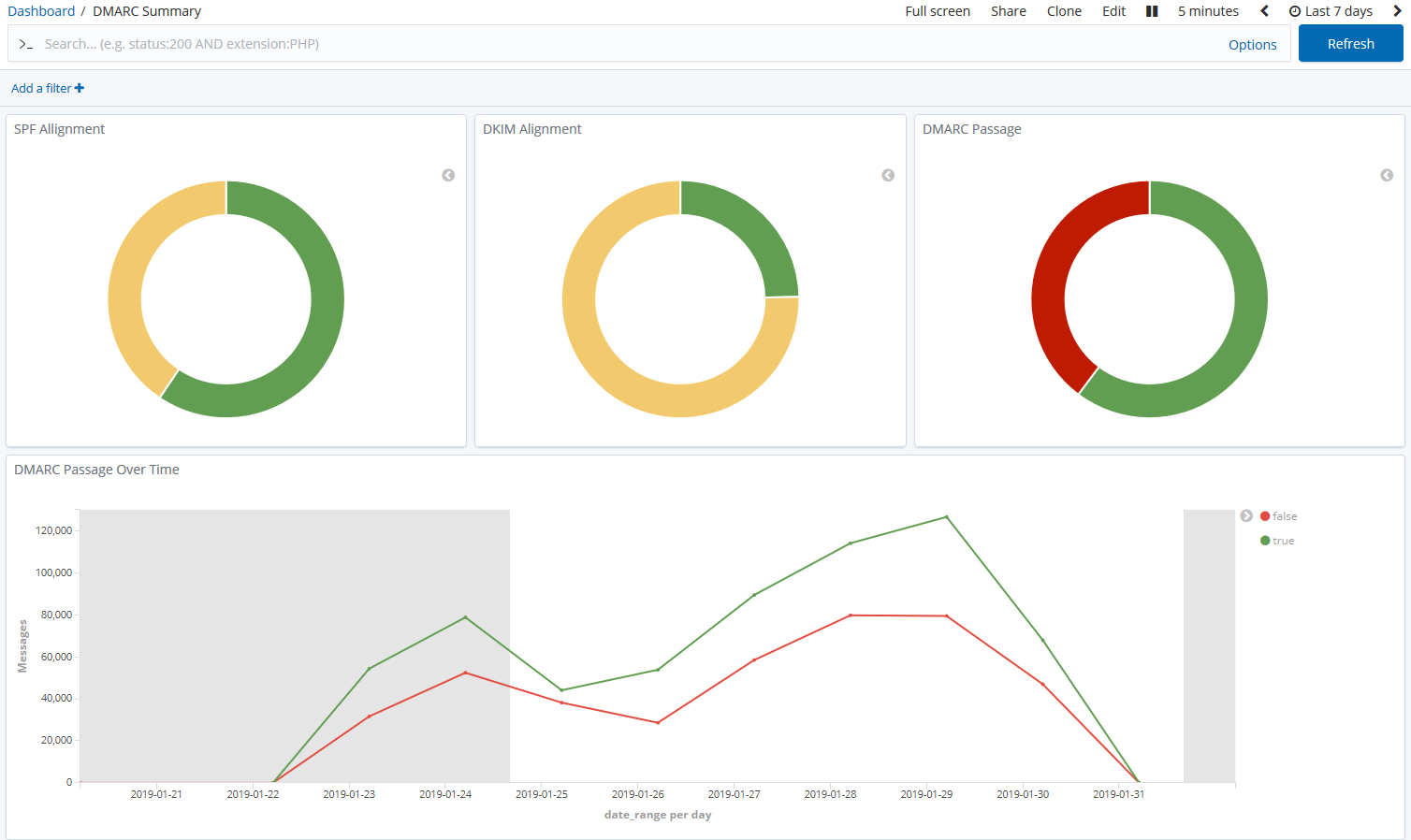
parsedmarc is a Python module and CLI utility for parsing DMARC
reports. When used with Elasticsearch and Kibana (or Splunk), or with
OpenSearch and Grafana, it works as a self-hosted open-source
alternative to commercial DMARC report processing services such as
Agari Brand Protection, Dmarcian, OnDMARC, ProofPoint Email Fraud
Defense, and Valimail.
Note
Domain-based Message Authentication, Reporting, and Conformance (DMARC) is an email authentication protocol.
Sponsors
This project is maintained by one developer. Please consider sponsoring my work if you or your organization benefit from it.
Features
- Parses aggregate/rua DMARC reports: the legacy draft and 1.0 schemas (RFC 7489) and the new RFC 9990 schema for the final DMARC standard (RFC 9989)
- Parses failure/ruf DMARC reports (RFC 6591 and RFC 9991; formerly called forensic reports)
- Parses reports from SMTP TLS Reporting (TLS-RPT, RFC 8460)
- Can parse reports from an inbox over IMAP, Microsoft Graph, or Gmail API
- Transparently handles gzip or zip compressed reports
- Consistent data structures
- Simple JSON and/or CSV output
- Optionally email the results
- Optionally send the results to Elasticsearch, OpenSearch, Splunk, or PostgreSQL, for use with premade dashboards
- Optionally send the results to Apache Kafka, Amazon S3, Azure Log Analytics (Microsoft Sentinel), a Graylog (GELF) endpoint, a syslog server, or an HTTP webhook
Python Compatibility
This project supports the following Python versions, which are either actively maintained or are the default versions for RHEL or Debian.
| Version | Supported | Reason |
|---|---|---|
| < 3.6 | ❌ | End of Life (EOL) |
| 3.6 | ❌ | Used in RHEL 8, but not supported by project dependencies |
| 3.7 | ❌ | End of Life (EOL) |
| 3.8 | ❌ | End of Life (EOL) |
| 3.9 | ❌ | Used in Debian 11 and RHEL 9, but not supported by project dependencies |
| 3.10 | ✅ | Actively maintained |
| 3.11 | ✅ | Actively maintained; supported until June 2028 (Debian 12) |
| 3.12 | ✅ | Actively maintained; supported until May 2035 (RHEL 10) |
| 3.13 | ✅ | Actively maintained; supported until June 2030 (Debian 13) |
| 3.14 | ✅ | Supported (requires imapclient>=3.1.0) |