mirror of
https://github.com/domainaware/parsedmarc.git
synced 2026-09-13 17:38:00 +00:00

 Sean WhalenandClaude Opus 5
b304cf8639
Sean WhalenandClaude Opus 5
b304cf8639
* Cover index_prefix_domain_map and index_suffix in index migrations (#868)

The startup Elasticsearch/OpenSearch index migrations built their target
index names from the [elasticsearch]/[opensearch] index_prefix and
index_suffix options alone, while the save path also honors
general.index_prefix_domain_map. A multi-tenant deployment therefore ran
the backfill guard `count` against dmarc_aggregate*/smtp_tls*, patterns
matching none of its real <tenant>_dmarc_aggregate-* indexes. The query
passes allow_no_indices=True, so a zero-match wildcard returns count 0 --
indistinguishable from "already backfilled" -- and the backfill was
skipped silently, with no log line at any level.

Resolve migration index names through a new _migration_index_names()
helper that widens both configurable axes: one name per tenant prefix in
the map plus the unprefixed name (unmapped domains are still saved
unprefixed), and, when an index_suffix is set, the unsuffixed name
alongside the suffixed one so history predating the suffix is covered. A
configured index_prefix still wins outright and suppresses the map
fan-out, matching save-time precedence. The key normalization is now
shared with get_index_prefix() via _normalize_index_prefix(), so the
names parsedmarc migrates cannot drift from the ones it writes. The
resolved lists are logged at DEBUG, and the SIGHUP reload path passes the
freshly parsed map, so a newly onboarded tenant is covered without a
restart.

Also repair the legacy published_policy.fo migration, which has been
unable to complete since mapping types were removed in Elasticsearch 7
(and never existed in OpenSearch): it read the field mapping in the
type-keyed response shape, so the check always fell through, and its
put_mapping() call passed a doc_type argument neither current client
accepts. It now reads either response shape, uses each client's current
signature, and takes its index names in a separate legacy_fo_indexes
argument -- exact names, since 5.0.0 introduced date-suffixed index names
in the same release that fixed the fo declaration, but prefixed and
suffixed where configured, since both options date back to 4.1.0. Tenant
prefixes are excluded: index_prefix_domain_map arrived in 8.19.0, and
this migration renames the index it rebuilds. The Elasticsearch copy,
removed as unreachable during the #806 client migration, is restored now
that the cause is understood.

Finally, reject an index_prefix_domain_map YAML file that is not a
mapping of string tenant names to lists of domains, instead of raising
mid-save on a non-string key or silently matching the wrong domains on a
scalar value -- `in` on a str is a substring test, so "example.co"
matches "example.com"
(https://docs.python.org/3/reference/expressions.html#membership-test-operations).

Co-Authored-By: Claude Opus 5 (1M context) <noreply@anthropic.com>

* Fix OpenSearch capitalization and spacing in the usage docs

Copilot review of #869: the `index_prefix_domain_map` option line spelled
"OpenSearch" as "Opensearch" and had a doubled space before the type. Both
predate this branch but sit inside a hunk it rewrites. Also wrapped the line
to match the continuation-indent style of every other option in the list, and
corrected the same misspelling in the multi-tenant section a few lines above
the paragraph this branch added.

Co-Authored-By: Claude Opus 5 (1M context) <noreply@anthropic.com>

* Require index_prefix_domain_map domain lists to hold strings

Copilot review of #869: the shape check verified that each value was a
list but not what the list contained, so `tenant_a: [42]` passed and then
never compared equal to any domain the save path looks up -- the same
silent-misbehavior class the check exists to reject, and a contradiction
of the "any other shape is rejected at startup" claim in the docs.

Check the list's items too, and reword the error message, comment,
CHANGELOG and docs to state the rule the check now enforces: a mapping of
tenant names to lists of domain names, all strings.

Co-Authored-By: Claude Opus 5 (1M context) <noreply@anthropic.com>

* Make the legacy fo migration retry-safe, and nest its mapping body

Copilot review of #869, verified against live Elasticsearch 8.19 and
OpenSearch 3 containers rather than mocks.

Retry safety (a real defect): an attempt interrupted between creating the
-v2 index and deleting the original left debris that made create() fail
with "resource already exists" on every later startup, inside the same try
that swallows the error -- so the index was never migrated and the debris
document survived. Reproduced on a live cluster. Discard a leftover target
first; that is safe precisely because reaching this point means the
original still holds the data, since it is deleted only once the reindex
has succeeded.

Mapping body: the reviewer's concern that a dotted key under `properties`
risks a runtime failure does not hold -- both clusters accept it and
produce a byte-identical mapping, with the dot expanded into
published_policy -> properties -> fo. Switch to the nested object form
anyway, since dot expansion is conditional on the object's `subobjects`
setting and this shape never is, and derive the object/leaf names from the
dotted constant so the write cannot drift from the field the read looks up.

Both fo-migration suites now build per-name Index mocks. A single shared
mock cannot express "the original exists but its migration target does
not", which is the ordinary case and the one the retry fix turns on; the
happy path now also asserts the target index is never deleted.

Co-Authored-By: Claude Opus 5 (1M context) <noreply@anthropic.com>

---------

Co-authored-by: Claude Opus 5 (1M context) <noreply@anthropic.com>
parsedmarc




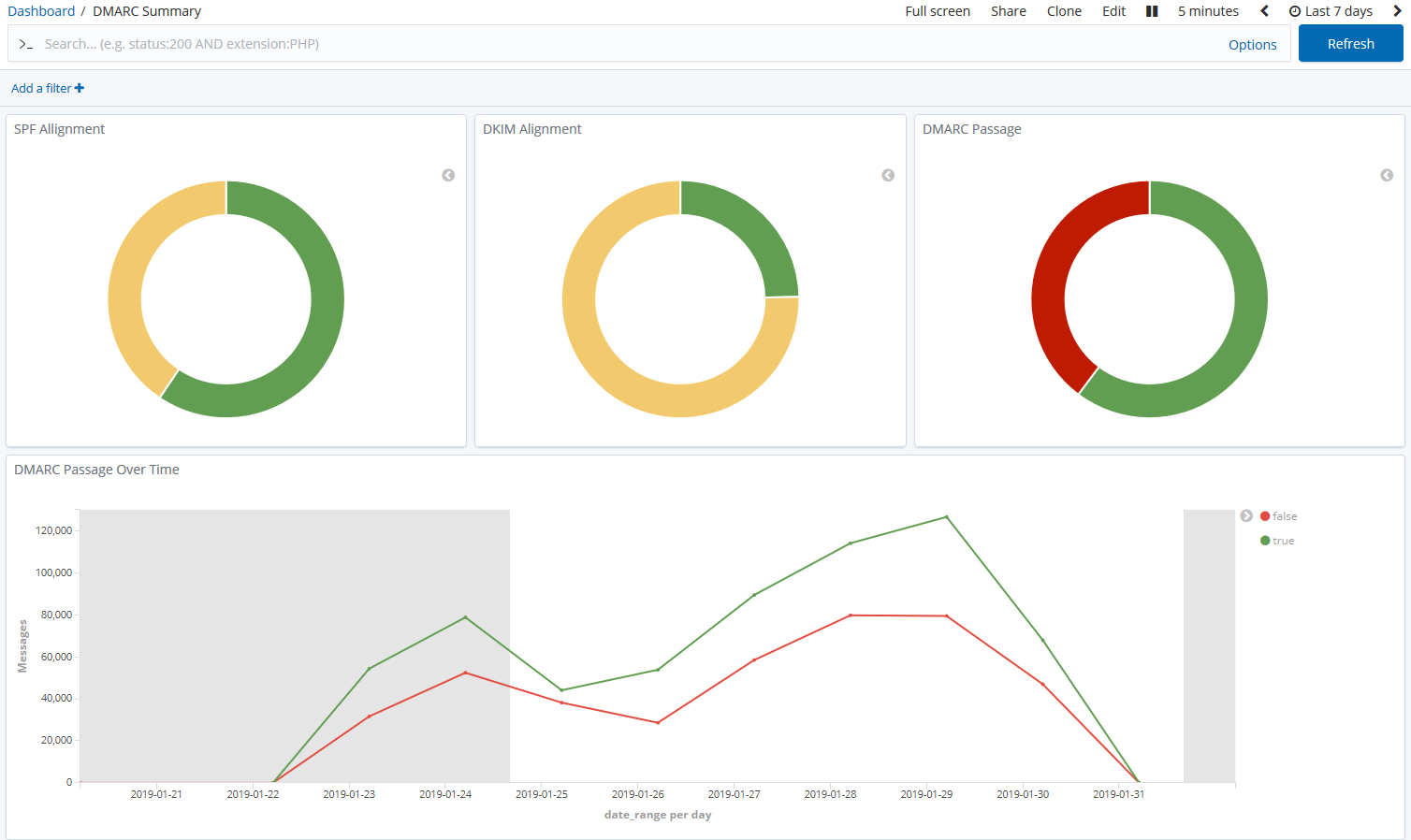
parsedmarc is a Python module and CLI utility for parsing DMARC
reports. When used with Elasticsearch and Kibana (or Splunk), it works
as a self-hosted open-source alternative to commercial DMARC report
processing services such as Agari Brand Protection, Dmarcian, OnDMARC,
ProofPoint Email Fraud Defense, and Valimail.
Note
Domain-based Message Authentication, Reporting, and Conformance (DMARC) is an email authentication protocol.
Sponsors
This project is maintained by one developer. Please consider sponsoring my work if you or your organization benefit from it.
Features
- Parses aggregate/rua DMARC reports: the legacy draft and 1.0 schemas (RFC 7489) and the new RFC 9990 schema for the final DMARC standard (RFC 9989)
- Parses failure/ruf DMARC reports (RFC 6591 and RFC 9991; formerly called forensic reports)
- Parses reports from SMTP TLS Reporting (TLS-RPT, RFC 8460)
- Can parse reports from an inbox over IMAP, Microsoft Graph, or Gmail API
- Transparently handles gzip or zip compressed reports
- Consistent data structures
- Simple JSON and/or CSV output
- Optionally email the results
- Optionally send the results to Elasticsearch, OpenSearch, Splunk, or PostgreSQL, for use with premade dashboards
- Optionally send the results to Apache Kafka, Amazon S3, Azure Log Analytics (Microsoft Sentinel), a Graylog (GELF) endpoint, a syslog server, or an HTTP webhook
Python Compatibility
This project supports the following Python versions, which are either actively maintained or are the default versions for RHEL or Debian.
| Version | Supported | Reason |
|---|---|---|
| < 3.6 | ❌ | End of Life (EOL) |
| 3.6 | ❌ | Used in RHEL 8, but not supported by project dependencies |
| 3.7 | ❌ | End of Life (EOL) |
| 3.8 | ❌ | End of Life (EOL) |
| 3.9 | ❌ | Used in Debian 11 and RHEL 9, but not supported by project dependencies |
| 3.10 | ✅ | Actively maintained |
| 3.11 | ✅ | Actively maintained; supported until June 2028 (Debian 12) |
| 3.12 | ✅ | Actively maintained; supported until May 2035 (RHEL 10) |
| 3.13 | ✅ | Actively maintained; supported until June 2030 (Debian 13) |
| 3.14 | ✅ | Supported (requires imapclient>=3.1.0) |