mirror of
https://github.com/domainaware/parsedmarc.git
synced 2026-10-25 20:18:54 +00:00

 Sean WhalenandClaude Opus 5
95ddc8a323
Sean WhalenandClaude Opus 5
95ddc8a323
Two `if not os.path.exists(path): print(f"Error: ...")` checks printed
the intended error message but had no sys.exit(1) after it, so execution
fell through into the subsequent open() call on the same missing path
and raised an unhandled FileNotFoundError instead of the clean error
exit the code clearly intended. Sibling duplicate-entry checks in the
same function already did print-then-sys.exit(1); these two now match.

Sites fixed (both in _main()):
- the nested load_list() helper's missing-file check (used for
  known_unknown_base_reverse_dns.txt and psl_overrides.txt)
- the base_reverse_dns_map.csv missing-file check

Both sites now have regression tests in a new TestFindUnknownBaseReverseDNS
class:
- the load_list() site: calling _main() in a temp directory with no
  known_unknown_base_reverse_dns.txt now raises SystemExit(1) instead of
  FileNotFoundError.
- the base_reverse_dns_map.csv site: _load_as_name_index() does its
  external work entirely through maxminddb.open_database(), the actual
  SDK boundary, so that call is mocked to a context manager over an
  empty iterable rather than loading the real ~23MB bundled MMDB or
  mocking an internal helper. Calling _main() in a temp directory with
  no base_reverse_dns_map.csv now raises SystemExit(1) instead of
  FileNotFoundError.

Both tests capture stdout and assert on the specific "Error: ... does
not exist" message, pinning the exit to the intended site rather than
any sys.exit(1) in the function. Cleanup uses two separate addCleanup
calls (rmtree registered before chdir, so LIFO order runs chdir first)
instead of one lambda wrapping both, so rmtree still runs even if
chdir were to raise.

Also fixed an adjacent prose bug a few lines from the second site: the
"is in known_unknown... and base_reverse_dns_map..." error message was
missing a space after "Error:" and was a backslash-continued f-string
that embedded the source's literal indentation in the printed output.
It now prints as a single clean line, consistent with the file's other
error messages.

Logged the user-facing symptom (clean error replaced by a
FileNotFoundError traceback) under CHANGELOG.md's Unreleased/Bug fixes
section, matching the project's precedent of logging maintainer-tooling
fixes (e.g. the sortlists.py entry).

Co-authored-by: Claude Opus 5 (1M context) <noreply@anthropic.com>
parsedmarc




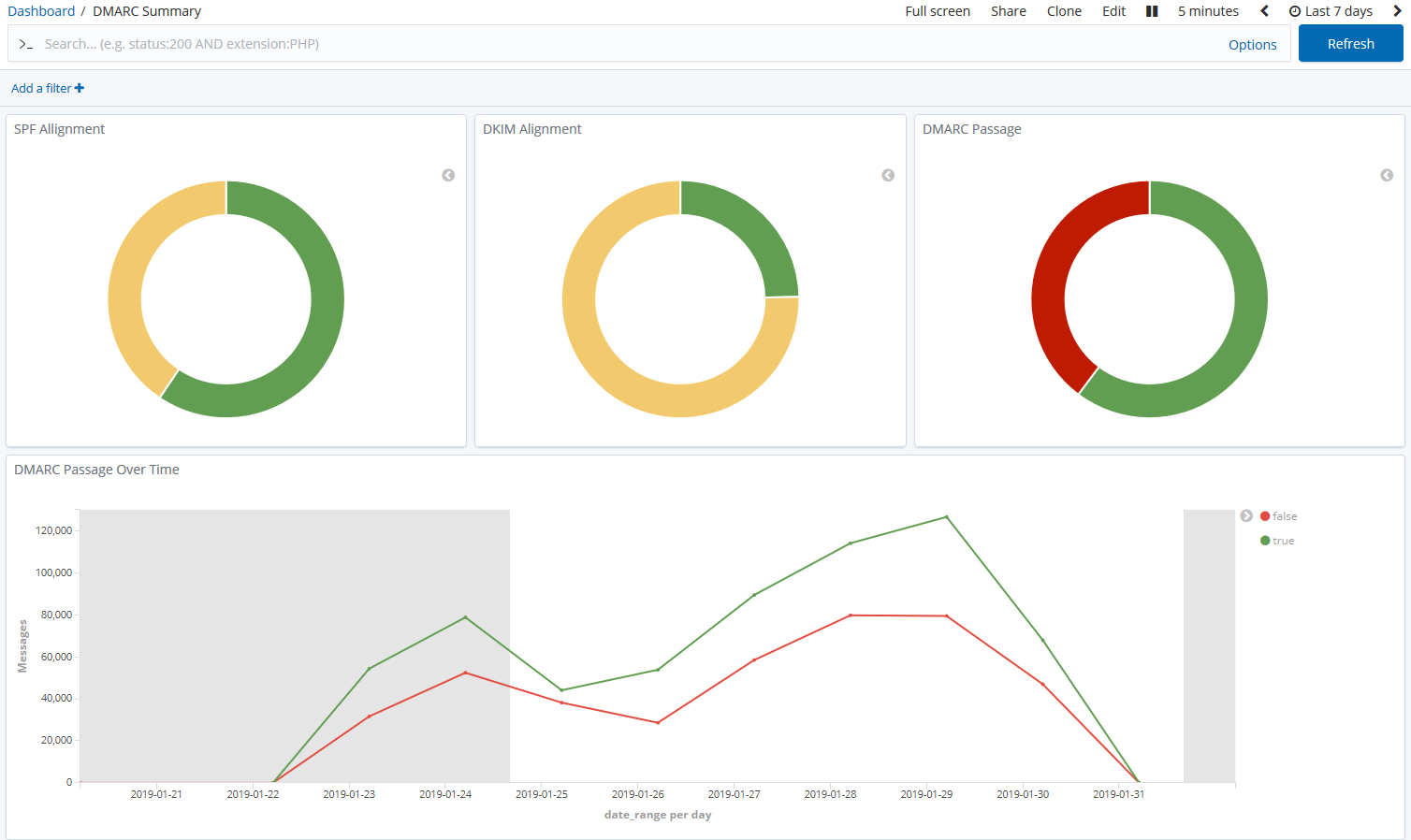
parsedmarc is a Python module and CLI utility for parsing DMARC
reports. When used with Elasticsearch and Kibana (or Splunk), or with
OpenSearch and Grafana, it works as a self-hosted open-source
alternative to commercial DMARC report processing services such as
Agari Brand Protection, Dmarcian, OnDMARC, ProofPoint Email Fraud
Defense, and Valimail.
Note
Domain-based Message Authentication, Reporting, and Conformance (DMARC) is an email authentication protocol.
Sponsors
This project is maintained by one developer. Please consider sponsoring my work if you or your organization benefit from it.
Features
- Parses aggregate/rua DMARC reports: the legacy draft and 1.0 schemas (RFC 7489) and the new RFC 9990 schema for the final DMARC standard (RFC 9989)
- Parses failure/ruf DMARC reports (RFC 6591 and RFC 9991; formerly called forensic reports)
- Parses reports from SMTP TLS Reporting (TLS-RPT, RFC 8460)
- Can parse reports from an inbox over IMAP, Microsoft Graph, or Gmail API
- Transparently handles gzip or zip compressed reports
- Consistent data structures
- Simple JSON and/or CSV output
- Optionally email the results
- Optionally send the results to Elasticsearch, OpenSearch, Splunk, or PostgreSQL, for use with premade dashboards
- Optionally send the results to Apache Kafka, Amazon S3, Azure Log Analytics (Microsoft Sentinel), a Graylog (GELF) endpoint, a syslog server, or an HTTP webhook
Python Compatibility
This project supports the following Python versions, which are either actively maintained or are the default versions for RHEL or Debian.
| Version | Supported | Reason |
|---|---|---|
| < 3.6 | ❌ | End of Life (EOL) |
| 3.6 | ❌ | Used in RHEL 8, but not supported by project dependencies |
| 3.7 | ❌ | End of Life (EOL) |
| 3.8 | ❌ | End of Life (EOL) |
| 3.9 | ❌ | Used in Debian 11 and RHEL 9, but not supported by project dependencies |
| 3.10 | ✅ | Actively maintained |
| 3.11 | ✅ | Actively maintained; supported until June 2028 (Debian 12) |
| 3.12 | ✅ | Actively maintained; supported until May 2035 (RHEL 10) |
| 3.13 | ✅ | Actively maintained; supported until June 2030 (Debian 13) |
| 3.14 | ✅ | Supported (requires imapclient>=3.1.0) |