mirror of
https://github.com/domainaware/parsedmarc.git
synced 2026-10-21 02:08:13 +00:00


 7fed72798a
* Stop system GeoIP files from shadowing the bundled IPinfo database

_get_ip_database_path() searched well-known system paths (including
/usr/share/GeoIP/GeoLite2-Country.mmdb and CWD-relative names) before
the database parsedmarc manages, so on any host with a distro GeoIP
package installed every lookup silently used a country-only — and
often years-old — database instead of the bundled IPinfo Lite one.
That disabled ASN enrichment entirely (asn/as_name/as_domain were None
for every IP) and with it the ASN-fallback path into the reverse-DNS
map, with no signal beyond a generic "IP database is more than a
month old" warning. Verified live on a Fedora host whose distro
GeoLite2-Country.mmdb dated to December 2019.

New precedence: explicit ip_db_path -> _IP_DB_PATH selected by
load_ip_db() (downloaded/cached/bundled) -> the bundled copy -> system
paths as a true last resort (only consulted when the bundled data
file is missing). The selected file is logged at debug level so a
--debug run shows which database answered.

The automatic system-path pickup was documented behavior, so
installation.md now tells MaxMind GeoLite2 users to set ip_db_path
explicitly, with a migration note.

Both new regression tests reproduce the shadowing portably via a decoy
CWD GeoLite2-Country.mmdb (the fallback list includes relative names),
and fail on the unfixed code (verified by stashing the source change).

Fixes https://github.com/domainaware/parsedmarc/issues/810.

Co-Authored-By: Claude Fable 5 <noreply@anthropic.com>

* Address review: accurate fallback comment, dedup selection log, cover fallback tiers

- Correct the nothing-found-anywhere comment: the os.stat() age check
  raises FileNotFoundError before the caller's open_database() would.
- Log "Using IP database at ..." only when the selected path changes
  instead of on every uncached IP lookup, so --debug runs over large
  batches aren't flooded; tracked via _LAST_LOGGED_IP_DB_PATH, reset in
  the test fixture for order-independence.
- Cover the previously untested branches of _get_ip_database_path:
  system-path fallback when the bundled database is missing, the
  FileNotFoundError when nothing exists anywhere, the stale-database
  warning, and the log-once-per-path behavior.

Co-Authored-By: Claude Fable 5 <noreply@anthropic.com>

---------

Co-authored-by: MISAPOR LAB <misapor@lab.misapor.pl>
Co-authored-by: Claude Fable 5 <noreply@anthropic.com>
Co-authored-by: Sean Whalen <44679+seanthegeek@users.noreply.github.com>
parsedmarc




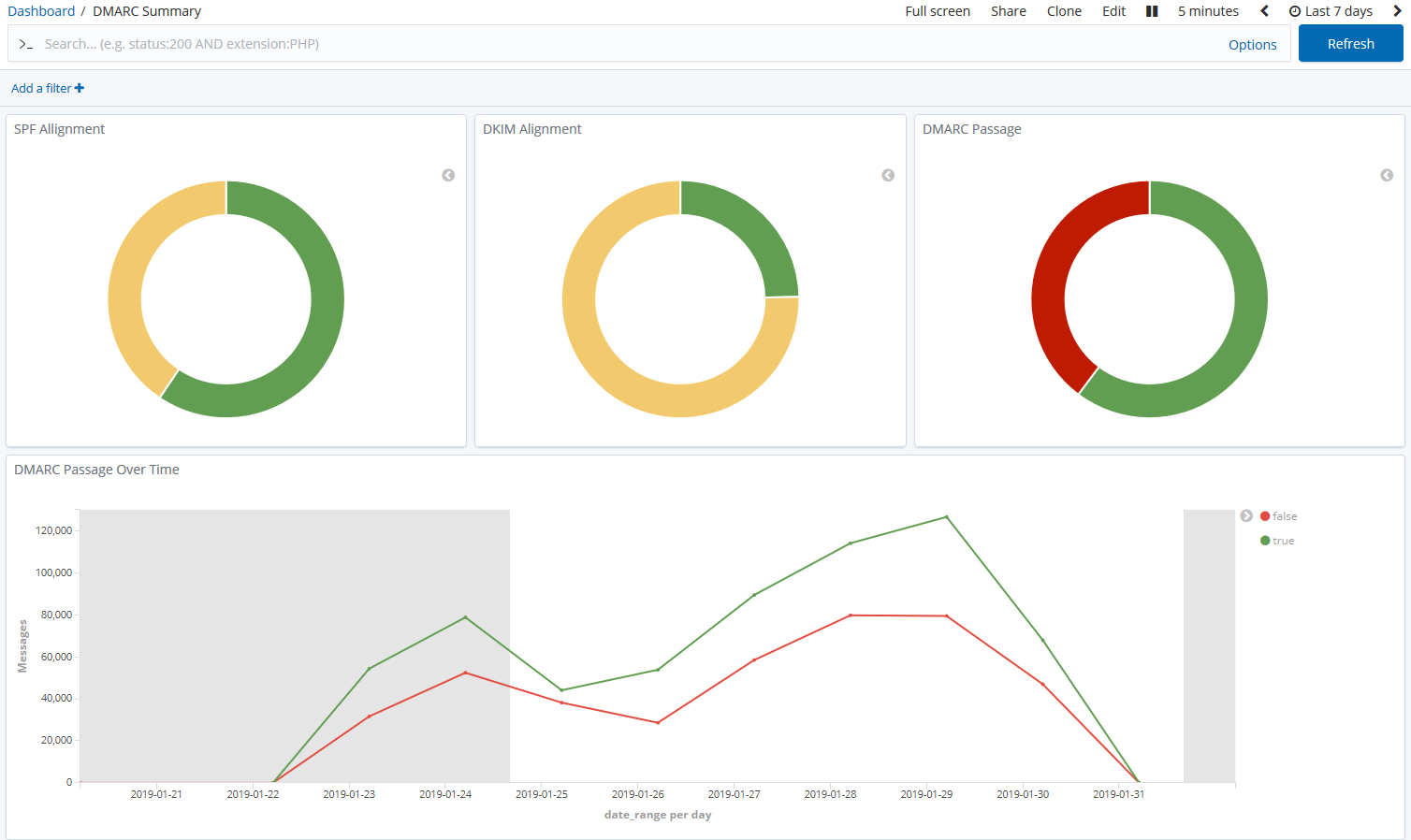
parsedmarc is a Python module and CLI utility for parsing DMARC
reports. When used with Elasticsearch and Kibana (or Splunk), it works
as a self-hosted open-source alternative to commercial DMARC report
processing services such as Agari Brand Protection, Dmarcian, OnDMARC,
ProofPoint Email Fraud Defense, and Valimail.
Note
Domain-based Message Authentication, Reporting, and Conformance (DMARC) is an email authentication protocol.
Sponsors
This project is maintained by one developer. Please consider sponsoring my work if you or your organization benefit from it.
Features
- Parses aggregate/rua DMARC reports: the legacy draft and 1.0 schemas (RFC 7489) and the new RFC 9990 schema for the final DMARC standard (RFC 9989)
- Parses failure/ruf DMARC reports (RFC 6591 and RFC 9991; formerly called forensic reports)
- Parses reports from SMTP TLS Reporting (TLS-RPT, RFC 8460)
- Can parse reports from an inbox over IMAP, Microsoft Graph, or Gmail API
- Transparently handles gzip or zip compressed reports
- Consistent data structures
- Simple JSON and/or CSV output
- Optionally email the results
- Optionally send the results to Elasticsearch, OpenSearch, Splunk, or PostgreSQL, for use with premade dashboards
- Optionally send the results to Apache Kafka, Amazon S3, Azure Log Analytics (Microsoft Sentinel), a Graylog (GELF) endpoint, a syslog server, or an HTTP webhook
Python Compatibility
This project supports the following Python versions, which are either actively maintained or are the default versions for RHEL or Debian.
| Version | Supported | Reason |
|---|---|---|
| < 3.6 | ❌ | End of Life (EOL) |
| 3.6 | ❌ | Used in RHEL 8, but not supported by project dependencies |
| 3.7 | ❌ | End of Life (EOL) |
| 3.8 | ❌ | End of Life (EOL) |
| 3.9 | ❌ | Used in Debian 11 and RHEL 9, but not supported by project dependencies |
| 3.10 | ✅ | Actively maintained |
| 3.11 | ✅ | Actively maintained; supported until June 2028 (Debian 12) |
| 3.12 | ✅ | Actively maintained; supported until May 2035 (RHEL 10) |
| 3.13 | ✅ | Actively maintained; supported until June 2030 (Debian 13) |
| 3.14 | ✅ | Supported (requires imapclient>=3.1.0) |