mirror of
https://github.com/domainaware/parsedmarc.git
synced 2026-10-25 20:18:54 +00:00

 Sean WhalenandClaude Opus 5
77045c2df0
Sean WhalenandClaude Opus 5
77045c2df0
- py/empty-except: add a short comment to each of the 10 flagged
  `except <Type>: pass` blocks explaining why swallowing the
  exception is correct there (best-effort cleanup/close, or
  intentional fall-through to the next report format).
- py/unnecessary-lambda: replace `map(lambda x: parse_email_address(x), ...)`
  with `map(parse_email_address, ...)` at the 5 flagged sites in
  parsedmarc/utils.py; parse_email_address takes exactly one
  positional argument, so this is behavior-preserving. Ran
  `ruff format` afterward, which collapsed 3 of the now-shorter
  calls onto single lines.
- py/imprecise-assert: replace `assertTrue(a > b)` / `assertTrue(a >= b)`
  with `assertGreater(a, b)` / `assertGreaterEqual(a, b)` at the 9
  flagged test sites; none carried a custom assertion message.
- .vscode/settings.json: drop three cSpell whitelist entries that are
  pure misspellings ("passsword", "httpasswd", "unparasable") and
  appear nowhere else in the tracked tree, so a recurrence of the typo
  they used to hide (see #888) would be caught again. The correctly
  spelled "htpasswd" and "unparseable" entries are untouched.

Verified clean: ruff check, ruff format --check, pyright (0
errors/warnings), and pytest tests/ (989 tests collected and passing
before and after, GITHUB_ACTIONS=true).

Co-authored-by: Claude Opus 5 (1M context) <noreply@anthropic.com>
parsedmarc




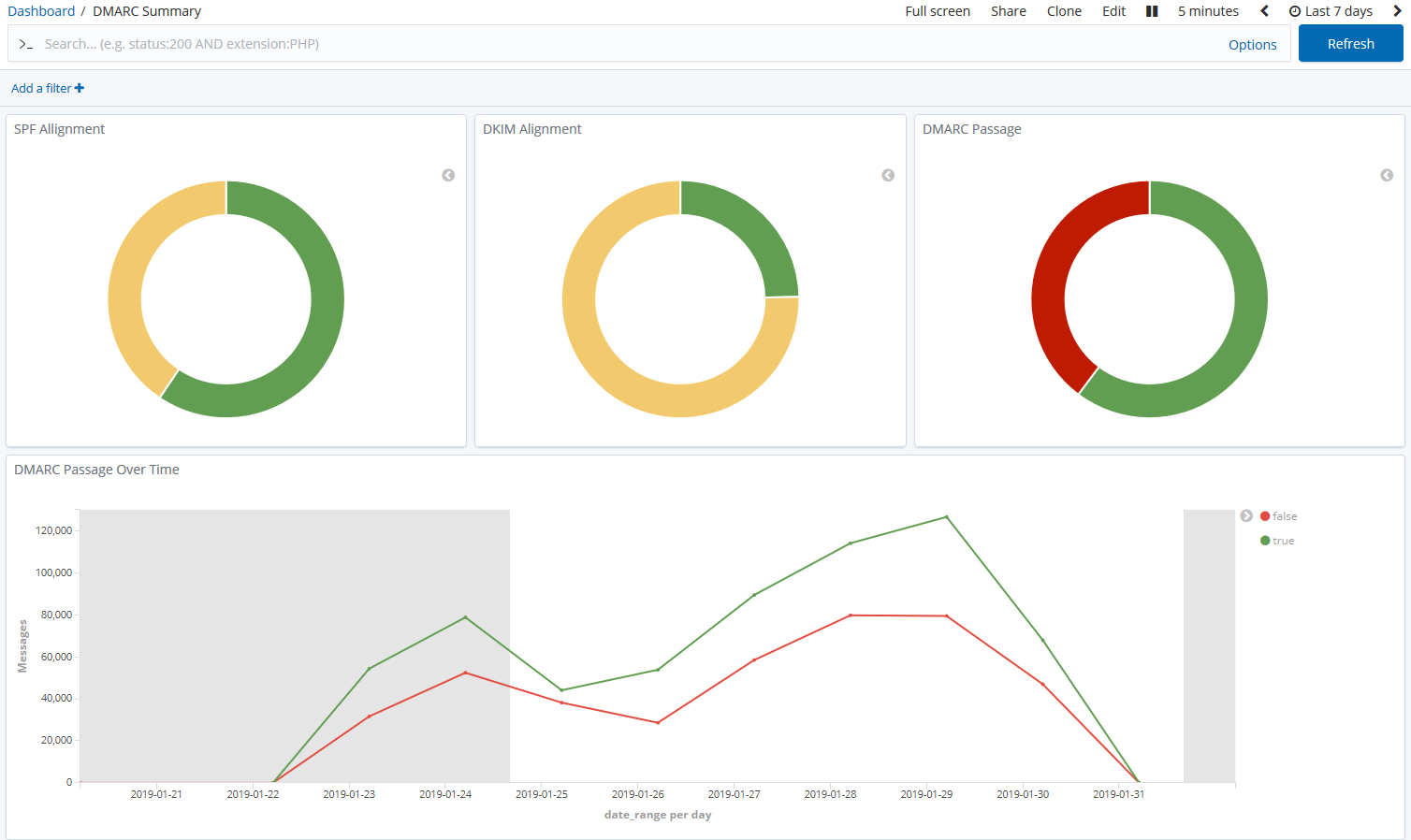
parsedmarc is a Python module and CLI utility for parsing DMARC
reports. When used with Elasticsearch and Kibana (or Splunk), or with
OpenSearch and Grafana, it works as a self-hosted open-source
alternative to commercial DMARC report processing services such as
Agari Brand Protection, Dmarcian, OnDMARC, ProofPoint Email Fraud
Defense, and Valimail.
Note
Domain-based Message Authentication, Reporting, and Conformance (DMARC) is an email authentication protocol.
Sponsors
This project is maintained by one developer. Please consider sponsoring my work if you or your organization benefit from it.
Features
- Parses aggregate/rua DMARC reports: the legacy draft and 1.0 schemas (RFC 7489) and the new RFC 9990 schema for the final DMARC standard (RFC 9989)
- Parses failure/ruf DMARC reports (RFC 6591 and RFC 9991; formerly called forensic reports)
- Parses reports from SMTP TLS Reporting (TLS-RPT, RFC 8460)
- Can parse reports from an inbox over IMAP, Microsoft Graph, or Gmail API
- Transparently handles gzip or zip compressed reports
- Consistent data structures
- Simple JSON and/or CSV output
- Optionally email the results
- Optionally send the results to Elasticsearch, OpenSearch, Splunk, or PostgreSQL, for use with premade dashboards
- Optionally send the results to Apache Kafka, Amazon S3, Azure Log Analytics (Microsoft Sentinel), a Graylog (GELF) endpoint, a syslog server, or an HTTP webhook
Python Compatibility
This project supports the following Python versions, which are either actively maintained or are the default versions for RHEL or Debian.
| Version | Supported | Reason |
|---|---|---|
| < 3.6 | ❌ | End of Life (EOL) |
| 3.6 | ❌ | Used in RHEL 8, but not supported by project dependencies |
| 3.7 | ❌ | End of Life (EOL) |
| 3.8 | ❌ | End of Life (EOL) |
| 3.9 | ❌ | Used in Debian 11 and RHEL 9, but not supported by project dependencies |
| 3.10 | ✅ | Actively maintained |
| 3.11 | ✅ | Actively maintained; supported until June 2028 (Debian 12) |
| 3.12 | ✅ | Actively maintained; supported until May 2035 (RHEL 10) |
| 3.13 | ✅ | Actively maintained; supported until June 2030 (Debian 13) |
| 3.14 | ✅ | Supported (requires imapclient>=3.1.0) |