mirror of
https://github.com/domainaware/parsedmarc.git
synced 2026-09-15 02:17:58 +00:00

 Sean WhalenandClaude Fable 5
6148002a43
Sean WhalenandClaude Fable 5
6148002a43
Elasticsearch and OpenSearch dynamic-map the dkim_results/spf_results
object arrays as `object` (create_indexes never registers the DSL
document mappings), so Lucene flattens each array into independent
multi-valued fields and stacked terms aggregations on
dkim_results.selector/.domain/.result return every combination of
values across a report's signatures — each phantom row repeating the
full message count.

Aggregate documents now also carry dkim_results_combined and
spf_results_combined: one "selector / domain / result"
("scope / domain / result") string per auth result, composed in
add_dkim_result/add_spf_result. The Kibana/OpenSearch Dashboards and
Grafana (Elasticsearch) alignment-detail tables aggregate those
instead, and the Splunk detail panels pair the values with
mvzip/mvexpand. A documented idempotent _update_by_query backfills
documents saved by older versions; the query matches only documents
that have auth results and lack the combined fields, because an
`exists` query cannot see an empty array.

Also corrects the dead _SPFResult.results (plural) declaration to
`result` (the save path always wrote the singular key), fixes the
result parameter annotations on add_dkim_result/add_spf_result, and
removes the Grafana dmarcian.com DKIM-checker data link, which
required the separate domain/selector columns.

The SMTP TLS visualizations have the same class of defect and are
tracked separately.

Co-Authored-By: Claude Fable 5 <noreply@anthropic.com>
parsedmarc




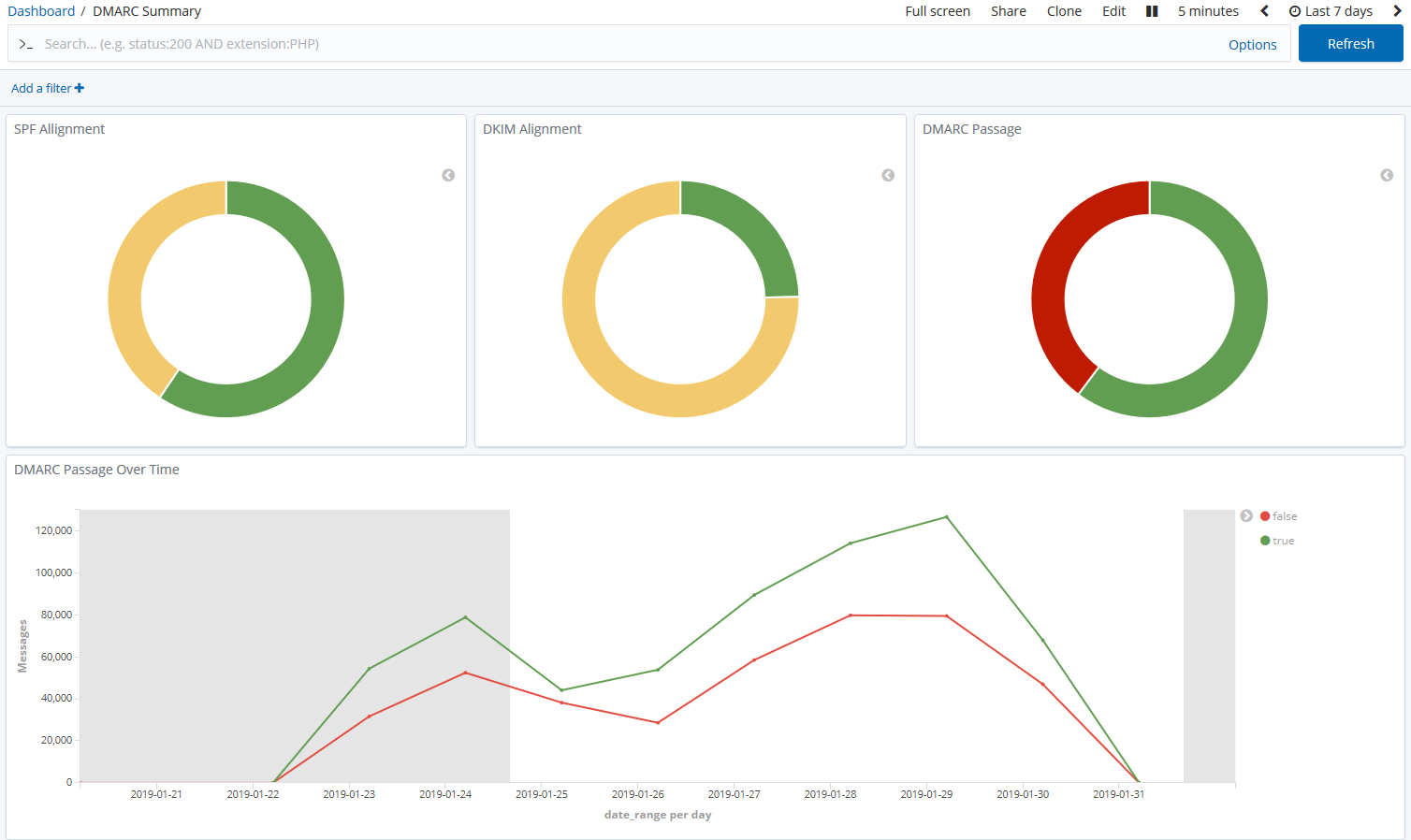
parsedmarc is a Python module and CLI utility for parsing DMARC
reports. When used with Elasticsearch and Kibana (or Splunk), it works
as a self-hosted open-source alternative to commercial DMARC report
processing services such as Agari Brand Protection, Dmarcian, OnDMARC,
ProofPoint Email Fraud Defense, and Valimail.
Note
Domain-based Message Authentication, Reporting, and Conformance (DMARC) is an email authentication protocol.
Sponsors
This project is maintained by one developer. Please consider sponsoring my work if you or your organization benefit from it.
Features
- Parses aggregate/rua DMARC reports: the legacy draft and 1.0 schemas (RFC 7489) and the new RFC 9990 schema for the final DMARC standard (RFC 9989)
- Parses failure/ruf DMARC reports (RFC 6591 and RFC 9991; formerly called forensic reports)
- Parses reports from SMTP TLS Reporting (TLS-RPT, RFC 8460)
- Can parse reports from an inbox over IMAP, Microsoft Graph, or Gmail API
- Transparently handles gzip or zip compressed reports
- Consistent data structures
- Simple JSON and/or CSV output
- Optionally email the results
- Optionally send the results to Elasticsearch, OpenSearch, Splunk, or PostgreSQL, for use with premade dashboards
- Optionally send the results to Apache Kafka, Amazon S3, Azure Log Analytics (Microsoft Sentinel), a Graylog (GELF) endpoint, a syslog server, or an HTTP webhook
Python Compatibility
This project supports the following Python versions, which are either actively maintained or are the default versions for RHEL or Debian.
| Version | Supported | Reason |
|---|---|---|
| < 3.6 | ❌ | End of Life (EOL) |
| 3.6 | ❌ | Used in RHEL 8, but not supported by project dependencies |
| 3.7 | ❌ | End of Life (EOL) |
| 3.8 | ❌ | End of Life (EOL) |
| 3.9 | ❌ | Used in Debian 11 and RHEL 9, but not supported by project dependencies |
| 3.10 | ✅ | Actively maintained |
| 3.11 | ✅ | Actively maintained; supported until June 2028 (Debian 12) |
| 3.12 | ✅ | Actively maintained; supported until May 2035 (RHEL 10) |
| 3.13 | ✅ | Actively maintained; supported until June 2030 (Debian 13) |
| 3.14 | ✅ | Supported (requires imapclient>=3.1.0) |