mirror of
https://github.com/domainaware/parsedmarc.git
synced 2026-09-23 14:10:31 +00:00


 5bb6570f4e
* collect_domain_info.py: replace curl shell-out with requests-based fallback

The previous fallback for cert-error / UA-blocked sites was a curl
subprocess. This was correct but added an external runtime dependency
(curl is usually present but not on minimal containers) and a fork +
tempfile + parse round-trip per fallback call. Replaced with a pure
requests-based path that uses a custom HTTPAdapter to relax the SSL
context to the same effective configuration:

  ssl.CERT_NONE                 (verify=False, equivalent to curl -k)
  set_ciphers("DEFAULT@SECLEVEL=0")  (allows weak DH/RSA, recovers
                                       DH_KEY_TOO_SMALL hosts that
                                       even curl's default config
                                       rejects)
  options |= 0x4 (OP_LEGACY_SERVER_CONNECT, allows unsafe legacy
                  TLS renegotiation for older server stacks)

Plus a real-browser User-Agent (same Chrome/124 string as before),
verify=False, allow_redirects=True, and Session.max_redirects=5.
InsecureRequestWarning is suppressed at module level since the
verify-disabled path is intentional.

Smoke-tested against the same eight cert-error domains as the original
curl fallback. Same recovery rate on all eight (six recover with full
title+description, two -- twmbroadband.com and ltt.ly -- remain
genuinely unreachable with both implementations). One additional win:
vnpt.com.vn (DH_KEY_TOO_SMALL) now recovers under the SECLEVEL=0
cipher list, which curl with default options did not. Happy-path
domains (google.com) still take the primary path and produce
identical output.

Side effects:
- removes the curl runtime dependency from collect_domain_info.py
- removes ~10ms of fork-and-parse overhead per fallback call
- removes the tempfile-on-disk round-trip; body is captured in-memory
- error suffix in the TSV's error column changes from "| curl: ..." to
  "| fallback: ..."

Co-Authored-By: Claude Opus 4.7 (1M context) <noreply@anthropic.com>

* Use getattr(ssl, "OP_LEGACY_SERVER_CONNECT", 0x4) instead of raw 0x4

Per PR review: prefer the constant where the interpreter exposes it
(Python 3.12+) and fall back to the raw value (0x4) only on older
interpreters that the project still supports. Self-documenting and
future-proof against any unlikely stdlib value reshuffle.

Co-Authored-By: Claude Opus 4.7 (1M context) <noreply@anthropic.com>

---------

Co-authored-by: Sean Whalen <seanthegeek@users.noreply.github.com>
Co-authored-by: Claude Opus 4.7 (1M context) <noreply@anthropic.com>
parsedmarc




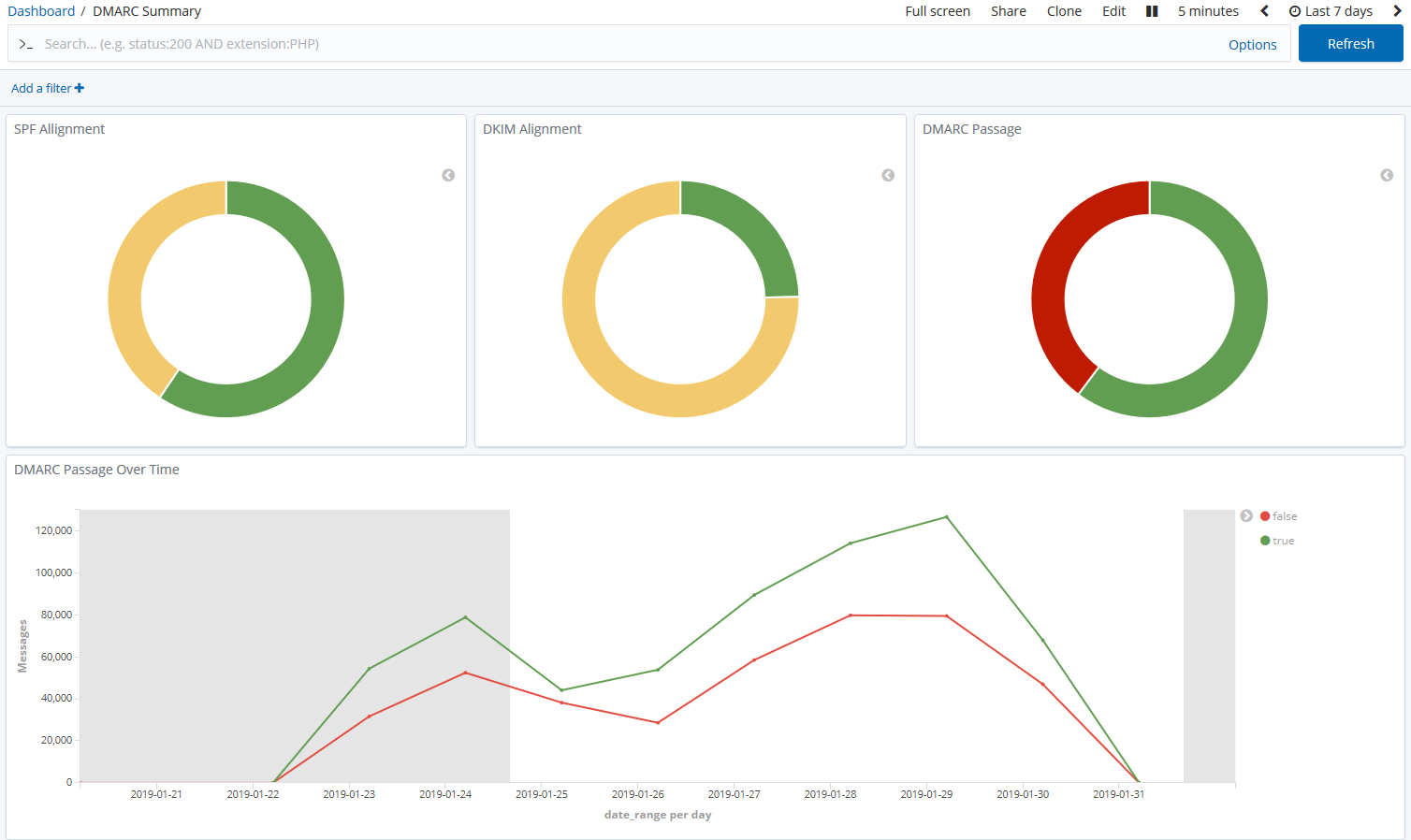
parsedmarc is a Python module and CLI utility for parsing DMARC
reports. When used with Elasticsearch and Kibana (or Splunk), it works
as a self-hosted open-source alternative to commercial DMARC report
processing services such as Agari Brand Protection, Dmarcian, OnDMARC,
ProofPoint Email Fraud Defense, and Valimail.
Note
Domain-based Message Authentication, Reporting, and Conformance (DMARC) is an email authentication protocol.
Sponsors
This is a project is maintained by one developer. Please consider sponsoring my work if you or your organization benefit from it.
Features
- Parses draft and 1.0 standard aggregate/rua DMARC reports
- Parses forensic/failure/ruf DMARC reports
- Parses reports from SMTP TLS Reporting
- Can parse reports from an inbox over IMAP, Microsoft Graph, or Gmail API
- Transparently handles gzip or zip compressed reports
- Consistent data structures
- Simple JSON and/or CSV output
- Optionally email the results
- Optionally send the results to Elasticsearch, Opensearch, and/or Splunk, for use with premade dashboards
- Optionally send reports to Apache Kafka
Python Compatibility
This project supports the following Python versions, which are either actively maintained or are the default versions for RHEL or Debian.
| Version | Supported | Reason |
|---|---|---|
| < 3.6 | ❌ | End of Life (EOL) |
| 3.6 | ❌ | Used in RHEL 8, but not supported by project dependencies |
| 3.7 | ❌ | End of Life (EOL) |
| 3.8 | ❌ | End of Life (EOL) |
| 3.9 | ❌ | Used in Debian 11 and RHEL 9, but not supported by project dependencies |
| 3.10 | ✅ | Actively maintained |
| 3.11 | ✅ | Actively maintained; supported until June 2028 (Debian 12) |
| 3.12 | ✅ | Actively maintained; supported until May 2035 (RHEL 10) |
| 3.13 | ✅ | Actively maintained; supported until June 2030 (Debian 13) |
| 3.14 | ✅ | Supported (requires imapclient>=3.1.0) |