mirror of
https://github.com/domainaware/parsedmarc.git
synced 2026-06-08 19:59:44 +00:00
 Sean Whalen
576c68ed67
Sean Whalen
576c68ed67
Rebased on top of master @ 2cda5bf (9.9.0), which added the ASN
source attribution work (#712, #713, #714, #715). Individual Copilot
iteration commits squashed into this single commit — the per-commit
history on the feature branch was iterative (add tests, fix lint,
move field, revert, etc.) and not worth preserving; GitHub squash-
merges PRs anyway.

New fields from the DMARCbis XSD, plumbed through types, parsing, CSV
output, and the Elasticsearch / OpenSearch mappings:

- ``np`` — non-existent subdomain policy (``none`` / ``quarantine`` /
  ``reject``)
- ``testing`` — testing mode flag (``n`` / ``y``), replaces RFC 7489
  ``pct``
- ``discovery_method`` — policy discovery method (``psl`` /
  ``treewalk``)
- ``generator`` — report generator software identifier (metadata)
- ``human_result`` — optional descriptive text on DKIM / SPF results

RFC 7489 reports parse with ``None`` for DMARCbis-only fields.

Forensic reports have been renamed to failure reports throughout the
project to reflect the proper naming since RFC 7489.

- Core: ``types.py``, ``__init__.py`` — ``ForensicReport`` →
  ``FailureReport``, ``parse_forensic_report`` →
  ``parse_failure_report``, report type ``"failure"``.
- Output modules: ``elastic.py``, ``opensearch.py``, ``splunk.py``,
  ``kafkaclient.py``, ``syslog.py``, ``gelf.py``, ``webhook.py``,
  ``loganalytics.py``, ``s3.py``.
- CLI: ``cli.py`` — args, config keys, index names
  (``dmarc_failure``).
- Docs + dashboards: all markdown, Grafana JSON, Kibana NDJSON,
  Splunk XML.

Backward compatibility preserved: old function / type names remain as
aliases (``parse_forensic_report = parse_failure_report``,
``ForensicReport = FailureReport``, etc.), CLI accepts both the old
(``save_forensic``, ``forensic_topic``) and new (``save_failure``,
``failure_topic``) config keys, and updated dashboards query both
old and new index / sourcetype names so data from before and after
the rename appears together.

Merge conflicts resolved in ``parsedmarc/constants.py`` (took bis's
10.0.0 bump), ``parsedmarc/__init__.py`` (combined bis's "failure"
wording with master's IPinfo MMDB mention), ``parsedmarc/elastic.py``
and ``parsedmarc/opensearch.py`` (kept master's ``source_asn`` /
``source_asn_name`` / ``source_asn_domain`` on the failure doc path
while renaming ``forensic_report`` → ``failure_report``), and
``CHANGELOG.md`` (10.0.0 entry now sits above the 9.9.0 entry).

All 324 tests pass; ``ruff check`` / ``ruff format --check`` clean.

Co-Authored-By: Claude Opus 4.7 (1M context) <noreply@anthropic.com>
parsedmarc




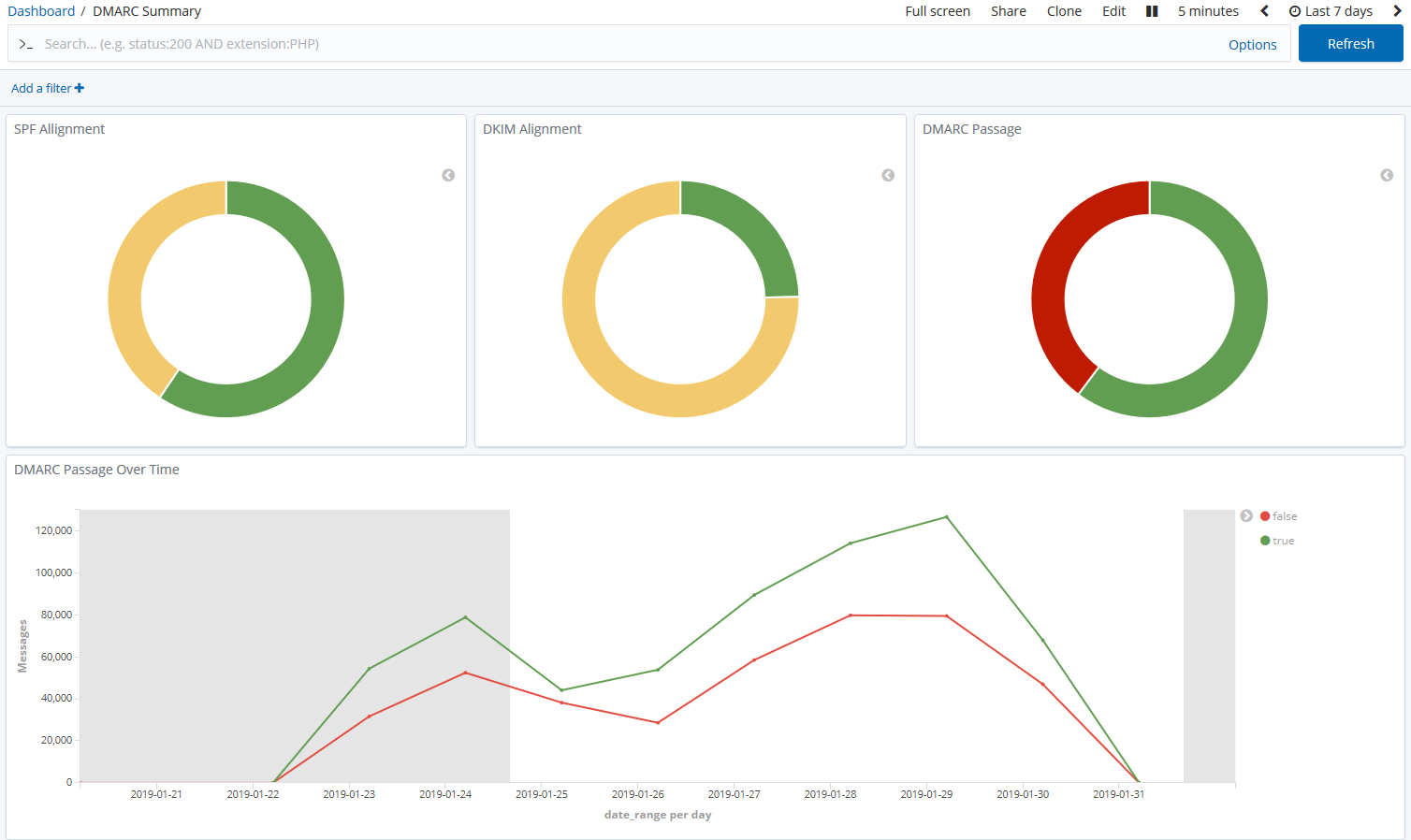
parsedmarc is a Python module and CLI utility for parsing DMARC
reports. When used with Elasticsearch and Kibana (or Splunk), it works
as a self-hosted open-source alternative to commercial DMARC report
processing services such as Agari Brand Protection, Dmarcian, OnDMARC,
ProofPoint Email Fraud Defense, and Valimail.
Note
Domain-based Message Authentication, Reporting, and Conformance (DMARC) is an email authentication protocol.
Sponsors
This is a project is maintained by one developer. Please consider sponsoring my work if you or your organization benefit from it.
Features
- Parses draft and 1.0 standard aggregate/rua DMARC reports
- Parses forensic/failure/ruf DMARC reports
- Parses reports from SMTP TLS Reporting
- Can parse reports from an inbox over IMAP, Microsoft Graph, or Gmail API
- Transparently handles gzip or zip compressed reports
- Consistent data structures
- Simple JSON and/or CSV output
- Optionally email the results
- Optionally send the results to Elasticsearch, Opensearch, and/or Splunk, for use with premade dashboards
- Optionally send reports to Apache Kafka
Python Compatibility
This project supports the following Python versions, which are either actively maintained or are the default versions for RHEL or Debian.
| Version | Supported | Reason |
|---|---|---|
| < 3.6 | ❌ | End of Life (EOL) |
| 3.6 | ❌ | Used in RHEL 8, but not supported by project dependencies |
| 3.7 | ❌ | End of Life (EOL) |
| 3.8 | ❌ | End of Life (EOL) |
| 3.9 | ❌ | Used in Debian 11 and RHEL 9, but not supported by project dependencies |
| 3.10 | ✅ | Actively maintained |
| 3.11 | ✅ | Actively maintained; supported until June 2028 (Debian 12) |
| 3.12 | ✅ | Actively maintained; supported until May 2035 (RHEL 10) |
| 3.13 | ✅ | Actively maintained; supported until June 2030 (Debian 13) |
| 3.14 | ✅ | Supported (requires imapclient>=3.1.0) |