mirror of
https://github.com/domainaware/parsedmarc.git
synced 2026-10-07 04:47:13 +00:00
 Vincent
535d9db1ad
Vincent
535d9db1ad
Appending _FILE to any PARSEDMARC_{SECTION}_{KEY} env var reads the
value from the referenced file, with one trailing newline stripped.
This matches the Postgres/MariaDB/Redis container-image convention so
Docker Compose and Kubernetes secret mounts work without extra glue,
keeping credentials out of plain environment: blocks (and out of
docker inspect, container logs, and /proc/<pid>/environ).

When both the direct var and its _FILE companion are set, the file
wins. A missing or unreadable file raises ConfigurationError rather
than silently degrading to an empty credential. The four pre-existing
config keys whose own names end in _file ([general] log_file,
[msgraph] token_file, [gmail_api] credentials_file / token_file)
keep their direct-path semantics; pass their values via secret by
doubling the suffix (_FILE_FILE).
parsedmarc




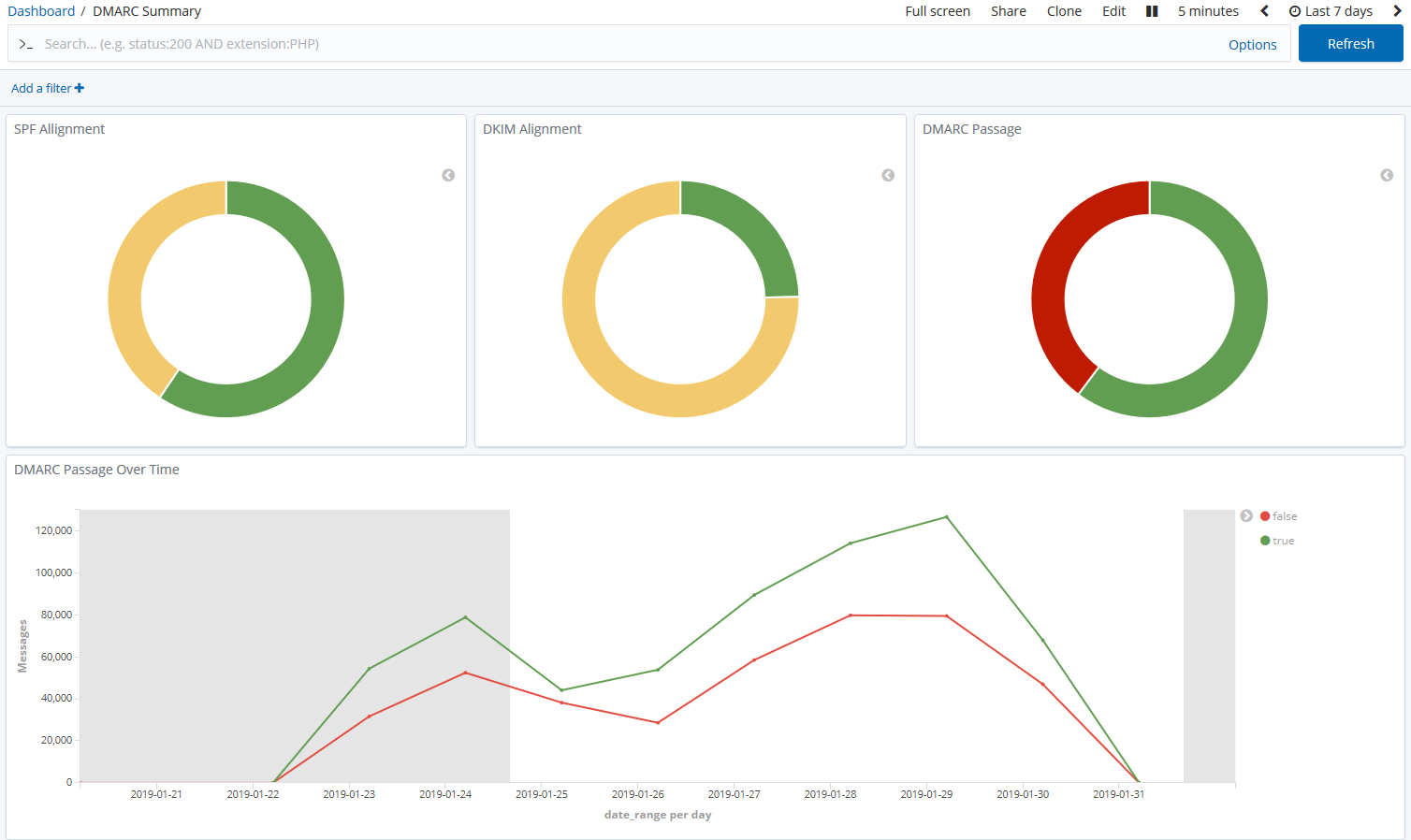
parsedmarc is a Python module and CLI utility for parsing DMARC
reports. When used with Elasticsearch and Kibana (or Splunk), it works
as a self-hosted open-source alternative to commercial DMARC report
processing services such as Agari Brand Protection, Dmarcian, OnDMARC,
ProofPoint Email Fraud Defense, and Valimail.
Note
Domain-based Message Authentication, Reporting, and Conformance (DMARC) is an email authentication protocol.
Sponsors
This is a project is maintained by one developer. Please consider sponsoring my work if you or your organization benefit from it.
Features
- Parses draft and 1.0 standard aggregate/rua DMARC reports
- Parses forensic/failure/ruf DMARC reports
- Parses reports from SMTP TLS Reporting
- Can parse reports from an inbox over IMAP, Microsoft Graph, or Gmail API
- Transparently handles gzip or zip compressed reports
- Consistent data structures
- Simple JSON and/or CSV output
- Optionally email the results
- Optionally send the results to Elasticsearch, Opensearch, and/or Splunk, for use with premade dashboards
- Optionally send reports to Apache Kafka
Python Compatibility
This project supports the following Python versions, which are either actively maintained or are the default versions for RHEL or Debian.
| Version | Supported | Reason |
|---|---|---|
| < 3.6 | ❌ | End of Life (EOL) |
| 3.6 | ❌ | Used in RHEL 8, but not supported by project dependencies |
| 3.7 | ❌ | End of Life (EOL) |
| 3.8 | ❌ | End of Life (EOL) |
| 3.9 | ❌ | Used in Debian 11 and RHEL 9, but not supported by project dependencies |
| 3.10 | ✅ | Actively maintained |
| 3.11 | ✅ | Actively maintained; supported until June 2028 (Debian 12) |
| 3.12 | ✅ | Actively maintained; supported until May 2035 (RHEL 10) |
| 3.13 | ✅ | Actively maintained; supported until June 2030 (Debian 13) |
| 3.14 | ✅ | Supported (requires imapclient>=3.1.0) |