mirror of
https://github.com/domainaware/parsedmarc.git
synced 2026-10-27 13:08:53 +00:00

 Sean WhalenandClaude Fable 5
4e80047e68
Sean WhalenandClaude Fable 5
4e80047e68
* Centralize configuration handling with ParserConfig (#503)

Add parsedmarc/config.py with ParserConfig, a frozen dataclass carrying
every parsing/enrichment option plus the three shared caches (IP address
info, seen aggregate report IDs, reverse DNS map). All eight public
parsing/mailbox functions accept a keyword-only config= argument; when
provided, the individual option keyword arguments are ignored in favor
of the config's values, and every existing per-option keyword argument
keeps working unchanged. The three hand-copied parse_kwargs dicts and
the dns_timeout<->timeout rename chain are gone; the CLI builds one
ParserConfig per run (rebuilt on SIGHUP) and passes it everywhere.

Explicitly constructed configs own fresh isolated caches;
dataclasses.replace() shares them; pickling drops cache contents and
rebinds the unpickling process's module defaults, preserving the
per-worker cache behavior of n_procs parallel parsing. The module
globals IP_ADDRESS_CACHE / SEEN_AGGREGATE_REPORT_IDS / REVERSE_DNS_MAP
remain, identity-preserved, as re-exports of the default caches.

Bug fixes that ride along, each with a regression test:

- One-shot mailbox runs now honor [general] dns_timeout/dns_retries;
  the CLI call site never forwarded dns_timeout, so the library's
  stray 6.0 default silently applied.
- Lazily-triggered reverse DNS map loads (get_ip_address_info /
  get_service_from_reverse_dns_base_domain, including in n_procs
  workers) now thread psl_overrides_path/psl_overrides_url through to
  load_reverse_dns_map instead of clobbering operator-configured PSL
  overrides with the bundled defaults.
- get_dmarc_reports_from_mailbox() and watch_inbox() dns_timeout
  defaults unified to DEFAULT_DNS_TIMEOUT (2.0s) from a stray 6.0, and
  normalize_timespan_threshold_hours to the float 24.0 used everywhere
  else.

Closes #503

Co-Authored-By: Claude Fable 5 <noreply@anthropic.com>

* Address CI and review feedback on #851

- Wrap the IMAPConnection example in usage.md so ruff format is clean
  over the docs code blocks (CI runs ruff format --check on the whole
  repo; the local runs were scoped to parsedmarc/ and tests/ and
  missed it).
- Fix the pre-existing "URL ro a reverse DNS map" docstring typo in
  get_service_from_reverse_dns_base_domain, caught by Copilot on the
  adjacent hunk.
- Import parsedmarc.config once, as an aliased plain import, in
  tests/test_config.py instead of mixing import and import-from of the
  same module (flagged by code quality scanning); the aliased module
  import also keeps pyright able to resolve the submodule attribute
  access.

Co-Authored-By: Claude Fable 5 <noreply@anthropic.com>

* Address second Copilot review round on #851

- Add parse_aggregate_report_file() to the library entry-point list in
  usage.md; the following paragraph describes the config= contract for
  "each of these functions", so the list must name all eight
  config-accepting entry points.
- ParserConfig.__setstate__ now initializes every non-cache field to
  its class default before applying the pickled state, so a config
  serialized by an older parsedmarc version (whose state predates
  fields added later) unpickles with the newer fields at their
  defaults instead of unset entirely (__init__ never runs during
  unpickling, so an absent field would raise AttributeError on first
  access). Covered by a regression test that feeds __setstate__ a
  partial state dict.

Co-Authored-By: Claude Fable 5 <noreply@anthropic.com>

---------

Co-authored-by: Claude Fable 5 <noreply@anthropic.com>
parsedmarc




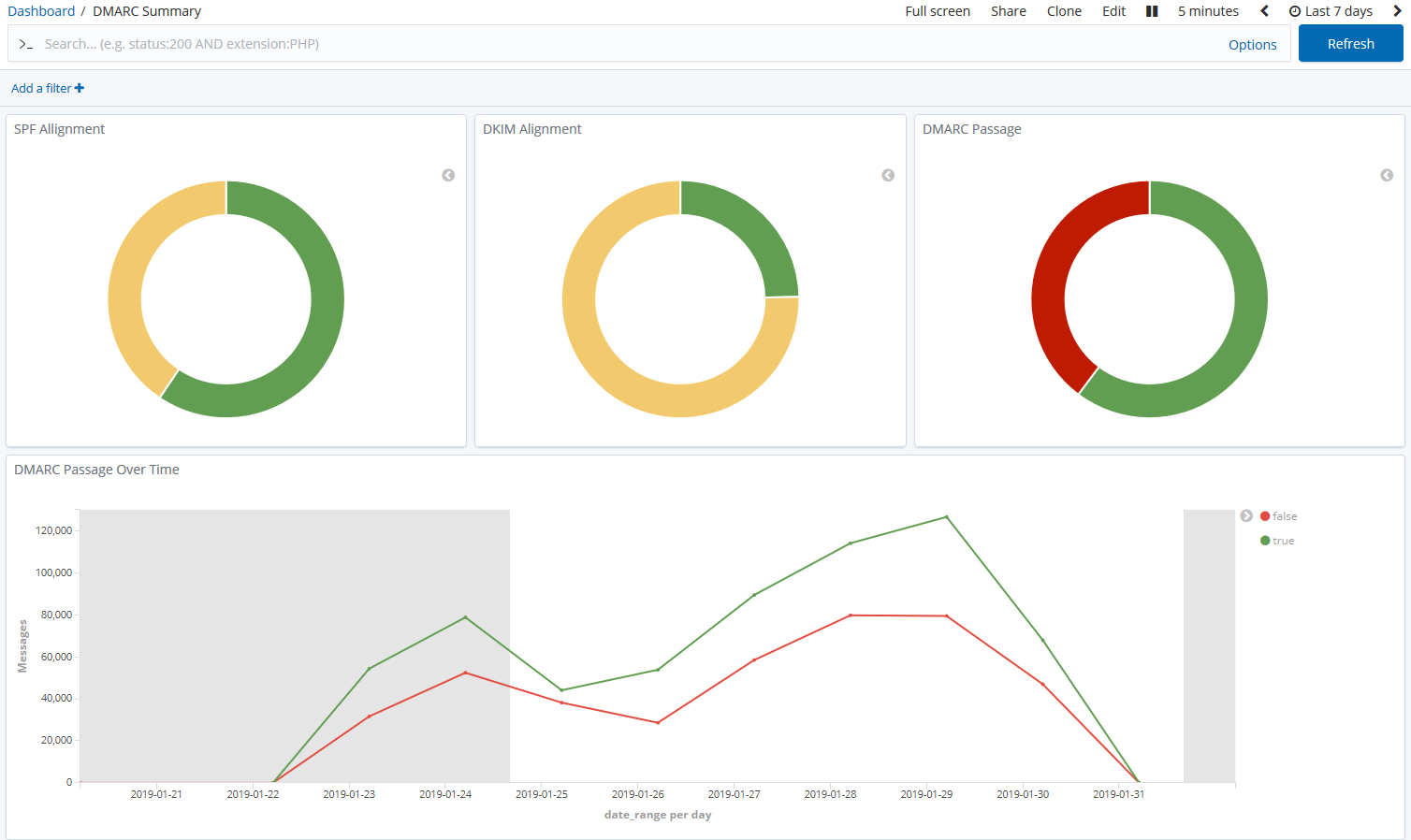
parsedmarc is a Python module and CLI utility for parsing DMARC
reports. When used with Elasticsearch and Kibana (or Splunk), it works
as a self-hosted open-source alternative to commercial DMARC report
processing services such as Agari Brand Protection, Dmarcian, OnDMARC,
ProofPoint Email Fraud Defense, and Valimail.
Note
Domain-based Message Authentication, Reporting, and Conformance (DMARC) is an email authentication protocol.
Sponsors
This project is maintained by one developer. Please consider sponsoring my work if you or your organization benefit from it.
Features
- Parses aggregate/rua DMARC reports: the legacy draft and 1.0 schemas (RFC 7489) and the new RFC 9990 schema for the final DMARC standard (RFC 9989)
- Parses failure/ruf DMARC reports (RFC 6591 and RFC 9991; formerly called forensic reports)
- Parses reports from SMTP TLS Reporting (TLS-RPT, RFC 8460)
- Can parse reports from an inbox over IMAP, Microsoft Graph, or Gmail API
- Transparently handles gzip or zip compressed reports
- Consistent data structures
- Simple JSON and/or CSV output
- Optionally email the results
- Optionally send the results to Elasticsearch, OpenSearch, Splunk, or PostgreSQL, for use with premade dashboards
- Optionally send the results to Apache Kafka, Amazon S3, Azure Log Analytics (Microsoft Sentinel), a Graylog (GELF) endpoint, a syslog server, or an HTTP webhook
Python Compatibility
This project supports the following Python versions, which are either actively maintained or are the default versions for RHEL or Debian.
| Version | Supported | Reason |
|---|---|---|
| < 3.6 | ❌ | End of Life (EOL) |
| 3.6 | ❌ | Used in RHEL 8, but not supported by project dependencies |
| 3.7 | ❌ | End of Life (EOL) |
| 3.8 | ❌ | End of Life (EOL) |
| 3.9 | ❌ | Used in Debian 11 and RHEL 9, but not supported by project dependencies |
| 3.10 | ✅ | Actively maintained |
| 3.11 | ✅ | Actively maintained; supported until June 2028 (Debian 12) |
| 3.12 | ✅ | Actively maintained; supported until May 2035 (RHEL 10) |
| 3.13 | ✅ | Actively maintained; supported until June 2030 (Debian 13) |
| 3.14 | ✅ | Supported (requires imapclient>=3.1.0) |