mirror of
https://github.com/domainaware/parsedmarc.git
synced 2026-10-13 15:37:13 +00:00

 Sean WhalenandClaude Opus 4.7
411f5a8886
Sean WhalenandClaude Opus 4.7
411f5a8886
- Ignore data/export trees via cSpell.ignorePaths: parsedmarc/resources/**
  (maps tooling holds thousands of intentional foreign-language classifier
  keywords + bundled data), plus samples/** and dashboards/** (report
  samples and dashboard exports). These are data, not whitelist vocabulary,
  so excluding them keeps the editor quiet without bloating the word list.
- Add the remaining genuine false-positives across code, docs, CI
  workflows, and editor config to cSpell.words (technical terms, library
  names, SQL/identifier tokens, brand/operator and multilingual examples
  from AGENTS.md, plus charliermarsh/junitxml/mktemp/pipefail/seanthegeek).
- Fix two genuine typos found while triaging rather than whitelisting
  them: "maidir" -> "maildir" and "connexion" -> "connection".

Co-authored-by: Claude Opus 4.7 (1M context) <noreply@anthropic.com>
parsedmarc




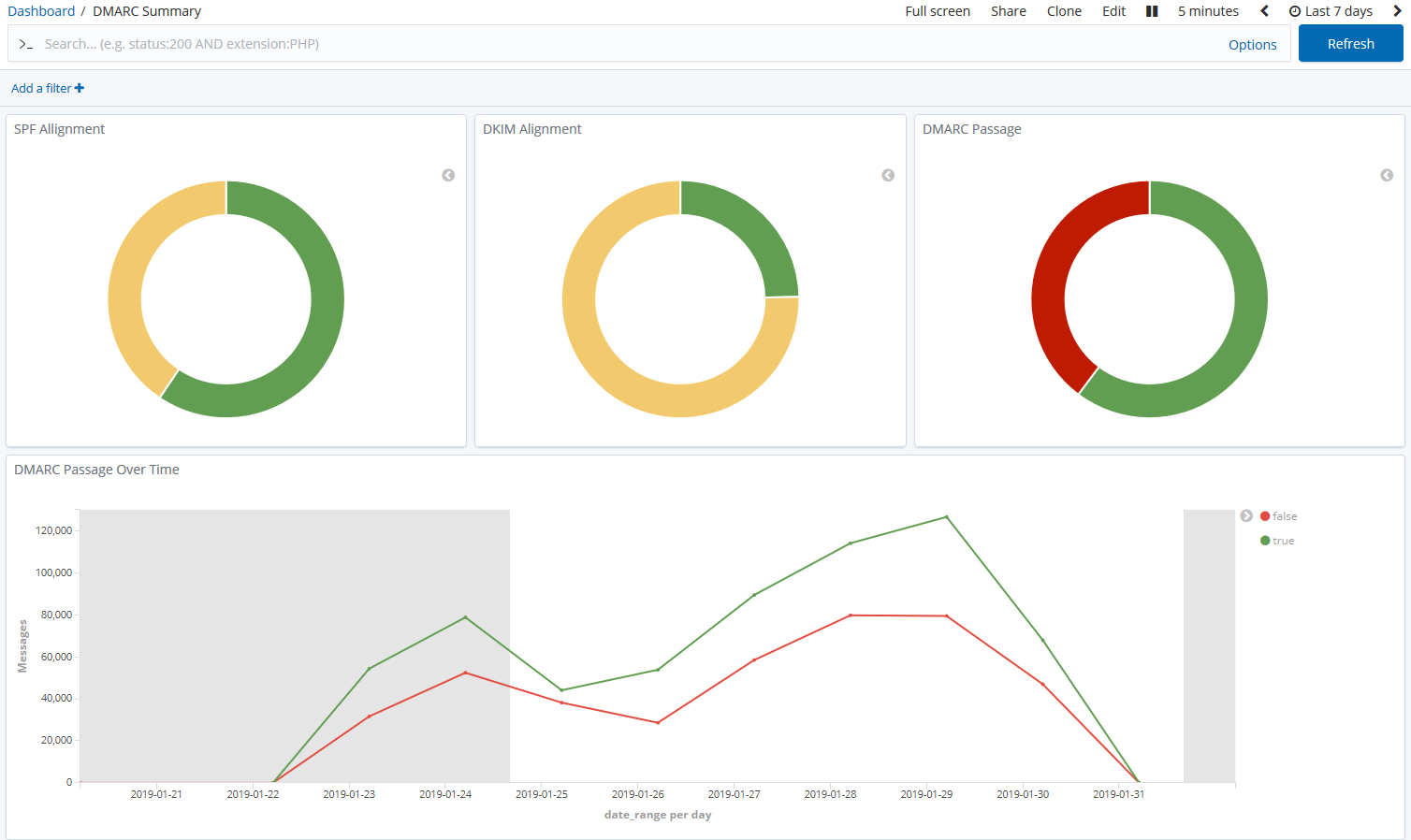
parsedmarc is a Python module and CLI utility for parsing DMARC
reports. When used with Elasticsearch and Kibana (or Splunk), it works
as a self-hosted open-source alternative to commercial DMARC report
processing services such as Agari Brand Protection, Dmarcian, OnDMARC,
ProofPoint Email Fraud Defense, and Valimail.
Note
Domain-based Message Authentication, Reporting, and Conformance (DMARC) is an email authentication protocol.
Sponsors
This is a project is maintained by one developer. Please consider sponsoring my work if you or your organization benefit from it.
Features
- Parses aggregate/rua DMARC reports: the legacy draft and 1.0 schemas (RFC 7489) and the new RFC 9990 schema for the final DMARC standard (RFC 9989)
- Parses failure/ruf DMARC reports (RFC 6591 and RFC 9991; formerly called forensic reports)
- Parses reports from SMTP TLS Reporting (TLS-RPT, RFC 8460)
- Can parse reports from an inbox over IMAP, Microsoft Graph, or Gmail API
- Transparently handles gzip or zip compressed reports
- Consistent data structures
- Simple JSON and/or CSV output
- Optionally email the results
- Optionally send the results to Elasticsearch, OpenSearch, or Splunk, for use with premade dashboards
- Optionally send the results to PostgreSQL, Apache Kafka, Amazon S3, Azure Log Analytics (Microsoft Sentinel), a Graylog (GELF) endpoint, a syslog server, or an HTTP webhook
Python Compatibility
This project supports the following Python versions, which are either actively maintained or are the default versions for RHEL or Debian.
| Version | Supported | Reason |
|---|---|---|
| < 3.6 | ❌ | End of Life (EOL) |
| 3.6 | ❌ | Used in RHEL 8, but not supported by project dependencies |
| 3.7 | ❌ | End of Life (EOL) |
| 3.8 | ❌ | End of Life (EOL) |
| 3.9 | ❌ | Used in Debian 11 and RHEL 9, but not supported by project dependencies |
| 3.10 | ✅ | Actively maintained |
| 3.11 | ✅ | Actively maintained; supported until June 2028 (Debian 12) |
| 3.12 | ✅ | Actively maintained; supported until May 2035 (RHEL 10) |
| 3.13 | ✅ | Actively maintained; supported until June 2030 (Debian 13) |
| 3.14 | ✅ | Supported (requires imapclient>=3.1.0) |