mirror of
https://github.com/domainaware/parsedmarc.git
synced 2026-10-20 09:58:11 +00:00

 Sean WhalenandClaude Fable 5
40509f801b
Sean WhalenandClaude Fable 5
40509f801b
* Migrate Elasticsearch output to the elasticsearch-py 8.x client (#806)

The mandatory elasticsearch<7.14.0 + elasticsearch-dsl==7.4.0 pins
transitively forced urllib3<2 (EOL 1.26.x) onto every install. The old
<7.14.0 cap only existed to dodge the client product check that broke
OpenSearch users (#452, #653) — obsolete now that parsedmarc has a
dedicated [opensearch] backend on opensearch-py.

- Depend on elasticsearch>=8.18,<9 and drop elasticsearch-dsl entirely
  (the DSL ships inside the client as elasticsearch.dsl since 8.18.0).
  The 8.x client's elastic-transport allows urllib3>=1.26.2,<3, so
  installs can now resolve urllib3 2.x. The 8.x line supports both
  Elasticsearch 8.x and 9.x servers; ES 7.x servers are no longer
  supported, and OpenSearch users pointing [elasticsearch] at an
  OpenSearch cluster must switch to the [opensearch] section.
- set_hosts() now builds 8.x connection kwargs (scheme-qualified host
  URLs, request_timeout, basic_auth) while keeping the function
  signature and every INI option unchanged.
- migrate_indexes() is now a documented no-op kept for API
  compatibility: its only migration (re-typing published_policy.fo
  from long to text) applied exclusively to indices carrying the
  legacy ES 6-era "doc" mapping type, which cannot exist on any
  server the 8.x client can reach.
- The elasticsearch.dsl 8.x stubs use dataclass_transform and don't
  surface pre-8.x-style bare `name = Text()` fields as constructor
  parameters; each Document/InnerDoc class now carries a
  TYPE_CHECKING-only `__init__(*args, **kwargs)` declaration matching
  the real runtime signature, which also made nine pre-existing
  pyright ignores unnecessary.

Verified with ruff, pyright (0 errors/0 warnings), the full pytest
suite (718 passed), and a CLI run over the bundled samples; CI's live
elasticsearch:8.19.7 service exercises the new client end-to-end.

Co-Authored-By: Claude Fable 5 <noreply@anthropic.com>

* Use pass instead of ... in TYPE_CHECKING __init__ stubs

CodeQL flags an ellipsis-only body as "Statement has no effect" (12
alerts on PR #822); pass is equivalent at runtime and to the type
checker and keeps the alerts from resurfacing on every future scan.

Co-Authored-By: Claude Fable 5 <noreply@anthropic.com>

---------

Co-authored-by: Claude Fable 5 <noreply@anthropic.com>
parsedmarc




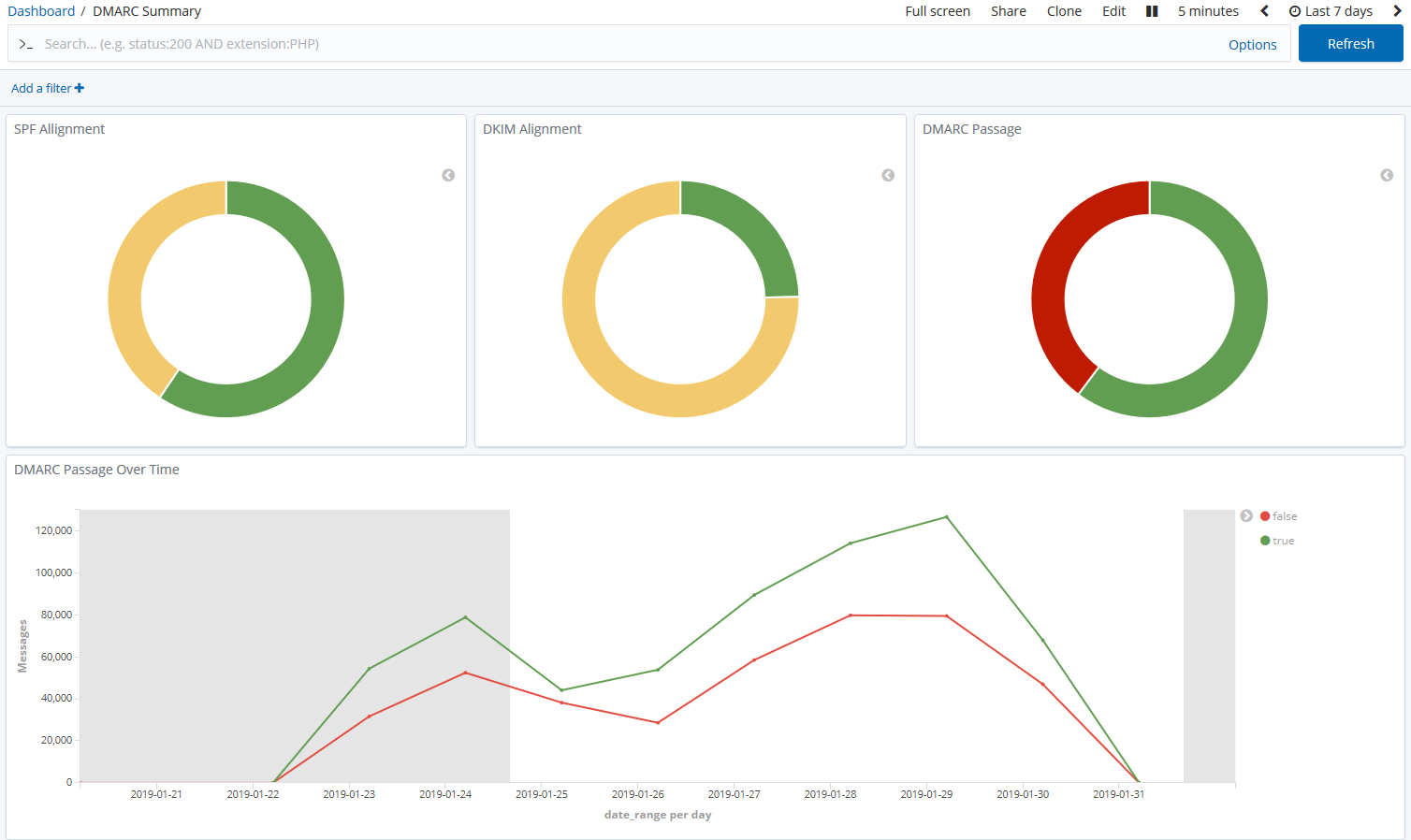
parsedmarc is a Python module and CLI utility for parsing DMARC
reports. When used with Elasticsearch and Kibana (or Splunk), it works
as a self-hosted open-source alternative to commercial DMARC report
processing services such as Agari Brand Protection, Dmarcian, OnDMARC,
ProofPoint Email Fraud Defense, and Valimail.
Note
Domain-based Message Authentication, Reporting, and Conformance (DMARC) is an email authentication protocol.
Sponsors
This project is maintained by one developer. Please consider sponsoring my work if you or your organization benefit from it.
Features
- Parses aggregate/rua DMARC reports: the legacy draft and 1.0 schemas (RFC 7489) and the new RFC 9990 schema for the final DMARC standard (RFC 9989)
- Parses failure/ruf DMARC reports (RFC 6591 and RFC 9991; formerly called forensic reports)
- Parses reports from SMTP TLS Reporting (TLS-RPT, RFC 8460)
- Can parse reports from an inbox over IMAP, Microsoft Graph, or Gmail API
- Transparently handles gzip or zip compressed reports
- Consistent data structures
- Simple JSON and/or CSV output
- Optionally email the results
- Optionally send the results to Elasticsearch, OpenSearch, Splunk, or PostgreSQL, for use with premade dashboards
- Optionally send the results to Apache Kafka, Amazon S3, Azure Log Analytics (Microsoft Sentinel), a Graylog (GELF) endpoint, a syslog server, or an HTTP webhook
Python Compatibility
This project supports the following Python versions, which are either actively maintained or are the default versions for RHEL or Debian.
| Version | Supported | Reason |
|---|---|---|
| < 3.6 | ❌ | End of Life (EOL) |
| 3.6 | ❌ | Used in RHEL 8, but not supported by project dependencies |
| 3.7 | ❌ | End of Life (EOL) |
| 3.8 | ❌ | End of Life (EOL) |
| 3.9 | ❌ | Used in Debian 11 and RHEL 9, but not supported by project dependencies |
| 3.10 | ✅ | Actively maintained |
| 3.11 | ✅ | Actively maintained; supported until June 2028 (Debian 12) |
| 3.12 | ✅ | Actively maintained; supported until May 2035 (RHEL 10) |
| 3.13 | ✅ | Actively maintained; supported until June 2030 (Debian 13) |
| 3.14 | ✅ | Supported (requires imapclient>=3.1.0) |