mirror of
https://github.com/domainaware/parsedmarc.git
synced 2026-10-21 02:08:13 +00:00


 3fda55d385
* Make Microsoft Graph connection activity observable

parsedmarc only configured its own logger, so all Graph connection
activity was silently dropped even with --debug: the mailbox layer
logs under mailsuite.mailbox.graph, token acquisition under
azure.identity (including the AADSTS error codes that distinguish a
local config problem from an Exchange Online / Entra ID one), and
HTTP traffic under httpx/msgraph — none of which had a handler or
level set. _main() also logged nothing around the MSGraphConnection
call, so a hang left no trace at all.

Three changes, all parsedmarc-side (no mailsuite changes needed):

- Log a redacted connection summary at INFO before connecting (auth
  method, tenant ID, client ID, mailbox, Graph URL) plus a --debug
  detail line with certificate path, token-file path, and set/not-set
  flags for secrets. Secret values are never logged; a regression
  test asserts they don't appear in captured output.
- Log a timing line after the connection object is initialized.
- Propagate parsedmarc's --verbose/--debug level and handlers to the
  dependency loggers (mailsuite, azure, msgraph, httpx, httpcore) via
  _configure_dependency_logging(), synced to exactly the parsedmarc
  logger's handlers so SIGHUP log-file swaps neither duplicate output
  nor write to closed handlers. At the default level dependency
  loggers sit at WARNING, so their warnings keep surfacing (formatted)
  without new noise.

All four new tests fail on the unfixed code (verified by stashing the
cli.py change).

Fixes https://github.com/domainaware/parsedmarc/issues/814.

Co-Authored-By: Claude Fable 5 <noreply@anthropic.com>

* Disable propagation on dependency loggers; document kiota's absence

Set propagate=False on the dependency loggers when syncing handlers, so
a stray logging.basicConfig() anywhere in the process cannot
double-print every dependency record through the root logger — the
function already owns these loggers' handler lists, and this makes that
ownership complete. Asserted alongside the existing level/handler checks.

kiota_http and its sibling packages were considered for
_DEPENDENCY_LOGGERS but verified to not use Python logging at all
(their observability is OpenTelemetry tracing), so a comment now
records why they are absent rather than leaving the omission to be
"fixed" later.

Co-Authored-By: Claude Fable 5 <noreply@anthropic.com>

---------

Co-authored-by: MISAPOR LAB <misapor@lab.misapor.pl>
Co-authored-by: Claude Fable 5 <noreply@anthropic.com>
Co-authored-by: Sean Whalen <44679+seanthegeek@users.noreply.github.com>
parsedmarc




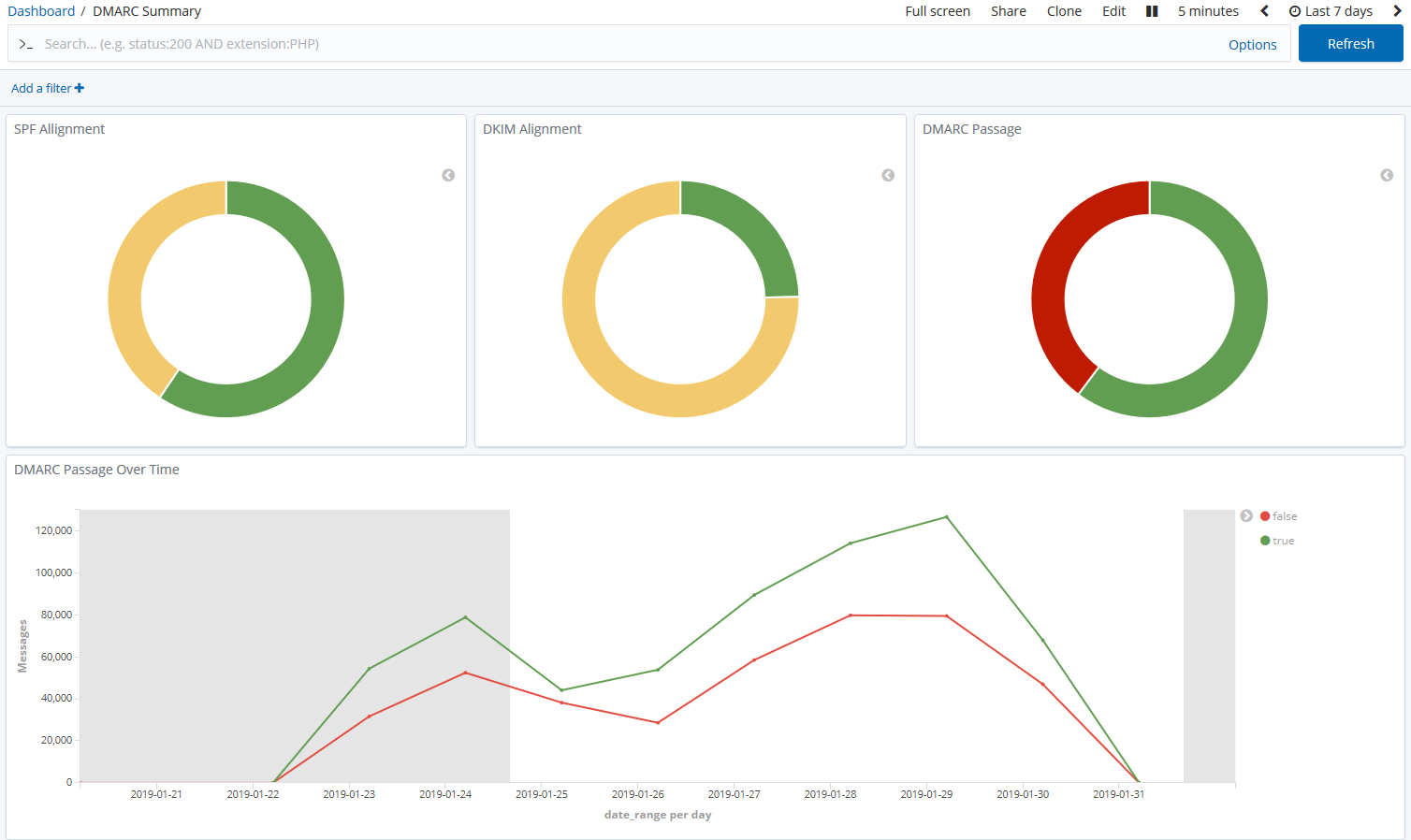
parsedmarc is a Python module and CLI utility for parsing DMARC
reports. When used with Elasticsearch and Kibana (or Splunk), it works
as a self-hosted open-source alternative to commercial DMARC report
processing services such as Agari Brand Protection, Dmarcian, OnDMARC,
ProofPoint Email Fraud Defense, and Valimail.
Note
Domain-based Message Authentication, Reporting, and Conformance (DMARC) is an email authentication protocol.
Sponsors
This project is maintained by one developer. Please consider sponsoring my work if you or your organization benefit from it.
Features
- Parses aggregate/rua DMARC reports: the legacy draft and 1.0 schemas (RFC 7489) and the new RFC 9990 schema for the final DMARC standard (RFC 9989)
- Parses failure/ruf DMARC reports (RFC 6591 and RFC 9991; formerly called forensic reports)
- Parses reports from SMTP TLS Reporting (TLS-RPT, RFC 8460)
- Can parse reports from an inbox over IMAP, Microsoft Graph, or Gmail API
- Transparently handles gzip or zip compressed reports
- Consistent data structures
- Simple JSON and/or CSV output
- Optionally email the results
- Optionally send the results to Elasticsearch, OpenSearch, Splunk, or PostgreSQL, for use with premade dashboards
- Optionally send the results to Apache Kafka, Amazon S3, Azure Log Analytics (Microsoft Sentinel), a Graylog (GELF) endpoint, a syslog server, or an HTTP webhook
Python Compatibility
This project supports the following Python versions, which are either actively maintained or are the default versions for RHEL or Debian.
| Version | Supported | Reason |
|---|---|---|
| < 3.6 | ❌ | End of Life (EOL) |
| 3.6 | ❌ | Used in RHEL 8, but not supported by project dependencies |
| 3.7 | ❌ | End of Life (EOL) |
| 3.8 | ❌ | End of Life (EOL) |
| 3.9 | ❌ | Used in Debian 11 and RHEL 9, but not supported by project dependencies |
| 3.10 | ✅ | Actively maintained |
| 3.11 | ✅ | Actively maintained; supported until June 2028 (Debian 12) |
| 3.12 | ✅ | Actively maintained; supported until May 2035 (RHEL 10) |
| 3.13 | ✅ | Actively maintained; supported until June 2030 (Debian 13) |
| 3.14 | ✅ | Supported (requires imapclient>=3.1.0) |