mirror of
https://github.com/domainaware/parsedmarc.git
synced 2026-10-26 20:48:54 +00:00

 Sean WhalenandClaude Opus 5
3d387c29e8
Sean WhalenandClaude Opus 5
3d387c29e8
_ElasticsearchHandle.close() and _OpenSearchHandle.close() re-resolved
the client library's "default" connection alias at close time. That is
wrong on the SIGHUP reload path, which is not a shutdown path:
_main's reload block calls _init_output_clients() -- and therefore
set_hosts() -> connections.create_connection() -- before
_close_output_clients() on the old clients, deliberately, so a broken
new config leaves the old clients running. By then the alias names the
*new* client, so the old handle closed the new client and then dropped
the alias entirely. Every later save raised
KeyError("There is no connection with alias 'default'.") until
parsedmarc was restarted, and the original client was leaked.

Verified against the installed SDK sources rather than the docs
(AGENTS.md, "Verify bug claims against authoritative sources", point 3):

  elasticsearch/dsl/connections.py (elasticsearch 9.x) and
  opensearchpy/connection/connections.py (opensearch-py 3.x) both define

      def create_connection(self, alias="default", **kwargs):
          conn = self._conns[alias] = <Client>(**kwargs)

  -- so create_connection() overwrites whatever the alias held, and
  returns the very object it stored (elasticsearch.dsl passes it through
  _with_user_agent(), which mutates headers and returns the same object,
  so identity is preserved) --

      def remove_connection(self, alias):
          errors = 0
          for d in (self._conns, self._kwargs):
              try:
                  del d[alias]
              except KeyError:
                  errors += 1
          if errors == 2:
              raise KeyError(f"There is no connection with alias {alias!r}.")

  -- i.e. it deletes the alias outright, with no regard for which client
  currently holds it, and

      def get_connection(self, alias="default"):
          if not isinstance(alias, str):
              return alias            # (opensearch-py; elasticsearch.dsl
                                      #  returns _with_user_agent(alias))
          try:
              return self._conns[alias]
          ...
          raise KeyError(f"There is no connection with alias {alias!r}.")

  -- a str only comes *back* out of get_connection() when a str was
  passed *in* as the alias, which these call sites never do; the client
  stored under "default" is always the object create_connection() built.
  The old `isinstance(conn, str)` guard was therefore dead code and is
  removed rather than carried forward (AGENTS.md: delete unreachable
  branches, don't hide them). add_connection(alias, conn) stores an
  arbitrary object as-is, which is what the new tests use.

set_hosts() now returns the client it registered, _init_output_clients()
passes that client to the handle, and close() closes that object and
gives up the alias only when the registry's current "default" *is* that
same object (identity check). The init/close order in the reload block
is unchanged.

tests/test_cli.py gains TestSearchBackendHandles, which drives the real
connection registries (the SDK boundary) with fake client objects, so no
network is touched: per backend, a reload-shaped test asserts the old
client is closed, the new one is not, and the alias still resolves to the
new client; a shutdown-shaped test asserts the alias is released when it
is still ours; and a best-effort test asserts a raising close() neither
propagates nor blocks the alias release. Each test restores whatever the
process-wide registry held beforehand. All six fail against the unfixed
handles.

Co-Authored-By: Claude Opus 5 (1M context) <noreply@anthropic.com>
parsedmarc




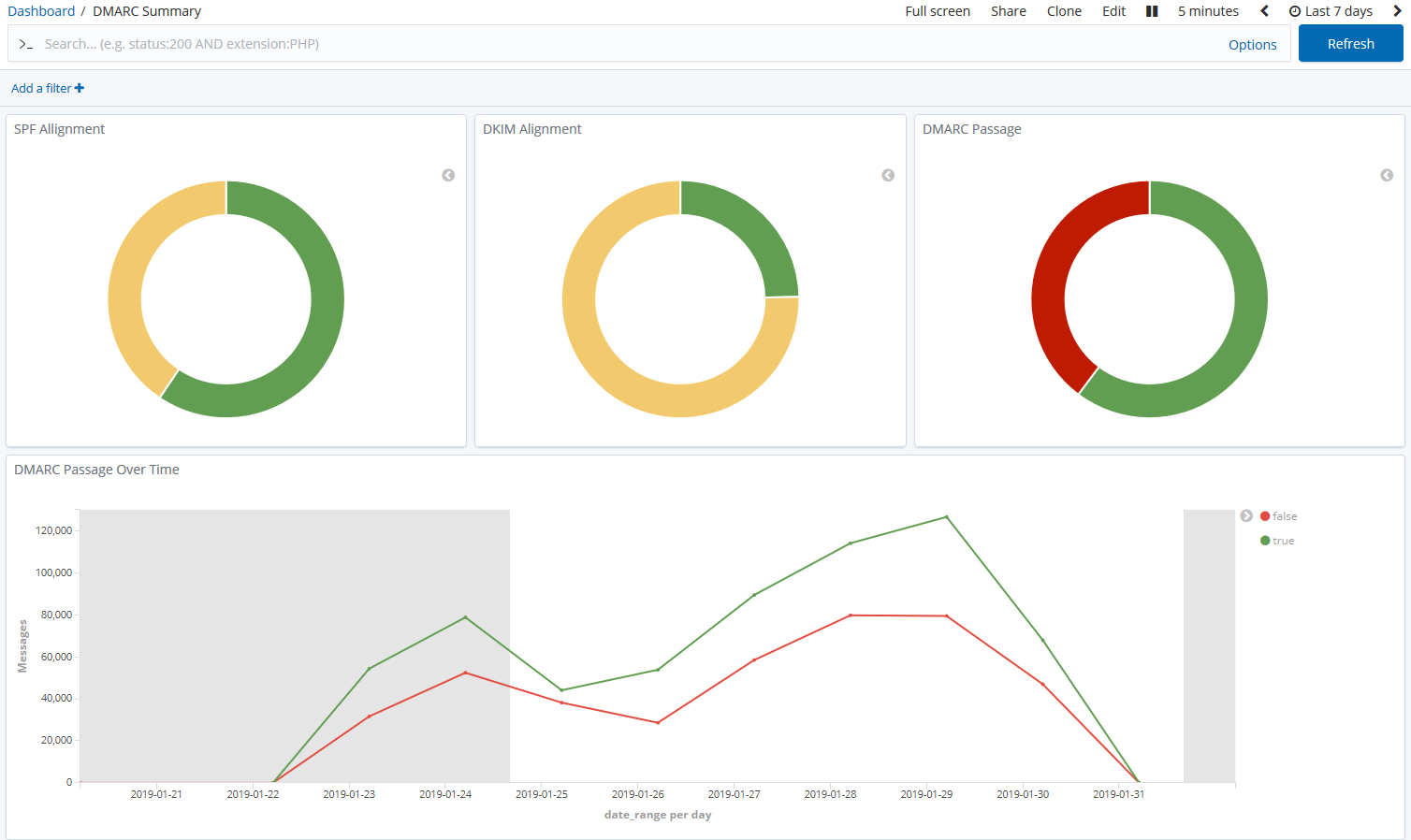
parsedmarc is a Python module and CLI utility for parsing DMARC
reports. When used with Elasticsearch and Kibana (or Splunk), or with
OpenSearch and Grafana, it works as a self-hosted open-source
alternative to commercial DMARC report processing services such as
Agari Brand Protection, Dmarcian, OnDMARC, ProofPoint Email Fraud
Defense, and Valimail.
Note
Domain-based Message Authentication, Reporting, and Conformance (DMARC) is an email authentication protocol.
Sponsors
This project is maintained by one developer. Please consider sponsoring my work if you or your organization benefit from it.
Features
- Parses aggregate/rua DMARC reports: the legacy draft and 1.0 schemas (RFC 7489) and the new RFC 9990 schema for the final DMARC standard (RFC 9989)
- Parses failure/ruf DMARC reports (RFC 6591 and RFC 9991; formerly called forensic reports)
- Parses reports from SMTP TLS Reporting (TLS-RPT, RFC 8460)
- Can parse reports from an inbox over IMAP, Microsoft Graph, or Gmail API
- Transparently handles gzip or zip compressed reports
- Consistent data structures
- Simple JSON and/or CSV output
- Optionally email the results
- Optionally send the results to Elasticsearch, OpenSearch, Splunk, or PostgreSQL, for use with premade dashboards
- Optionally send the results to Apache Kafka, Amazon S3, Azure Log Analytics (Microsoft Sentinel), a Graylog (GELF) endpoint, a syslog server, or an HTTP webhook
Python Compatibility
This project supports the following Python versions, which are either actively maintained or are the default versions for RHEL or Debian.
| Version | Supported | Reason |
|---|---|---|
| < 3.6 | ❌ | End of Life (EOL) |
| 3.6 | ❌ | Used in RHEL 8, but not supported by project dependencies |
| 3.7 | ❌ | End of Life (EOL) |
| 3.8 | ❌ | End of Life (EOL) |
| 3.9 | ❌ | Used in Debian 11 and RHEL 9, but not supported by project dependencies |
| 3.10 | ✅ | Actively maintained |
| 3.11 | ✅ | Actively maintained; supported until June 2028 (Debian 12) |
| 3.12 | ✅ | Actively maintained; supported until May 2035 (RHEL 10) |
| 3.13 | ✅ | Actively maintained; supported until June 2030 (Debian 13) |
| 3.14 | ✅ | Supported (requires imapclient>=3.1.0) |