mirror of
https://github.com/domainaware/parsedmarc.git
synced 2026-09-13 09:27:59 +00:00

 Sean WhalenandClaude Fable 5
35e51218b9
Sean WhalenandClaude Fable 5
35e51218b9
* Don't archive/delete mailbox messages until output destinations confirm the save (#242)

get_dmarc_reports_from_mailbox() gains a keyword-only save_callback,
invoked once per fetched batch before any message is deleted or moved.
A False return (or an exception) marks the batch unsaved: its messages
stay in the reports folder for retry, and the aggregate-report dedup
keys staged for that batch are dropped so the retry reparses instead of
skipping. watch_inbox() passes its callback through as save_callback,
so watch mode gets the same protection.

To bound duplicate delivery to destinations that don't deduplicate, a
new [mailbox] max_unsaved_retries option (default 2) caps retries: a
message whose batch has failed the initial attempt plus that many
retries moves to {archive_folder}/Unsaved -- never deleted, whatever
the delete options say. Counts are process-local, so the cap applies
across watch-mode checks; one-shot runs retry indefinitely, which is
the safe direction. A raising callback (the CLI's, under
fail_on_output_error) is counted against the cap the same way before
the exception is re-raised, since mailsuite's IMAP and Maildir watch
loops swallow exceptions and keep checking.

CLI: process_reports() now returns its output-error list and the
mailbox_save_callback adapter feeds that verdict to the library;
save_output() failures (the one uncaught destination) are recorded like
every other sink's; file/mbox-derived reports are saved in a separate
pass from mailbox batches so nothing is saved twice; the combined
results fed to email_results() are filtered by index_prefix_domain_map
explicitly, restoring the SMTP TLS filtering the emailed summary lost
when saving moved into per-batch callbacks.

Credit to @mkilijanek for the original approach in #823.

Fixes #242

Co-Authored-By: Claude Fable 5 <noreply@anthropic.com>

* Address automated review feedback on #863

- Keep a message's failure counter until its move to Unsaved actually
  succeeds. The counter was popped when the message was classified
  over-cap, before the move was attempted, so a failed move handed the
  still-in-place message a fresh set of under-cap retries and duplicate
  deliveries; now the next failed save classifies it over-cap again and
  re-attempts the move. Regression-tested at cap 1, where the reset
  would observably leave the message in the INBOX instead of moving it.
- Use sys.exit(1) instead of the site-dependent exit() built-in in the
  two new ParserError handlers.
- Close the sample files opened by the new Maildir tests via context
  managers.
- Keep the docs' section-link text on one line and fix the adjacent
  pre-existing "a IMAP" typo.

Co-Authored-By: Claude Fable 5 <noreply@anthropic.com>

* Address Copilot re-review feedback on #863

- Document mailbox_save_callback's raise path: with fail_on_output_error
  it raises ParserError via process_reports() instead of returning
  False, and the library counts that as an unsaved batch too.
- Use str(error_) instead of error_.__str__() in the new File output
  handler.

Co-Authored-By: Claude Fable 5 <noreply@anthropic.com>

* Reject negative max_unsaved_retries with a ValueError

The option is user-configurable (INI/env/kwarg); a negative value
silently behaved like 0. Both get_dmarc_reports_from_mailbox() and
watch_inbox() now validate it at the door alongside the existing
test/delete guard. watch_inbox() validates before entering the watch
loop, because a ValueError raised inside a check would be swallowed
and endlessly retried by the IMAP and Maildir backends' per-check
exception handling instead of surfacing.

Co-Authored-By: Claude Fable 5 <noreply@anthropic.com>

* Fix two pre-existing bugs surfaced by review of #863

- MAGIC_JSON was b"\7b" -- the octal escape \7 (BEL) plus a literal
  "b", not 0x7B, the "{" every RFC 8259 JSON object begins with -- so
  extract_report() rejected plain uncompressed JSON. Every in-tree
  caller pre-guarded with its own zip/gzip or "{" check, masking the
  dead branch; the practical impact was extract_report() as a public
  API and application/tlsrpt+gzip attachments whose payload is really
  uncompressed JSON. Now b"\x7b".

- get_index_prefix() unconditionally indexed policies[0], while
  parse_smtp_tls_report_json() accepts a report whose policies list is
  empty -- an IndexError crash whenever index_prefix_domain_map was
  configured. An empty-policies report has no domain to map, so it is
  now treated as unmappable and excluded from prefix-mapped output.
  This code was moved into filter_smtp_tls_reports_for_index_prefix()
  by this PR, which widened its exposure to the email_results() path.

Both regression tests were verified to fail against the unfixed code.

Co-Authored-By: Claude Fable 5 <noreply@anthropic.com>

* Rewrap the max_unsaved_retries docstring paragraph

The ValueError sentence was inserted without reflowing, leaving a
112-character line in a docstring wrapped at ~76; ruff formats code,
not docstring prose, so it slipped through lint.

Co-Authored-By: Claude Fable 5 <noreply@anthropic.com>

---------

Co-authored-by: Claude Fable 5 <noreply@anthropic.com>
parsedmarc




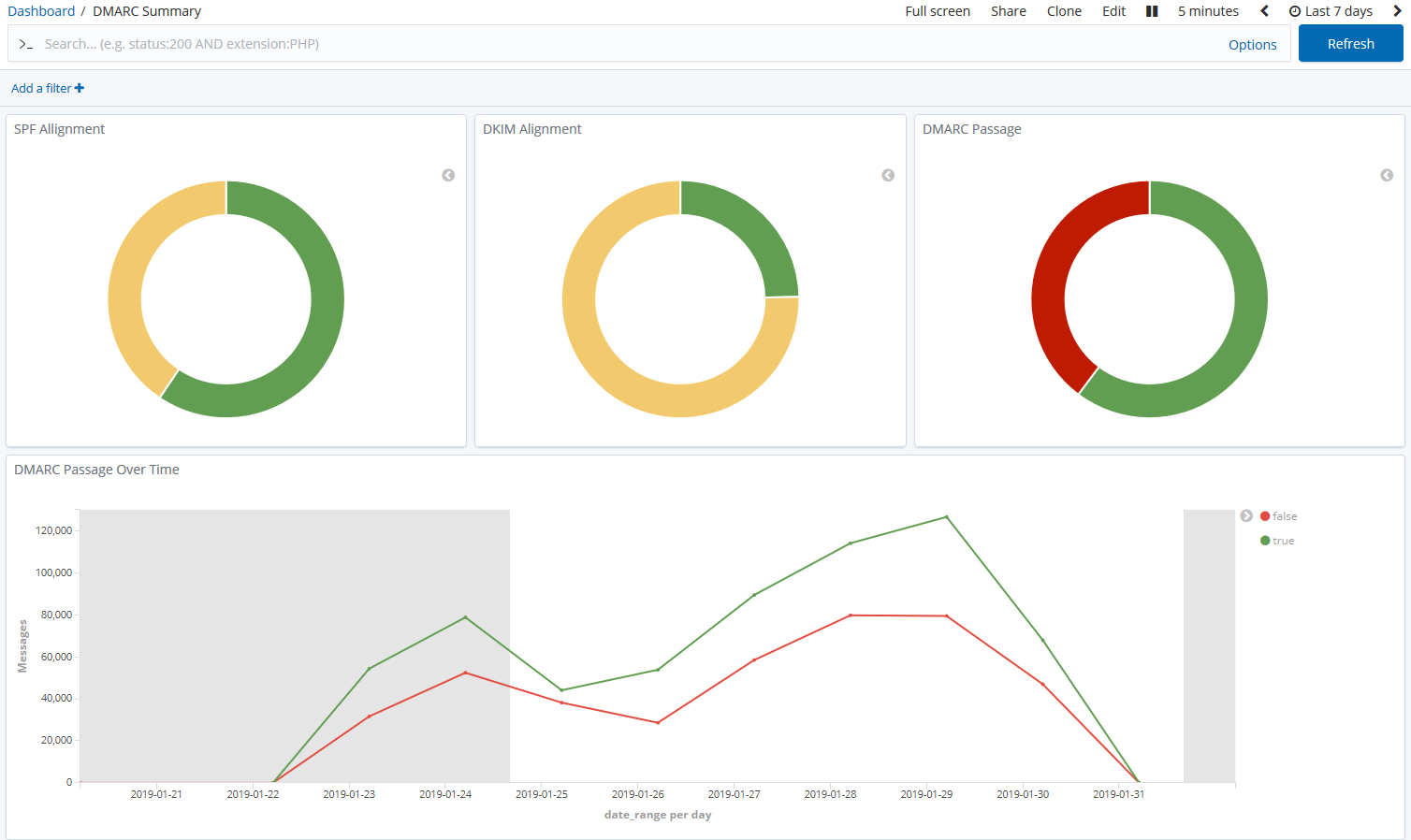
parsedmarc is a Python module and CLI utility for parsing DMARC
reports. When used with Elasticsearch and Kibana (or Splunk), it works
as a self-hosted open-source alternative to commercial DMARC report
processing services such as Agari Brand Protection, Dmarcian, OnDMARC,
ProofPoint Email Fraud Defense, and Valimail.
Note
Domain-based Message Authentication, Reporting, and Conformance (DMARC) is an email authentication protocol.
Sponsors
This project is maintained by one developer. Please consider sponsoring my work if you or your organization benefit from it.
Features
- Parses aggregate/rua DMARC reports: the legacy draft and 1.0 schemas (RFC 7489) and the new RFC 9990 schema for the final DMARC standard (RFC 9989)
- Parses failure/ruf DMARC reports (RFC 6591 and RFC 9991; formerly called forensic reports)
- Parses reports from SMTP TLS Reporting (TLS-RPT, RFC 8460)
- Can parse reports from an inbox over IMAP, Microsoft Graph, or Gmail API
- Transparently handles gzip or zip compressed reports
- Consistent data structures
- Simple JSON and/or CSV output
- Optionally email the results
- Optionally send the results to Elasticsearch, OpenSearch, Splunk, or PostgreSQL, for use with premade dashboards
- Optionally send the results to Apache Kafka, Amazon S3, Azure Log Analytics (Microsoft Sentinel), a Graylog (GELF) endpoint, a syslog server, or an HTTP webhook
Python Compatibility
This project supports the following Python versions, which are either actively maintained or are the default versions for RHEL or Debian.
| Version | Supported | Reason |
|---|---|---|
| < 3.6 | ❌ | End of Life (EOL) |
| 3.6 | ❌ | Used in RHEL 8, but not supported by project dependencies |
| 3.7 | ❌ | End of Life (EOL) |
| 3.8 | ❌ | End of Life (EOL) |
| 3.9 | ❌ | Used in Debian 11 and RHEL 9, but not supported by project dependencies |
| 3.10 | ✅ | Actively maintained |
| 3.11 | ✅ | Actively maintained; supported until June 2028 (Debian 12) |
| 3.12 | ✅ | Actively maintained; supported until May 2035 (RHEL 10) |
| 3.13 | ✅ | Actively maintained; supported until June 2030 (Debian 13) |
| 3.14 | ✅ | Supported (requires imapclient>=3.1.0) |