mirror of
https://github.com/domainaware/parsedmarc.git
synced 2026-09-16 02:47:59 +00:00


 2cda5bf59b
* Surface ASN info and fall back to it when a PTR is absent

Adds three new fields to every IP source record — ``asn`` (integer,
e.g. 15169), ``asn_name`` (``"Google LLC"``), ``asn_domain``
(``"google.com"``) — sourced from the bundled IPinfo Lite MMDB. These
flow through to CSV, JSON, Elasticsearch, OpenSearch, and Splunk
outputs as ``source_asn``, ``source_asn_name``, ``source_asn_domain``.

More importantly: when an IP has no reverse DNS (common for many
large senders), source attribution now falls back to the ASN domain
as a lookup key into the same ``reverse_dns_map``. Thanks to #712
and #714, ~85% of routed IPv4 space now has an ``as_domain`` that
hits the map, so rows that were previously unattributable now get a
``source_name``/``source_type`` derived from the ASN. When the ASN
domain misses the map, the raw AS name is used as ``source_name``
with ``source_type`` left null — still better than nothing.

Crucially, ``source_reverse_dns`` and ``source_base_domain`` remain
null on ASN-derived rows, so downstream consumers can still tell a
PTR-resolved attribution apart from an ASN-derived one.

ASN is stored as an integer at the schema level (Elasticsearch /
OpenSearch mappings use ``Integer``) so consumers can do range
queries and numeric sorts; dashboards can prepend ``AS`` at display
time. The MMDB reader normalizes both IPinfo's ``"AS15169"`` string
and MaxMind's ``autonomous_system_number`` int to the same int form.

Also fixes a pre-existing caching bug in ``get_ip_address_info``:
entries without reverse DNS were never written to the IP-info cache,
so every no-PTR IP re-did the MMDB read and DNS attempt on every
call. The cache write is now unconditional.

Co-Authored-By: Claude Opus 4.7 (1M context) <noreply@anthropic.com>

* Bump to 9.9.0 and document the ASN fallback work

Updates the changelog with a 9.9.0 entry covering the ASN-domain
aliases (#712, #714), map-maintenance tooling fixes (#713), and the
ASN-fallback source attribution added in this branch.

Extends AGENTS.md to explain that ``base_reverse_dns_map.csv`` is now
a mixed-namespace map (rDNS bases alongside ASN domains) and adds a
short recipe for finding high-value ASN-domain misses against the
bundled MMDB, so future contributors know where the map's second
lookup path comes from.

Co-Authored-By: Claude Opus 4.7 (1M context) <noreply@anthropic.com>

* Document project conventions previously held only in agent memory

Promotes four conventions out of per-agent memory and into AGENTS.md
so every contributor — human or agent — works from the same baseline:

- Run ruff check + format before committing (Code Style).
- Store natively numeric values as numbers, not pre-formatted strings
  (e.g. ASN as int 15169, not "AS15169"; ES/OS mappings as Integer)
  (Code Style).
- Before rewriting a tracked list/data file from freshly-generated
  content, verify the existing content via git — these files
  accumulate manually-curated entries across sessions (Editing tracked
  data files).
- A release isn't done until hatch-built sdist + wheel are attached to
  the GitHub release page; full 8-step sequence documented (Releases).

Co-Authored-By: Claude Opus 4.7 (1M context) <noreply@anthropic.com>

---------

Co-authored-by: Sean Whalen <seanthegeek@users.noreply.github.com>
Co-authored-by: Claude Opus 4.7 (1M context) <noreply@anthropic.com>
parsedmarc




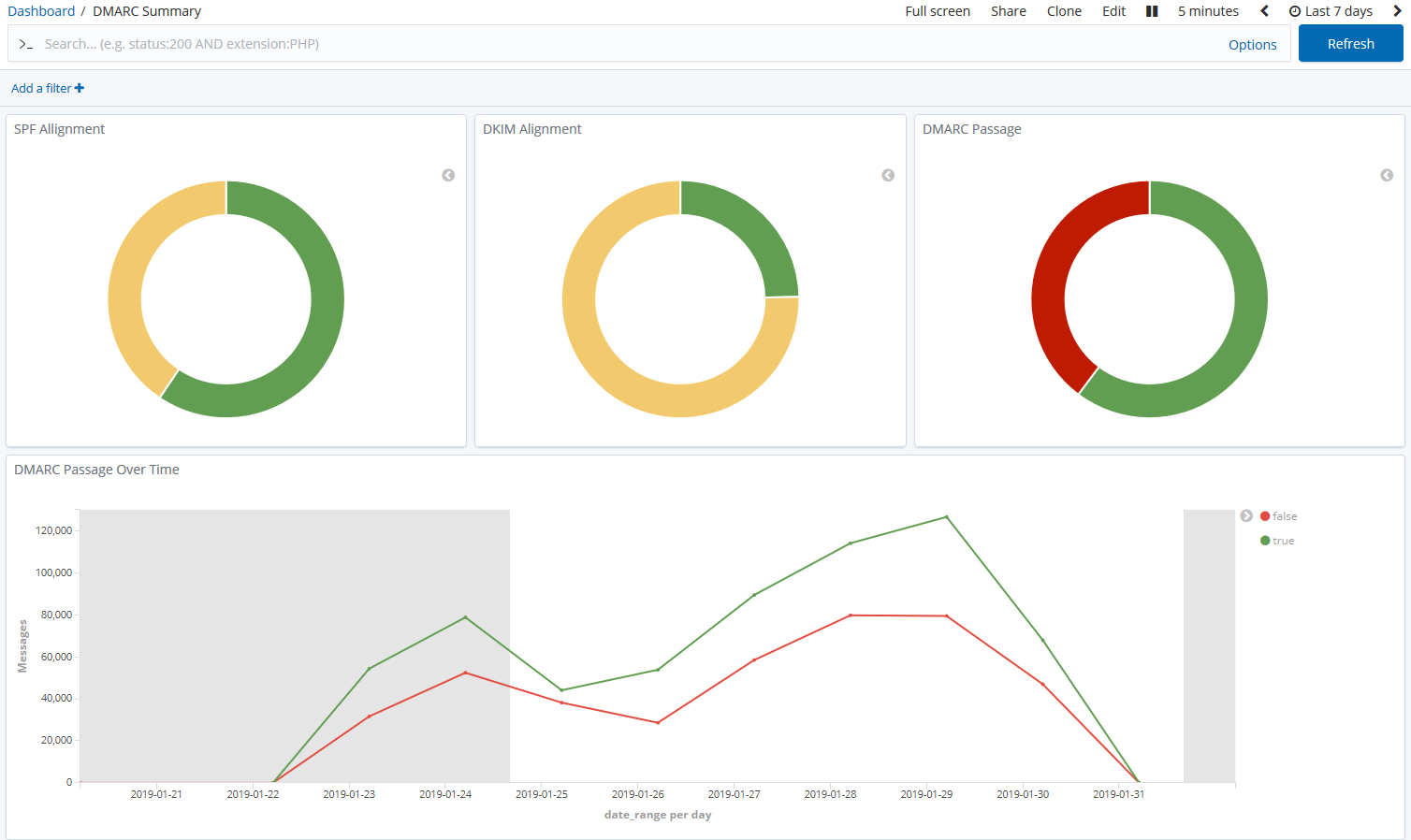
parsedmarc is a Python module and CLI utility for parsing DMARC
reports. When used with Elasticsearch and Kibana (or Splunk), it works
as a self-hosted open-source alternative to commercial DMARC report
processing services such as Agari Brand Protection, Dmarcian, OnDMARC,
ProofPoint Email Fraud Defense, and Valimail.
Note
Domain-based Message Authentication, Reporting, and Conformance (DMARC) is an email authentication protocol.
Sponsors
This is a project is maintained by one developer. Please consider sponsoring my work if you or your organization benefit from it.
Features
- Parses draft and 1.0 standard aggregate/rua DMARC reports
- Parses forensic/failure/ruf DMARC reports
- Parses reports from SMTP TLS Reporting
- Can parse reports from an inbox over IMAP, Microsoft Graph, or Gmail API
- Transparently handles gzip or zip compressed reports
- Consistent data structures
- Simple JSON and/or CSV output
- Optionally email the results
- Optionally send the results to Elasticsearch, Opensearch, and/or Splunk, for use with premade dashboards
- Optionally send reports to Apache Kafka
Python Compatibility
This project supports the following Python versions, which are either actively maintained or are the default versions for RHEL or Debian.
| Version | Supported | Reason |
|---|---|---|
| < 3.6 | ❌ | End of Life (EOL) |
| 3.6 | ❌ | Used in RHEL 8, but not supported by project dependencies |
| 3.7 | ❌ | End of Life (EOL) |
| 3.8 | ❌ | End of Life (EOL) |
| 3.9 | ❌ | Used in Debian 11 and RHEL 9, but not supported by project dependencies |
| 3.10 | ✅ | Actively maintained |
| 3.11 | ✅ | Actively maintained; supported until June 2028 (Debian 12) |
| 3.12 | ✅ | Actively maintained; supported until May 2035 (RHEL 10) |
| 3.13 | ✅ | Actively maintained; supported until June 2030 (Debian 13) |
| 3.14 | ✅ | Supported (requires imapclient>=3.1.0) |