mirror of
https://github.com/domainaware/parsedmarc.git
synced 2026-10-13 15:37:13 +00:00

 Sean WhalenandClaude Opus 4.7
180fc581fe
Sean WhalenandClaude Opus 4.7
180fc581fe
* fix: import OpenSearch dashboards into the real Global tenant

dashboard-dev-bootstrap.sh sent `securitytenant: global_tenant`. The
OpenSearch security plugin reads that header as a tenant *name*, and
`global_tenant` is a sample custom tenant from the security demo config
-- not the shared Global tenant, whose token is the literal `global`.
The import therefore landed in a separate `global_tenant` tenant (its
own `.kibana_<hash>_globaltenant_1` index) and the dashboards were
invisible to anyone viewing the Global tenant in OpenSearch Dashboards.

Verified against the live dev cluster: `_find` under `securitytenant:
global` returned 26 objects and `.kibana_1` (the Global tenant index the
UI reads) went from 2 to 67 docs after re-importing with the fix. An
empty/omitted header read 0 from Global -- it falls back to the user's
configured default tenant -- so `global` is the only reliable token.

Co-Authored-By: Claude Opus 4.7 (1M context) <noreply@anthropic.com>

* fix: don't drop report files whose names contain glob metacharacters

The CLI expanded every file argument with glob(), which treats [, ], *,
and ? as pattern syntax. A literal path like
"[Netease DMARC Failure Report] Rent Reminder.eml" -- the bracketed shape
many providers use for emailed failure reports -- was read as a character
class, matched nothing, and was dropped before reaching the parser, with
no error. File arguments that exist on disk are now taken literally; only
non-existent paths are globbed, so shell-style wildcards still expand.

Also adds "postgresql" to _KNOWN_SECTIONS so PARSEDMARC_POSTGRESQL_* env
vars (and their _FILE Docker-secret variants) resolve like every other
backend -- the PostgreSQL backend is new in 10.0.0, so this completes the
unreleased feature rather than fixing a released regression, and is
documented under the PostgreSQL enhancement, not Bug fixes.

Regression tests added for both. Verified end-to-end: all four
samples/failure/*.eml now index (the bracketed Netease report included).

Co-Authored-By: Claude Opus 4.7 (1M context) <noreply@anthropic.com>

* dev: validate dashboards on OpenSearch 3.x and add PostgreSQL to the dev stack

The dev stack ran OpenSearch Dashboards 3.x against OpenSearch 2.x, an
unsupported cross-major pairing. Bump opensearch to :3 (validated on
3.6.0: OSD import into the Global tenant and all dashboards work).

Add a postgresql service plus bootstrap wiring so the new PostgreSQL
backend is exercised alongside the others: wait for PG, seed it via
PARSEDMARC_POSTGRESQL_* env vars on the same parsedmarc run, wipe it on
RESEED, create a Grafana grafana-postgresql-datasource (uid dmarc-pg),
and import dashboards/grafana/Grafana-DMARC_Reports-PostgreSQL.json.

PG seeding is gated on psycopg being importable: parsedmarc aborts the
whole run (exit 1, nothing written to any backend) when a configured
output backend can't initialize, so wiring in PG without the optional
extra would silently zero ES/OS/Splunk too. When psycopg is absent the
script warns and skips PG, leaving the other backends seeded.

Also fix the Grafana admin password env: the container was given
GRAFANA_PASSWORD, which Grafana ignores -- it reads
GF_SECURITY_ADMIN_PASSWORD. Defaults to admin to match the script.

Co-Authored-By: Claude Opus 4.7 (1M context) <noreply@anthropic.com>

* docs: list PostgreSQL on the premade-dashboards features bullet

PostgreSQL ships a premade Grafana dashboard
(dashboards/grafana/Grafana-DMARC_Reports-PostgreSQL.json), so it belongs
on the "for use with premade dashboards" bullet alongside Elasticsearch,
OpenSearch, and Splunk rather than on the plain-output-destinations line.

Co-Authored-By: Claude Opus 4.7 (1M context) <noreply@anthropic.com>

* fix: clear stale org_email mapping conflict in the OpenSearch dashboards

The aggregate index pattern in dashboards/opensearch/opensearch_dashboards.ndjson
shipped a cached field-list snapshot where org_email was a text/object
conflict, plus leftover org_email.#text and org_email.#text.keyword
subfields. Those came from a cluster that had indexed a langAttrString
email dict ({"#text": ..., "@lang": ...}) before the parser unwrapped it.

org_email is mapped as Text() and parse_aggregate_report_xml now unwraps a
dict email to a plain string, so current data is consistently text -- a
clean cluster's _field_caps reports no conflict. Cleared the frozen
conflict and the two artifact subfields, leaving org_email (text) and
org_email.keyword, matching the live mapping.

Verified: re-importing the corrected ndjson yields an index pattern with
org_email as a plain text field and zero conflicts; only the aggregate
index-pattern line changed, all other saved objects byte-identical.

Co-Authored-By: Claude Opus 4.7 (1M context) <noreply@anthropic.com>

* dev: seed the RFC 9990 (dmarc-2.0) aggregate samples

samples/aggregate/rfc9990-sample.xml and rfc9990-example.net!...xml were
not in the bootstrap's SAMPLE_FILES, so the dev stack only ever indexed
RFC 7489 reports and the new DMARCbis fields (np, testing,
discovery_method, generator, xml_namespace) never appeared in the
OpenSearch/Kibana indices or were available to the dashboards.

Added both samples (one declares the urn:ietf:params:xml:ns:dmarc-2.0
namespace, the other is namespaceless RFC 9990-shaped, covering both
detection paths). Verified the seeded data now carries np/testing/
discovery_method/generator and xml_namespace=urn:ietf:params:xml:ns:dmarc-2.0;
OpenSearch Dashboards surfaces them on an index-pattern field-list refresh.

Co-Authored-By: Claude Opus 4.7 (1M context) <noreply@anthropic.com>

* dev: auto-resolve (or create) a venv for the seed and ensure psycopg

The seed previously required parsedmarc to be pre-installed and only
warned-and-skipped PostgreSQL when psycopg was missing. Resolve the seed
environment by precedence instead:

  1. explicit PARSEDMARC_BIN  -> used as-is, nothing installed
  2. active $VIRTUAL_ENV
  3. existing repo venv/ or .venv/
  4. otherwise create $REPO_ROOT/venv

For cases 2-4, run `pip install -e .[postgresql]` only when the CLI or
psycopg is missing, so the dev stack can populate Postgres out of the box
without a manual install step. The explicit-PARSEDMARC_BIN path is left
untouched (and the psycopg seed guard still warns/skips if that env lacks
the extra).

Verified: a RESEED run resolves the active venv, seeds ES/OS/Splunk/PG
including the RFC 9990 fields, with no output-client errors.

Co-Authored-By: Claude Opus 4.7 (1M context) <noreply@anthropic.com>

---------

Co-authored-by: Claude Opus 4.7 (1M context) <noreply@anthropic.com>
parsedmarc




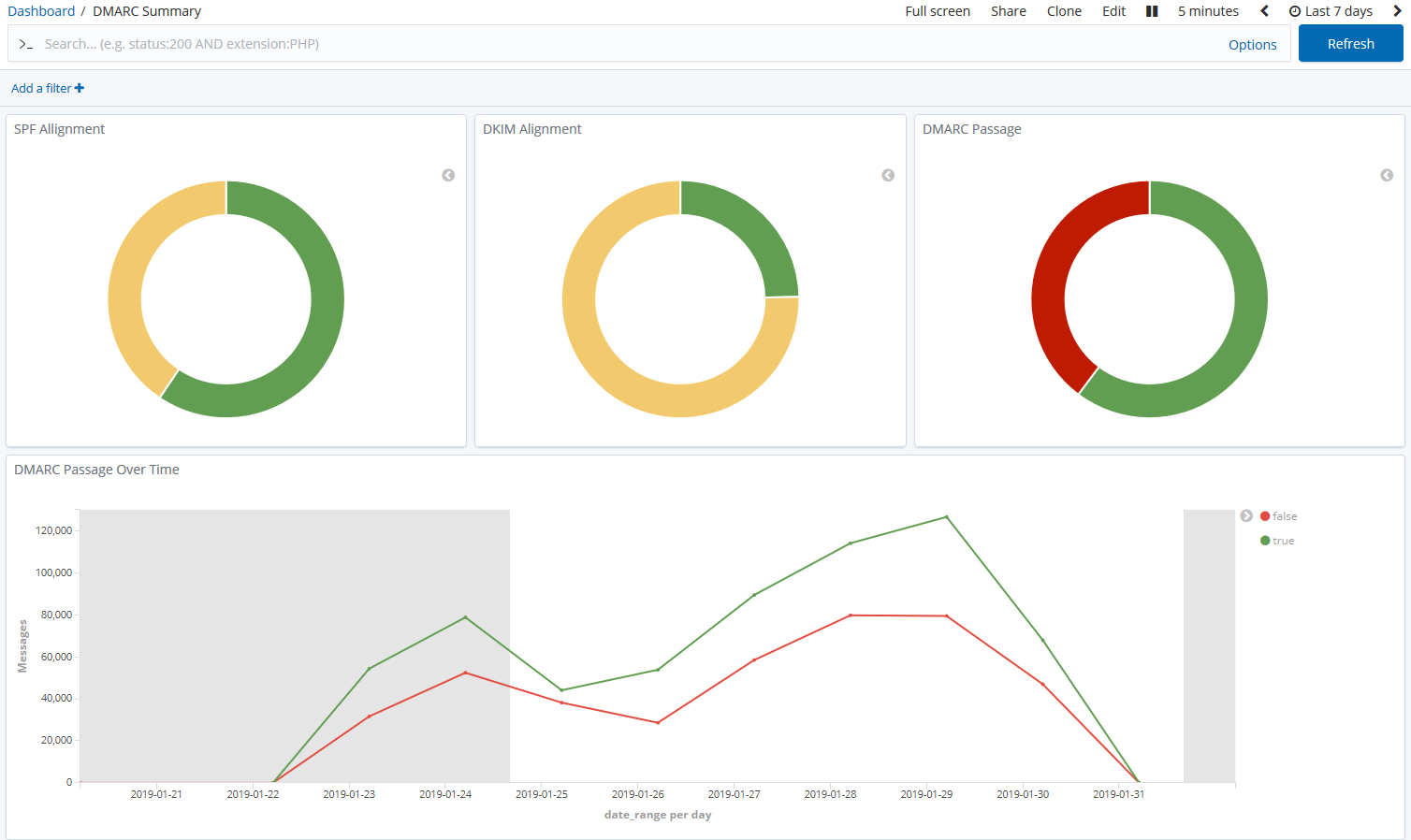
parsedmarc is a Python module and CLI utility for parsing DMARC
reports. When used with Elasticsearch and Kibana (or Splunk), it works
as a self-hosted open-source alternative to commercial DMARC report
processing services such as Agari Brand Protection, Dmarcian, OnDMARC,
ProofPoint Email Fraud Defense, and Valimail.
Note
Domain-based Message Authentication, Reporting, and Conformance (DMARC) is an email authentication protocol.
Sponsors
This is a project is maintained by one developer. Please consider sponsoring my work if you or your organization benefit from it.
Features
- Parses aggregate/rua DMARC reports: the legacy draft and 1.0 schemas (RFC 7489) and the new RFC 9990 schema for the final DMARC standard (RFC 9989)
- Parses failure/ruf DMARC reports (RFC 6591 and RFC 9991; formerly called forensic reports)
- Parses reports from SMTP TLS Reporting (TLS-RPT, RFC 8460)
- Can parse reports from an inbox over IMAP, Microsoft Graph, or Gmail API
- Transparently handles gzip or zip compressed reports
- Consistent data structures
- Simple JSON and/or CSV output
- Optionally email the results
- Optionally send the results to Elasticsearch, OpenSearch, Splunk, or PostgreSQL, for use with premade dashboards
- Optionally send the results to Apache Kafka, Amazon S3, Azure Log Analytics (Microsoft Sentinel), a Graylog (GELF) endpoint, a syslog server, or an HTTP webhook
Python Compatibility
This project supports the following Python versions, which are either actively maintained or are the default versions for RHEL or Debian.
| Version | Supported | Reason |
|---|---|---|
| < 3.6 | ❌ | End of Life (EOL) |
| 3.6 | ❌ | Used in RHEL 8, but not supported by project dependencies |
| 3.7 | ❌ | End of Life (EOL) |
| 3.8 | ❌ | End of Life (EOL) |
| 3.9 | ❌ | Used in Debian 11 and RHEL 9, but not supported by project dependencies |
| 3.10 | ✅ | Actively maintained |
| 3.11 | ✅ | Actively maintained; supported until June 2028 (Debian 12) |
| 3.12 | ✅ | Actively maintained; supported until May 2035 (RHEL 10) |
| 3.13 | ✅ | Actively maintained; supported until June 2030 (Debian 13) |
| 3.14 | ✅ | Supported (requires imapclient>=3.1.0) |