mirror of
https://github.com/domainaware/parsedmarc.git
synced 2026-10-27 13:08:53 +00:00

 Sean WhalenandClaude Fable 5
0a95a0ceb2
Sean WhalenandClaude Fable 5
0a95a0ceb2
* Upgrade ruff to 0.16.0 and pyright to 1.1.411; convert to f-strings

ruff 0.16.0 expanded the default lint rule selection well beyond the
long-standing E4/E7/E9/F, so [tool.ruff.lint] now selects the rule set
explicitly: the pre-0.16 defaults plus the modern-type-hint UP rules and
the two f-string rules (UP030/UP032). All 352 UP030/UP032 findings were
auto-fixed; conversions requiring Python 3.12 f-string quote reuse were
conservatively left as .format() by ruff (verified: the whole package and
test suite byte-compile under CPython 3.10.20, the oldest CI version).
Adopting the other newly-default rule families (BLE, SIM, C4, DTZ, I, ...)
is deferred as a deliberate per-family decision.

ruff format with 0.16.0 also now formats Python code fences in Markdown,
which reformatted one block in parsedmarc/resources/maps/AGENTS.md.

ruff check, ruff format --check, pyright (0 errors/warnings), and the
full test suite (775 passed) are green on the new versions.

Co-Authored-By: Claude Fable 5 <noreply@anthropic.com>

* Address Copilot review findings on the f-string conversion

- Rewrite messages that used backslash line continuations inside string
  literals, which embedded the source indentation as literal whitespace
  in the logged/raised text: the duplicate search-error messages in the
  Elasticsearch and OpenSearch outputs, the 'since'-option warning (which
  also implicitly concatenated "24hrs" and "SMTP" with no separator) and
  the IMAP 'since' debug line, and the missing-org_name KeyError message.
- Build the Splunk HEC newline-delimited payloads by appending to a list
  and joining once instead of quadratic string concatenation in a loop.

Declined: switching the webhook output's logger.error to
logger.exception — the single-line ERROR without a traceback is the
deliberate house pattern for batch-resilient sinks, and changing log
verbosity is out of scope for this refactor PR.

ruff check/format, pyright (0 errors/warnings), 775 tests, and a
CPython 3.10 compileall all pass.

Co-Authored-By: Claude Fable 5 <noreply@anthropic.com>

---------

Co-authored-by: Claude Fable 5 <noreply@anthropic.com>
parsedmarc




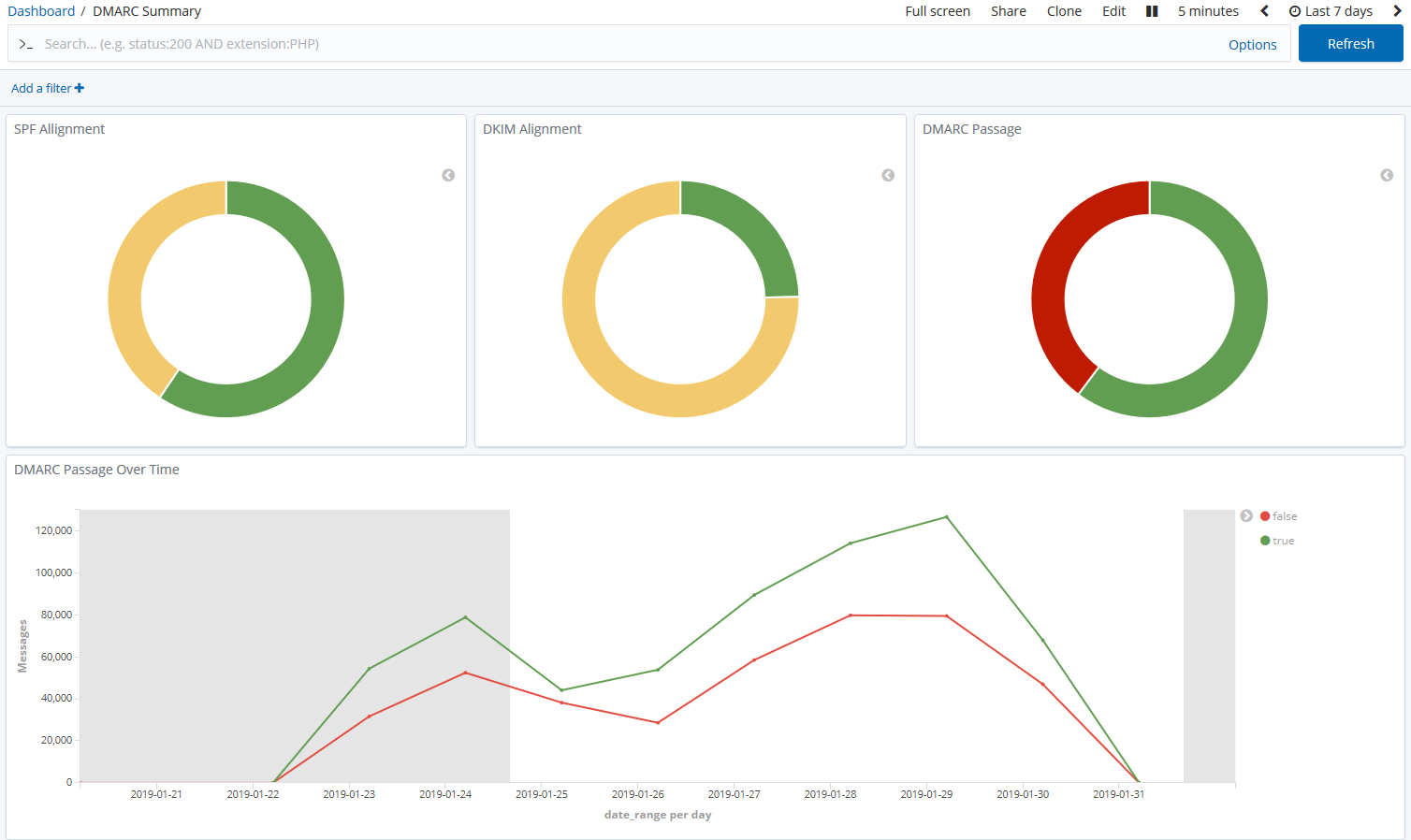
parsedmarc is a Python module and CLI utility for parsing DMARC
reports. When used with Elasticsearch and Kibana (or Splunk), it works
as a self-hosted open-source alternative to commercial DMARC report
processing services such as Agari Brand Protection, Dmarcian, OnDMARC,
ProofPoint Email Fraud Defense, and Valimail.
Note
Domain-based Message Authentication, Reporting, and Conformance (DMARC) is an email authentication protocol.
Sponsors
This project is maintained by one developer. Please consider sponsoring my work if you or your organization benefit from it.
Features
- Parses aggregate/rua DMARC reports: the legacy draft and 1.0 schemas (RFC 7489) and the new RFC 9990 schema for the final DMARC standard (RFC 9989)
- Parses failure/ruf DMARC reports (RFC 6591 and RFC 9991; formerly called forensic reports)
- Parses reports from SMTP TLS Reporting (TLS-RPT, RFC 8460)
- Can parse reports from an inbox over IMAP, Microsoft Graph, or Gmail API
- Transparently handles gzip or zip compressed reports
- Consistent data structures
- Simple JSON and/or CSV output
- Optionally email the results
- Optionally send the results to Elasticsearch, OpenSearch, Splunk, or PostgreSQL, for use with premade dashboards
- Optionally send the results to Apache Kafka, Amazon S3, Azure Log Analytics (Microsoft Sentinel), a Graylog (GELF) endpoint, a syslog server, or an HTTP webhook
Python Compatibility
This project supports the following Python versions, which are either actively maintained or are the default versions for RHEL or Debian.
| Version | Supported | Reason |
|---|---|---|
| < 3.6 | ❌ | End of Life (EOL) |
| 3.6 | ❌ | Used in RHEL 8, but not supported by project dependencies |
| 3.7 | ❌ | End of Life (EOL) |
| 3.8 | ❌ | End of Life (EOL) |
| 3.9 | ❌ | Used in Debian 11 and RHEL 9, but not supported by project dependencies |
| 3.10 | ✅ | Actively maintained |
| 3.11 | ✅ | Actively maintained; supported until June 2028 (Debian 12) |
| 3.12 | ✅ | Actively maintained; supported until May 2035 (RHEL 10) |
| 3.13 | ✅ | Actively maintained; supported until June 2030 (Debian 13) |
| 3.14 | ✅ | Supported (requires imapclient>=3.1.0) |