mirror of
https://github.com/domainaware/parsedmarc.git
synced 2026-10-24 03:28:58 +00:00

 Sean WhalenandClaude Fable 5.1
09c88ca2a3
Sean WhalenandClaude Fable 5.1
09c88ca2a3
* Harden failure-report sample filenames and cap decompressed report size

Fixes the two open security advisories.

GHSA-c284-w5m6-jhjm (path traversal, affects 9.0.6 through 11.0.0):
save_output() named each failure report's message sample after the
sample's Subject header, falling back to the raw subject whenever
sanitizing it produced an empty string. A subject of only path
separators and dots -- "../../../" or "/" -- sanitizes to "", so the raw
value reached os.path.join() and the .eml landed outside the samples
directory or at an absolute path. That subject comes from a message that
failed authentication, so any sender a monitored mailbox accepts
controls it. The name is now sanitized at write time and falls back to
"sample", and the caller-supplied filename_safe_subject key is no longer
trusted. get_filename_safe_string() also strips NUL (which would
otherwise make open() raise ValueError: embedded null byte and hold back
the whole mailbox batch), truncates before stripping trailing
characters, and strips trailing spaces along with trailing dots, since
Windows drops both when creating a file; its docstring now states the
guarantees callers depend on.

GHSA-43qf-f35w-2x4r (unbounded decompression, affects all versions
through 11.0.0): extract_report() inflated gzip with one unbounded
zlib.decompress() and read zip members with an unbounded .read(). The
attachment's content is chosen by its sender, and deflate reaches about
1000:1 on degenerate input, so a 100 KB attachment inflated to 100 MB
with a ~209 MiB peak. Extraction now stops at
MAX_DECOMPRESSED_REPORT_SIZE (100 MiB) and raises ParserError. The gzip
path moves to a zlib.decompressobj() bounded by max_length, which does
not raise on a stream that ends early the way the one-shot call did, so
the helper checks decompressor.eof itself; a stream with trailing bytes
after the gzip member still extracts, matching the old behavior. Both
behaviors were observed against the unmodified code first and are
pinned by tests.

Co-Authored-By: Claude Fable 5.1 <noreply@anthropic.com>

* Strip NUL from CSV fields so Python 3.10's csv writer accepts them

Python 3.10's csv writer raises _csv.Error: need to escape, but no
escapechar set on any field containing NUL (CPython issue 97503, a 3.10
regression fixed in 3.11+). Failure report text fields (subject, user
agent, authentication results, addresses, etc.) come from untrusted
mail, so a NUL byte in one made parsed_failure_reports_to_csv() -- and
therefore save_output() -- raise on 3.10, which the CLI's
except (OSError, ValueError) around save_output does not catch. NUL is
now stripped from every CSV field on all Python versions via a shared
_csv_safe() helper, applied in all three CSV writers, so output is
identical regardless of interpreter version.

Co-Authored-By: Claude Fable 5.1 <noreply@anthropic.com>

* 11.0.1 release: bump version and finalize changelog

Co-Authored-By: Claude Fable 5.1 <noreply@anthropic.com>

---------

Co-authored-by: Claude Fable 5.1 <noreply@anthropic.com>
parsedmarc




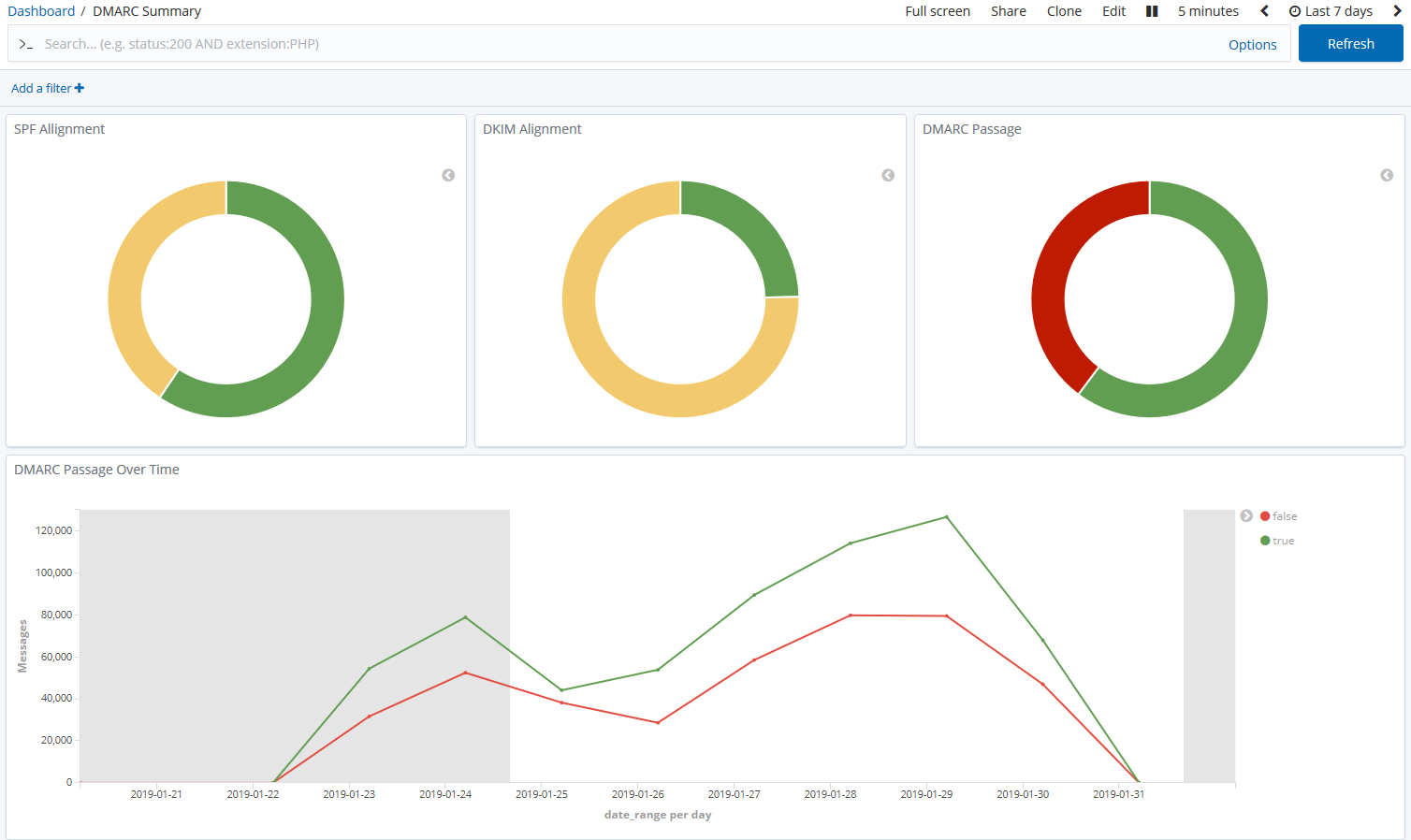
parsedmarc is a Python module and CLI utility for parsing DMARC
reports. When used with Elasticsearch and Kibana (or Splunk), or with
OpenSearch and Grafana, it works as a self-hosted open-source
alternative to commercial DMARC report processing services such as
Agari Brand Protection, Dmarcian, OnDMARC, ProofPoint Email Fraud
Defense, and Valimail.
Note
Domain-based Message Authentication, Reporting, and Conformance (DMARC) is an email authentication protocol.
Sponsors
This project is maintained by one developer. Please consider sponsoring my work if you or your organization benefit from it.
Features
- Parses aggregate/rua DMARC reports: the legacy draft and 1.0 schemas (RFC 7489) and the new RFC 9990 schema for the final DMARC standard (RFC 9989)
- Parses failure/ruf DMARC reports (RFC 6591 and RFC 9991; formerly called forensic reports)
- Parses reports from SMTP TLS Reporting (TLS-RPT, RFC 8460)
- Can parse reports from an inbox over IMAP, Microsoft Graph, or Gmail API
- Transparently handles gzip or zip compressed reports
- Consistent data structures
- Simple JSON and/or CSV output
- Optionally email the results
- Optionally send the results to Elasticsearch, OpenSearch, Splunk, or PostgreSQL, for use with premade dashboards
- Optionally send the results to Apache Kafka, Amazon S3, Azure Log Analytics (Microsoft Sentinel), a Graylog (GELF) endpoint, a syslog server, or an HTTP webhook
Python Compatibility
This project supports the following Python versions, which are either actively maintained or are the default versions for RHEL or Debian.
| Version | Supported | Reason |
|---|---|---|
| < 3.6 | ❌ | End of Life (EOL) |
| 3.6 | ❌ | Used in RHEL 8, but not supported by project dependencies |
| 3.7 | ❌ | End of Life (EOL) |
| 3.8 | ❌ | End of Life (EOL) |
| 3.9 | ❌ | Used in Debian 11 and RHEL 9, but not supported by project dependencies |
| 3.10 | ✅ | Actively maintained |
| 3.11 | ✅ | Actively maintained; supported until June 2028 (Debian 12) |
| 3.12 | ✅ | Actively maintained; supported until May 2035 (RHEL 10) |
| 3.13 | ✅ | Actively maintained; supported until June 2030 (Debian 13) |
| 3.14 | ✅ | Supported (requires imapclient>=3.1.0) |