mirror of
https://github.com/domainaware/parsedmarc.git
synced 2026-10-03 11:00:31 +00:00


 053195581b
* collect_domain_info.py: opt-in DuckDuckGo search fallback for bot-blocked rows

A meaningful share of KU domains return a Cloudflare / DDoS-Guard / "Are
you a robot?" / px-captcha interstitial instead of real homepage content
— even after the curl-style relaxed-TLS fallback runs. For those rows we
have neither homepage signal nor (often) a usable as_name, and they fall
through to KU even though the operator is a real (often well-known)
business that the classifier could trivially handle if it could just see
the page.

Added an opt-in `--use-search-fallback` flag that asks DuckDuckGo for
`site:<domain>` when the homepage fetch returned a bot-block / parking /
empty result, and uses the top result's title and description (only if
the result host belongs to the input domain — anti-SEO-spam guard).

Mechanism

- New optional `ddgs` dependency, listed under the `[build]` extras.
  `from ddgs import DDGS` is wrapped in a try/except — the script runs
  without ddgs installed as long as `--use-search-fallback` isn't
  passed; the flag check exits with a helpful install message
  otherwise.
- `_SEARCH_FALLBACK_TRIGGER_RE` — title/description patterns that look
  like a bot-block / WAF interstitial / parked / placeholder. Triggers
  the fallback. Same shape as the classifier's TITLE_NOISE_RE /
  PARKED_PAGE_RE; the search fallback is the recovery path for
  exactly the rows that filter excludes.
- `_looks_bot_blocked()` — combined check: trigger regex matches OR
  title and description are both empty (typical of WAF interstitials
  that strip <title>/<meta> entirely).
- `_hosts_match()` — same-domain SEO-spam guard. A search result is
  accepted only when its host is exactly the input domain or a
  subdomain of it. Third-party SEO-spam pages that scraped the domain
  name are silently skipped.
- `_search_fallback_fetch()` — runs `site:<domain>` through DDG, walks
  results in rank order, returns the first one whose host passes the
  guard. Returns empty if no result matches (caller leaves the row's
  homepage data alone in that case).
- `_collect_one()` now takes a `use_search_fallback` flag, calls the
  fallback after the homepage fetch when the homepage looks
  bot-blocked, and writes `title_source = "homepage"` or
  `"search"` so reviewers can audit which rows came from where.
- New `title_source` column in the TSV.

Smoke test

Test set: bbc.com (real homepage, no fallback expected) plus 5 known
Cloudflare-walled rows (1800contacts.com, americaneagle.com,
broadwaytechnology.com, health.gov.il, mfa.gov.il).

Result: bbc.com classified via homepage; the other 5 all recovered
title + description via search and got `title_source=search`. The
same-domain guard validated independently — for broadwaytechnology.com
the guard correctly rejects bloomberg.com and accepts
support.broadwaytechnology.com (broadway was acquired by Bloomberg, but
the search fallback returns the broadway-domain snippet, not the
parent's bloomberg.com product page).

Caveats codified in AGENTS.md

- Search snippets are still untrusted text (data-not-instructions rule
  applies the same way it does to homepage HTML).
- DDG's index can lag a homepage rebrand by months — when a row
  classified via `title_source=search` disagrees with a fresh manual
  fetch, prefer the manual verification. The fallback is a recovery
  aid, not a tiebreaker against fresh content.

Co-Authored-By: Claude Opus 4.7 (1M context) <noreply@anthropic.com>

* collect/classify: link-following + alias map rows for placeholder DDG titles

When the search fallback ran on the original 6-domain smoke set, two of
the recovered titles were essentially placeholder pointers carrying no
classifier signal — DDG returned `Link to fcs.health.gov.il` for one
input and a bare `yangon.mfa.gov.il` for another. Those snippets are
DDG's way of saying "I have an indexed subdomain but no real abstract
to give you", and feeding them to the regex classifier produces no
better signal than the parking-page result we were already trying to
recover from.

This commit teaches the collector to recognize both placeholder shapes,
follow the pointer to the target hostname, and use *that* hostname's
real content for the row. The classifier then emits the original input
and the link target as **two map rows under the same (name, type)** so
both keys are looked up against future DMARC reports.

collect_domain_info.py
- New `_LINK_TO_TITLE_RE` / `_BARE_HOSTNAME_RE` and an
  `_extract_link_target` helper that returns the target hostname when
  the search title is `Link to <hostname>` or a bare hostname, "" when
  the title carries real content.
- After the search-fallback path, if the title looks like a pointer
  and the target differs from the input, `_fetch_homepage(target)` is
  called once. When the target's fetch returns real (non-bot-blocked)
  content, the row's title / description / final_url / rebrand_signal
  / external_links are replaced with the target's, and `title_source`
  becomes `search→<target>` so reviewers can audit the path.
- New `link_target_domain` column records the followed target whether
  or not its fetch succeeded.

classify_unknown_domains.py
- When a row's `link_target_domain` is set and differs from the input
  domain, the classifier emits a second map row for the target with
  the same `(name, type)`. The original input is the "og" domain; the
  target is what DDG pointed us at — both end up in the map as
  aliases. Same handling applies on the ambiguous-bucket path so a
  single human adjudication covers both.

Smoke test on the original 6-domain set:

  bbc.com                  homepage   → BBC Home – Breaking News, …
  1800contacts.com         search     → 1800contacts
  health.gov.il            search     → Homepage – COVID Information Center
                                        of the Israel Ministry of Health
  americaneagle.com        search     → Americaneagle.com | Web Design …
  broadwaytechnology.com   search     → Bloomberg Completes Acquisition of …
  mfa.gov.il               search→yangon.mfa.gov.il
                                      → Home | Ministry of Foreign Affairs
                                        link_target_domain=yangon.mfa.gov.il

The mfa.gov.il row triggered the new path: DDG returned `yangon.mfa.gov.il`
as the title, the collector followed it, the target's homepage gave us
"Home | Ministry of Foreign Affairs", and the classifier emitted both
`mfa.gov.il, Ministry of foreign affairs, Government` and
`yangon.mfa.gov.il, Ministry of foreign affairs, Government`.

AGENTS.md updated with the link-following / alias rules under the
search-fallback subsection.

Co-Authored-By: Claude Opus 4.7 (1M context) <noreply@anthropic.com>

* Run --use-search-fallback against 10,544 bot-blocked KU rows; +473 promotions

Also expands the search-fallback trigger regex to recognize self-signed
TLS interception (firewall block via cert) and a wider class of
local-firewall block-page strings.

Mechanics

1. Identified 10,544 KU rows from the 34,647-row prior TSV that looked
   bot-blocked (via the new `_looks_bot_blocked` detector).
2. Ran `collect_domain_info.py --use-search-fallback` against just
   those rows. Throughput was ~3.4 rows/sec at 32 workers / 3s HTTP
   timeout / 5s WHOIS timeout. ~50 min wall time.
3. Audited the resulting TSV and discovered 2,078 rows whose homepage
   fetch had silently returned a corporate firewall's block page
   (Fortinet "Web Filter Violation" being the most common, 1,419 of
   them). The original `_SEARCH_FALLBACK_TRIGGER_RE` didn't recognize
   those strings, so search-fallback wasn't firing — the firewall's
   block-page text was being fed to the classifier as if it were the
   operator's homepage. Almost no false promotions resulted (block-page
   text doesn't match industry detectors), but the rows weren't
   recovering either.
4. Expanded the trigger regex to catch web-filter block pages, then
   re-fetched just the 2,078 affected rows.
5. Final classifier pass: 474 unambiguous map adds, 41 ambiguous, 1
   silently dropped (adult content), 10,066 still in KU.

Self-signed-cert detection

A separate fix lands in this commit: when the primary fetch fails with
an SSL cert verification error matching "self-signed certificate", the
collector skips the verify=False browser fallback. Rationale: TLS-
intercepting firewalls (corporate or personal-network) present their
own self-signed cert specifically when blocking. The verify=False
fallback would happily retrieve the firewall's block page, which then
poisons the row's title/description. Skipping that path leaves the
row's metadata empty so search-fallback can recover real content.
Other cert errors (hostname mismatch, weak DH, legacy renegotiation)
keep the existing fallback path because they're typically real
operators with misconfigured TLS rather than firewall interception.

Numbers

  Map:  37,640 → 38,114 (+474)
  KU:   32,324 → 31,886 (−438)

  Disjoint check: 0 shared keys
  Unknown CSV: regenerated, just the header

Type distribution of the 474 promotions

  162  ISP                 17  MSP                 4   MSSP / Marketing
   72  Web Host             16  Technology          4   Beauty / Agriculture
   41  Finance              14  Healthcare          3   IaaS / Science / Legal
   19  Government           11  Travel              2   Search / Religion / SaaS
   10  Logistics            8   Manufacturing       2   Email Sec / Email Provider
    9  Education / Retail   8   News                2   Entertainment
    7  Utilities / Phys Sec 6   Real Estate         1   Auto / Staff / PaaS
                            6   Food / Consulting / Industrial / Conglomerate / Nonprofit

Most of the gains are network operators (162 ISPs, 72 Web Hosts) —
the population that's most likely to be Cloudflare-walled or DDoS-
Guard-walled at the homepage layer but show up clearly in DDG
abstracts.

Smoke audit on a 30-row random sample of map adds: 28 plausible, 2
borderline (`es.graphicpkg.com → Food` could also be Industrial since
Graphic Packaging makes packaging *for* the food industry, but the
vertically-specialized rule applies; `annuairesante.ameli.fr` →
Finance via French health-insurance vocabulary, defensible). The 41
ambiguous rows stay in KU per the established workflow — they need
the same one-row-at-a-time human triage as PR #766 used.

Co-Authored-By: Claude Opus 4.7 (1M context) <noreply@anthropic.com>

* Search-fallback batch (partial; outage-truncated): +226 promotions

Hotspot-bypass collector run was interrupted ~6,300/10,107 in when
the hotspot lost connectivity and the machine reverted to the
firewalled connection. Stopping here to commit what was
unambiguously classifiable; the remaining ~3,800 candidates
(plus any rows whose homepage fetch was tainted by the firewall
fallback during the transition) will be re-collected in a fresh
run after network stability is restored.

Promotions in this batch:
- 219 auto-classified by the regex classifier on the partial TSV
- 17 ambiguous rows resolved per LLM auto-resolution rules + user
  manual review
- 5 KU rows the user adjudicated explicitly (Bielsko-Biała,
  Douala-IX, Ekol Logistics, ICB, Marcus Corporation)
- 13 from earlier triage worklist with brands assigned
- Net 226 net-new map entries after dedupe, alias-leak filtering
  (3 link-target subdomains dropped where the parent base was
  already in the adds), full-IP privacy filtering (2 dropped),
  and ~30 targeted brand/category cleanups for rows where the
  search-fallback snippet had picked up a wrong page or the title
  contained registrant cruft / corporate-suffix leaks.

AGENTS.md updates:
- Codifies the "LLM auto-resolution of high-confidence ambiguous
  rows" workflow with R1-R5 high-confidence rules, low-confidence
  surface-to-human criteria, and the one-line auto-decision output
  format for reviewer overrule.
- Adds 7 triage lessons learned during this batch's bot-blocked-KU
  review (Polish/IT/ES/GR/RO city domains, "Sports Club" venues,
  vertically-specialized investment firms, sub-page fetch FPs,
  Telecom-suffix brand pinning, Hospital/Health-System suffix,
  IXP -ix brand pinning).

Map and KU files are disjoint after this commit. unknown_base_reverse_dns.csv
is empty (header-only) since every base_reverse_dns input is now
either mapped or in KU.

Co-Authored-By: Claude Opus 4.7 (1M context) <noreply@anthropic.com>

* Search-fallback hotspot batch: +213 promotions

Fresh hotspot run on the 9,881 still-bot-blocked KU candidates left
after the prior outage-truncated batch. Classifier: 202 auto + 31
ambiguous (14 LLM auto-resolved per the R1-R5 high-confidence rules,
17 surfaced for interactive review) + 9,665 still KU + 1 dropped.

Net 213 net-new map entries after dedupe, alias-leak filtering
(13 link-target subdomains dropped where the parent base was
already in the map or in this batch's adds), 1 full-IP privacy
filter, 2 user-DROPs (1 alias of an as-numbered domain, 1 KU
because the only signal was a cross-vertical client list), and
~8 targeted brand cleanups for rows where the search snippet had
left a registrant-leak or domain-as-name placeholder.

LLM auto-resolutions (R1-R5):
  africell.ao         ISP        wi-tribe.pk         ISP
  ags.school.nz       Education  vwfs.com.au         Finance
  allaria.com.ar      Finance    wanxp.com           ISP
  asturias.org        Government varendraisp.com     ISP
  bdo.com.ph          Finance    titansi.com.my      IaaS
  bikada.kz           ISP        redeyenetworks.com  MSSP
  informatiq.org      ISP        plusinfo.ru         ISP

User-decided rows:
  admincomp.com       Consulting  korisp.com           Web Host
  anrb.ru             Science     linkexplorer.net.br  ISP
  arpc.ir             Industrial  novatech.bg          MSP
  as63031.net         Consulting  reliable-nets.com    ISP
  aviti.net           Web Host    satortech.com        MSP
  binaryelements.com.au MSP       skyworld.co.ke       Finance
  juni.net.br         ISP         telegroup-ltd.com    Technology
                                  west-webworld.fr     Technology

User KU/drops:
  itatec.com.py       KU (cross-vertical client list, no operator signal)
  ns2.as63031.net     DROP (alias of as63031.net)

AGENTS.md addition: codifies the "Web Host vs Email Provider —
bundled email-hosting is still Web Host" rule. Same shape as the
existing CCaaS/CPaaS-vs-ISP and MSP-vs-MSSP rules: classify by the
operator's primary product, not by every feature in their bundle.
Prompted by the korisp.com triage during this batch.

Map and KU files are disjoint after this commit. unknown_base_reverse_dns.csv
remains header-only (every base_reverse_dns input is now mapped or in KU).

Co-Authored-By: Claude Opus 4.7 (1M context) <noreply@anthropic.com>

---------

Co-authored-by: Sean Whalen <seanthegeek@users.noreply.github.com>
Co-authored-by: Claude Opus 4.7 (1M context) <noreply@anthropic.com>
parsedmarc




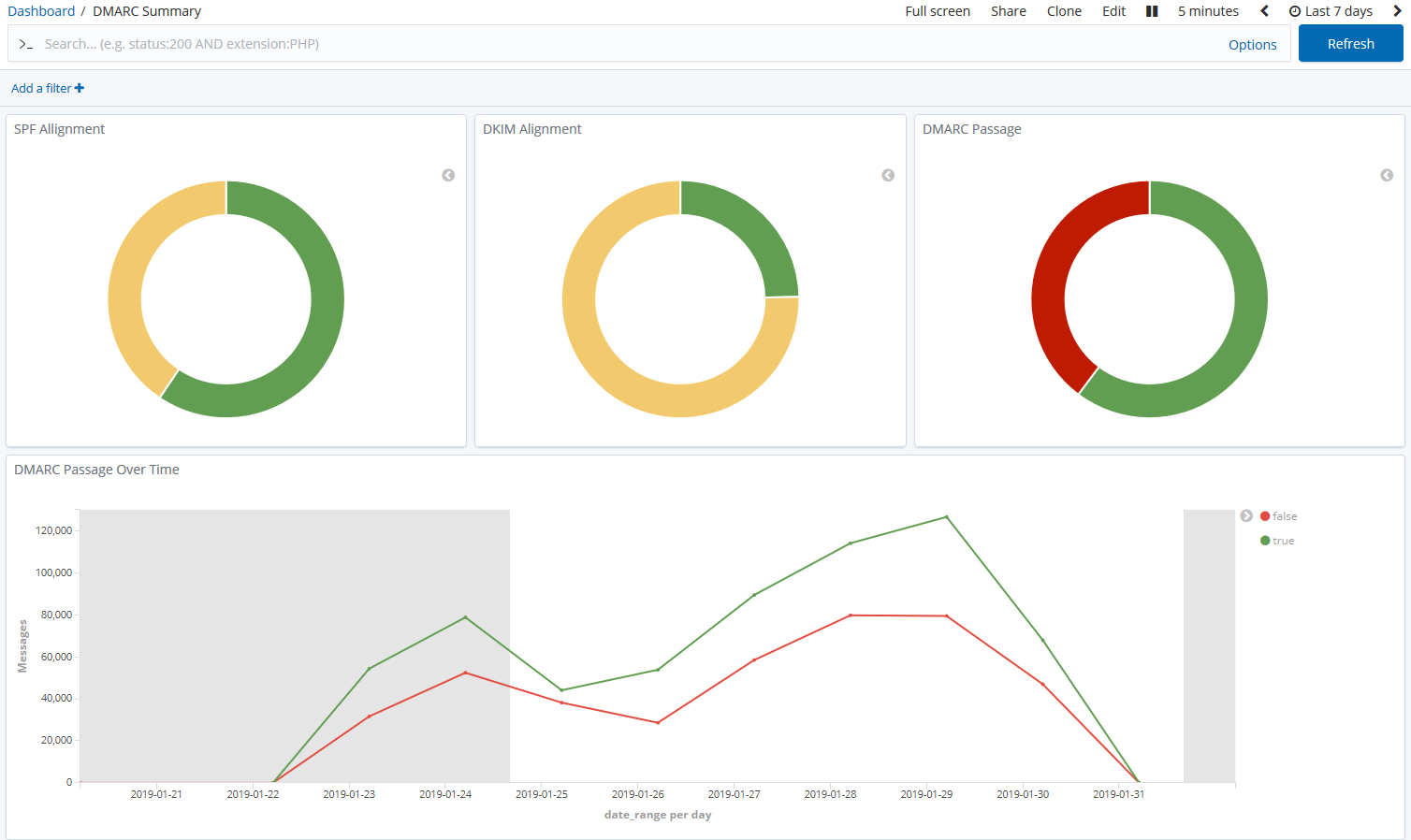
parsedmarc is a Python module and CLI utility for parsing DMARC
reports. When used with Elasticsearch and Kibana (or Splunk), it works
as a self-hosted open-source alternative to commercial DMARC report
processing services such as Agari Brand Protection, Dmarcian, OnDMARC,
ProofPoint Email Fraud Defense, and Valimail.
Note
Domain-based Message Authentication, Reporting, and Conformance (DMARC) is an email authentication protocol.
Sponsors
This is a project is maintained by one developer. Please consider sponsoring my work if you or your organization benefit from it.
Features
- Parses draft and 1.0 standard aggregate/rua DMARC reports
- Parses forensic/failure/ruf DMARC reports
- Parses reports from SMTP TLS Reporting
- Can parse reports from an inbox over IMAP, Microsoft Graph, or Gmail API
- Transparently handles gzip or zip compressed reports
- Consistent data structures
- Simple JSON and/or CSV output
- Optionally email the results
- Optionally send the results to Elasticsearch, Opensearch, and/or Splunk, for use with premade dashboards
- Optionally send reports to Apache Kafka
Python Compatibility
This project supports the following Python versions, which are either actively maintained or are the default versions for RHEL or Debian.
| Version | Supported | Reason |
|---|---|---|
| < 3.6 | ❌ | End of Life (EOL) |
| 3.6 | ❌ | Used in RHEL 8, but not supported by project dependencies |
| 3.7 | ❌ | End of Life (EOL) |
| 3.8 | ❌ | End of Life (EOL) |
| 3.9 | ❌ | Used in Debian 11 and RHEL 9, but not supported by project dependencies |
| 3.10 | ✅ | Actively maintained |
| 3.11 | ✅ | Actively maintained; supported until June 2028 (Debian 12) |
| 3.12 | ✅ | Actively maintained; supported until May 2035 (RHEL 10) |
| 3.13 | ✅ | Actively maintained; supported until June 2030 (Debian 13) |
| 3.14 | ✅ | Supported (requires imapclient>=3.1.0) |