 stumpylog
8780bcd5c7
stumpylog
8780bcd5c7
bulk_edit.set_permissions and BulkEditObjectPermissionsView both
looped documents/objects and called set_permissions_for_object per
object, which itself calls guardian's assign_perm/remove_perm once
per (object, user) pair -- ~10-20+ queries per object, scaling with
selection size.

Added set_permissions_for_objects, a bulk equivalent that resolves
existing permission holders once across the whole batch (not once per
object) and applies changes with a small, batch-size-independent
number of queries per action instead of one per (object, user) pair.

Deliberately does not use guardian's queryset-aware assign_perm:
passing a list as the target routes to bulk_assign_perm, which skips
creating a direct permission row for anyone who already has the
permission via ANY group membership (checked via
ObjectPermissionChecker.has_perm, which is group-inheritance-aware) --
unlike the single-object assign_perm this replaces, which always
ensures a direct row via get_or_create. Losing that guarantee would
mean a later revocation of the group's grant silently strips access
an admin explicitly asked to be direct. Bulk-creates rows straight
against UserObjectPermission/GroupObjectPermission instead
(ignore_conflicts=True, relying on the existing (identity, permission,
object_pk) unique constraint), which preserves the original semantics
exactly while still batching every object and identity into one query
per action. Also raises Permission.DoesNotExist for an unrecognized
action name instead of silently no-op-ing, matching the original
per-object path -- BulkEditObjectsSerializer never actually validates
action keys against the raw client-supplied permissions dict, so this
is reachable from client input, not just internal callers.

Verified via CaptureQueriesContext: query count is now identical at 5
vs. 50 documents/objects (was 1,123 queries for 20 documents on the
Document path, 2,806 for 50 tags on the BulkEditObjectPermissionsView
path, both now flat). Full documents test suite green (2,148 passed,
1 skipped).





Paperless-ngx
Paperless-ngx is a document management system that transforms your physical documents into a searchable online archive so you can keep, well, less paper.
Paperless-ngx is the official successor to the original Paperless & Paperless-ng projects and is designed to distribute the responsibility of advancing and supporting the project among a team of people. Consider joining us!
Thanks to the generous folks at DigitalOcean, a demo is available at demo.paperless-ngx.com using login demo / demo. Note: demo content is reset frequently and confidential information should not be uploaded.
This project is supported by:

Features
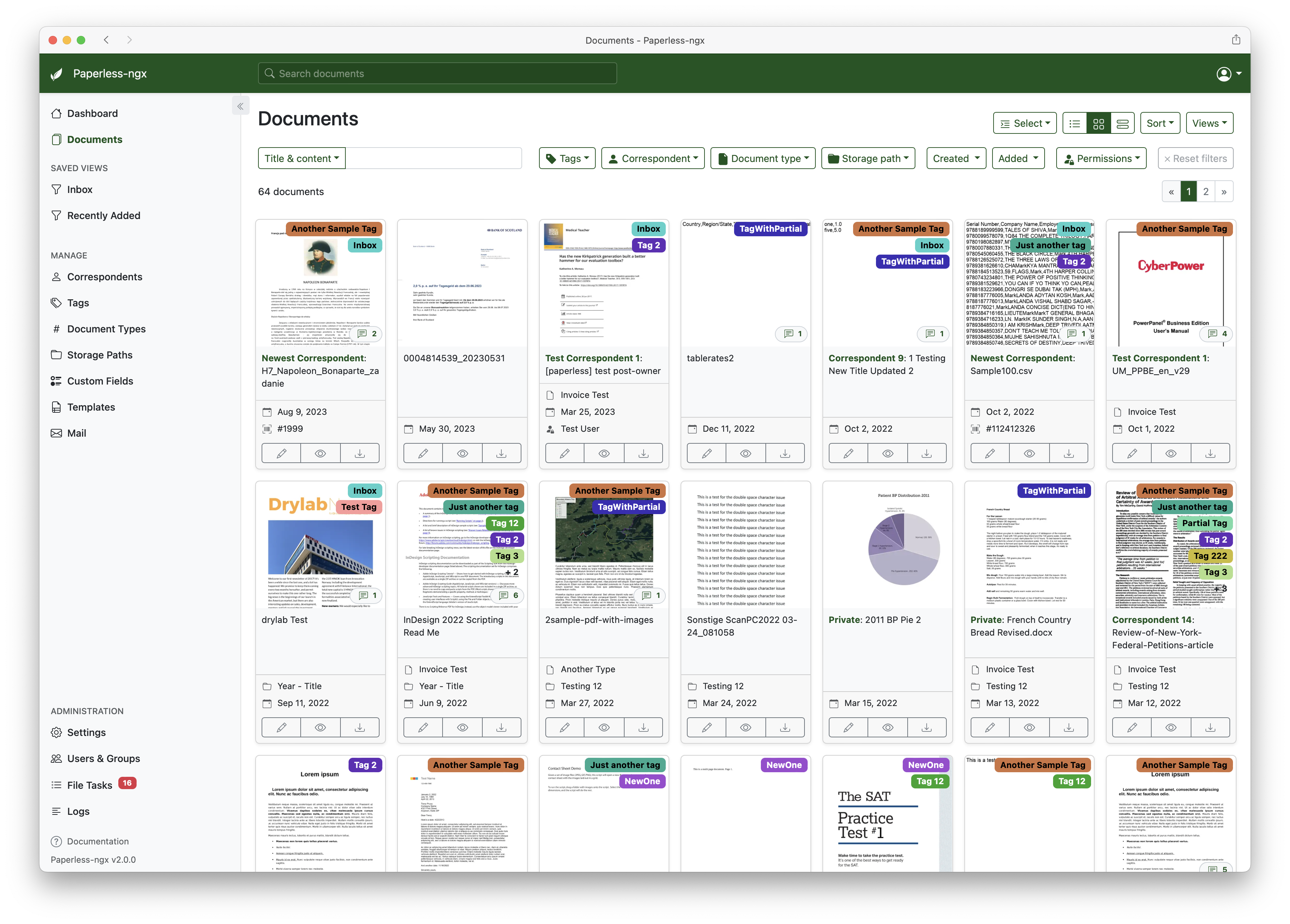
A full list of features and screenshots are available in the documentation.
Getting started
The easiest way to deploy paperless is docker compose. The files in the /docker/compose directory are configured to pull the image from the GitHub container registry.
If you'd like to jump right in, you can configure a docker compose environment with our install script:
bash -c "$(curl -L https://raw.githubusercontent.com/paperless-ngx/paperless-ngx/main/install-paperless-ngx.sh)"
More details and step-by-step guides for alternative installation methods can be found in the documentation.
Migrating from Paperless-ng is easy, just drop in the new docker image! See the documentation on migrating for more details.
Documentation
The documentation for Paperless-ngx is available at https://docs.paperless-ngx.com.
Contributing
If you feel like contributing to the project, please do! Bug fixes, enhancements, visual fixes etc. are always welcome. If you want to implement something big: Please start a discussion about that! The documentation has some basic information on how to get started.
Community Support
People interested in continuing the work on paperless-ngx are encouraged to reach out here on github and in the Matrix Room. If you would like to contribute to the project on an ongoing basis there are multiple teams (frontend, ci/cd, etc) that could use your help so please reach out!
Translation
Paperless-ngx is available in many languages that are coordinated on Crowdin. If you want to help out by translating paperless-ngx into your language, please head over to https://crowdin.com/project/paperless-ngx, and thank you! More details can be found in CONTRIBUTING.md.
Feature Requests
Feature requests can be submitted via GitHub Discussions, you can search for existing ideas, add your own and vote for the ones you care about.
Bugs
For bugs please open an issue or start a discussion if you have questions.
Related Projects
Please see the wiki for a user-maintained list of related projects and software that is compatible with Paperless-ngx.
Important Note
Document scanners are typically used to scan sensitive documents like your social insurance number, tax records, invoices, etc. Paperless-ngx should never be run on an untrusted host because information is stored in clear text without encryption. No guarantees are made regarding security (but we do try!) and you use the app at your own risk. The safest way to run Paperless-ngx is on a local server in your own home with backups in place.