
 stumpylogandClaude Sonnet 5
7372cdaf6b
stumpylogandClaude Sonnet 5
7372cdaf6b
vec0 only inlines TEXT metadata up to 12 bytes (sqlite-vec.c); modified
is an ISO timestamp (e.g. "2026-07-28T12:34:56.789012+00:00", 32 chars),
always over that threshold, so every read of it recompiled and stepped a
fresh SQL statement per row -- uncached, on every full scan
(get_modified_times(), every compact(), every structural migration). It
was also never filtered on inside a KNN query, so it never needed to be
a vec0 column in the first place.

Add document_meta(document_id INTEGER PRIMARY KEY, modified TEXT), one
row per document rather than per chunk (all of a document's chunks share
the same modified value). get_modified_times() drops its per-chunk dedup
loop entirely as a result -- one row read per document, not per chunk.
No separate index needed here (unlike document_chunks): document_id
being the INTEGER PRIMARY KEY makes it the table's own rowid, and every
access pattern is already keyed by it directly.

Schema bump to v3 (m0002), backfilling document_meta from the old vec0
column for existing stores. Along the way:
- _Row/_Vec0Params (NamedTuple) replace bare positional tuples for node
  rows and vec0 bind parameters -- still plain tuples as far as
  sqlite3.executemany() is concerned, but self-documenting.
- Both new document_meta copy paths (compact()/migration backfill) are
  batched via fetchmany(), matching the existing discipline for the
  chunk-scoped copy -- small today (one row per document), but the same
  bounded-memory principle applies regardless of size.
- Discovered along the way: m0001 delegated to _rebuild_into(), which
  always reflects the *current* schema. That was fine while v2 was
  current, but silently wrong the moment v3 existed (m0001 would
  produce a v3-shaped table instead of its actual v2 shape) -- fixed
  upstream on perf/13314-vecstore-point-delete, since it's a defect in
  that branch's own code independent of this change.

Second item from VECTOR_STORE_PERF_BACKLOG.md.

Co-Authored-By: Claude Sonnet 5 <noreply@anthropic.com>





Paperless-ngx
Paperless-ngx is a document management system that transforms your physical documents into a searchable online archive so you can keep, well, less paper.
Paperless-ngx is the official successor to the original Paperless & Paperless-ng projects and is designed to distribute the responsibility of advancing and supporting the project among a team of people. Consider joining us!
Thanks to the generous folks at DigitalOcean, a demo is available at demo.paperless-ngx.com using login demo / demo. Note: demo content is reset frequently and confidential information should not be uploaded.
This project is supported by:

Features
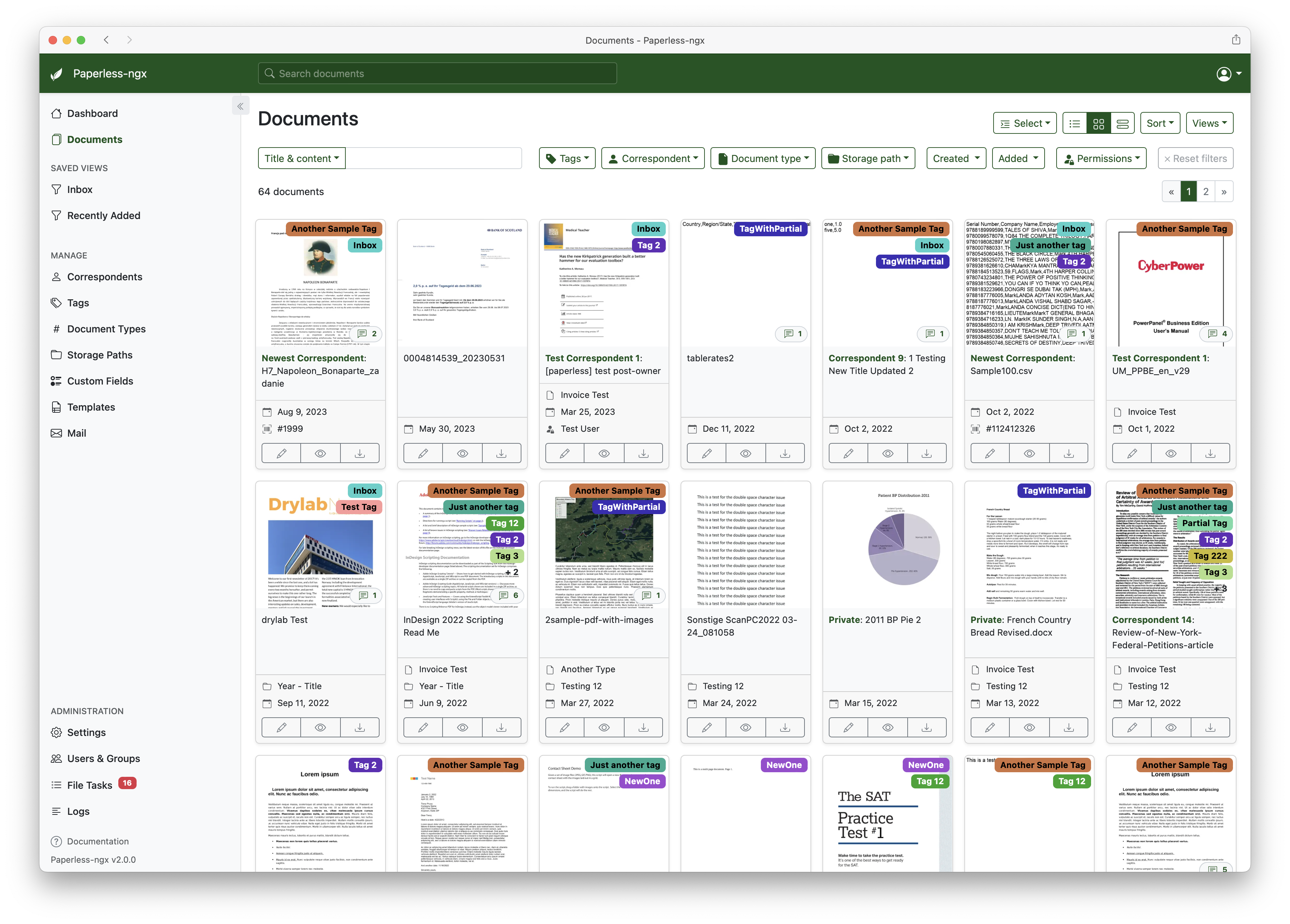
A full list of features and screenshots are available in the documentation.
Getting started
The easiest way to deploy paperless is docker compose. The files in the /docker/compose directory are configured to pull the image from the GitHub container registry.
If you'd like to jump right in, you can configure a docker compose environment with our install script:
bash -c "$(curl -L https://raw.githubusercontent.com/paperless-ngx/paperless-ngx/main/install-paperless-ngx.sh)"
More details and step-by-step guides for alternative installation methods can be found in the documentation.
Migrating from Paperless-ng is easy, just drop in the new docker image! See the documentation on migrating for more details.
Documentation
The documentation for Paperless-ngx is available at https://docs.paperless-ngx.com.
Contributing
If you feel like contributing to the project, please do! Bug fixes, enhancements, visual fixes etc. are always welcome. If you want to implement something big: Please start a discussion about that! The documentation has some basic information on how to get started.
Community Support
People interested in continuing the work on paperless-ngx are encouraged to reach out here on github and in the Matrix Room. If you would like to contribute to the project on an ongoing basis there are multiple teams (frontend, ci/cd, etc) that could use your help so please reach out!
Translation
Paperless-ngx is available in many languages that are coordinated on Crowdin. If you want to help out by translating paperless-ngx into your language, please head over to https://crowdin.com/project/paperless-ngx, and thank you! More details can be found in CONTRIBUTING.md.
Feature Requests
Feature requests can be submitted via GitHub Discussions, you can search for existing ideas, add your own and vote for the ones you care about.
Bugs
For bugs please open an issue or start a discussion if you have questions.
Related Projects
Please see the wiki for a user-maintained list of related projects and software that is compatible with Paperless-ngx.
Important Note
Document scanners are typically used to scan sensitive documents like your social insurance number, tax records, invoices, etc. Paperless-ngx should never be run on an untrusted host because information is stored in clear text without encryption. No guarantees are made regarding security (but we do try!) and you use the app at your own risk. The safest way to run Paperless-ngx is on a local server in your own home with backups in place.