mirror of
https://github.com/domainaware/parsedmarc.git
synced 2026-05-26 05:35:24 +00:00
 Sean Whalen
a6778707d7
Sean Whalen
a6778707d7
The forensic→failure rename (#659) left a few loose ends and one deliberate
hold-back. This closes them.

Leftover rename misses (broken paths / stale canonical names):
- CONTRIBUTING.md, dashboard-dev-bootstrap.sh: samples/forensic/* → samples/failure/*
- dashboard-dev-bootstrap.sh, dashboards/README.md: dmarc_forensic_dashboard.xml
  → dmarc_failure_dashboard.xml (the file was already renamed; the import path
  and view name were not)
- docs/source/usage.md: PARSEDMARC_GENERAL_SAVE_FORENSIC → ..._SAVE_FAILURE example
- samples/parsedmarc.ini: save_forensic → save_failure
- pyproject.toml, README.md: canonical "failure" naming
(ci.ini intentionally keeps save_forensic to smoke-test the deprecated alias.)

Archive subfolder rename + on-startup migration:
- New failure reports now archive to <archive>/Failure (was <archive>/Forensic).
- _migrate_forensic_archive_folder() runs once on startup (best-effort):
  renames Forensic→Failure when no Failure folder exists yet, merges the two
  when both exist, no-ops when there's no legacy folder, and logs-and-skips a
  mailbox it can't reorganize (warn, don't crash). This consolidates pre- and
  post-rename failure reports into one folder, replacing the previously
  documented decision to keep the folder named Forensic to avoid a split
  archive. Uses the folder-management API (folder_exists / rename_folder /
  merge_folders) added in mailsuite 2.1.0; the pin is bumped to >=2.1.0.

Grafana dashboard (the rename PR updated OSD/Splunk/ES-OS but not Grafana):
- Forensic panel titles + the datasource label → Failure; the fo-column display
  label and its linked byName field-override matcher both → "Failure Policy"
  (changed together so the column-width override keeps matching).
- dev-bootstrap Grafana ES datasource: dmarc_forensic* → dmarc_f* (matches both
  pre-rename dmarc_forensic* and post-rename dmarc_failure*, like the OSD/Kibana
  dashboards); RESEED wipe loop now also clears dmarc_failure* indices.
- Removed dashboards/grafana/Grafana-DMARC_Reports.json-new_panel.json, an
  orphan export accidentally committed in #736 and referenced by nothing.

Tests (tests/test_init.py):
- TestMigrateForensicArchiveFolderMaildir: real on-disk Maildir round-trips via
  mailsuite's MaildirConnection (no mocks) — rename, merge, no-op, and the full
  get_dmarc_reports_from_mailbox orchestration. Runs in CI (no network/creds).
- TestMigrateForensicArchiveFolderErrorHandling: the one path a real Maildir
  can't reproduce — a backend that raises mid-operation must warn, not crash.

Co-authored-by: Claude Opus 4.7 (1M context) <noreply@anthropic.com>
3.1 KiB
3.1 KiB
parsedmarc




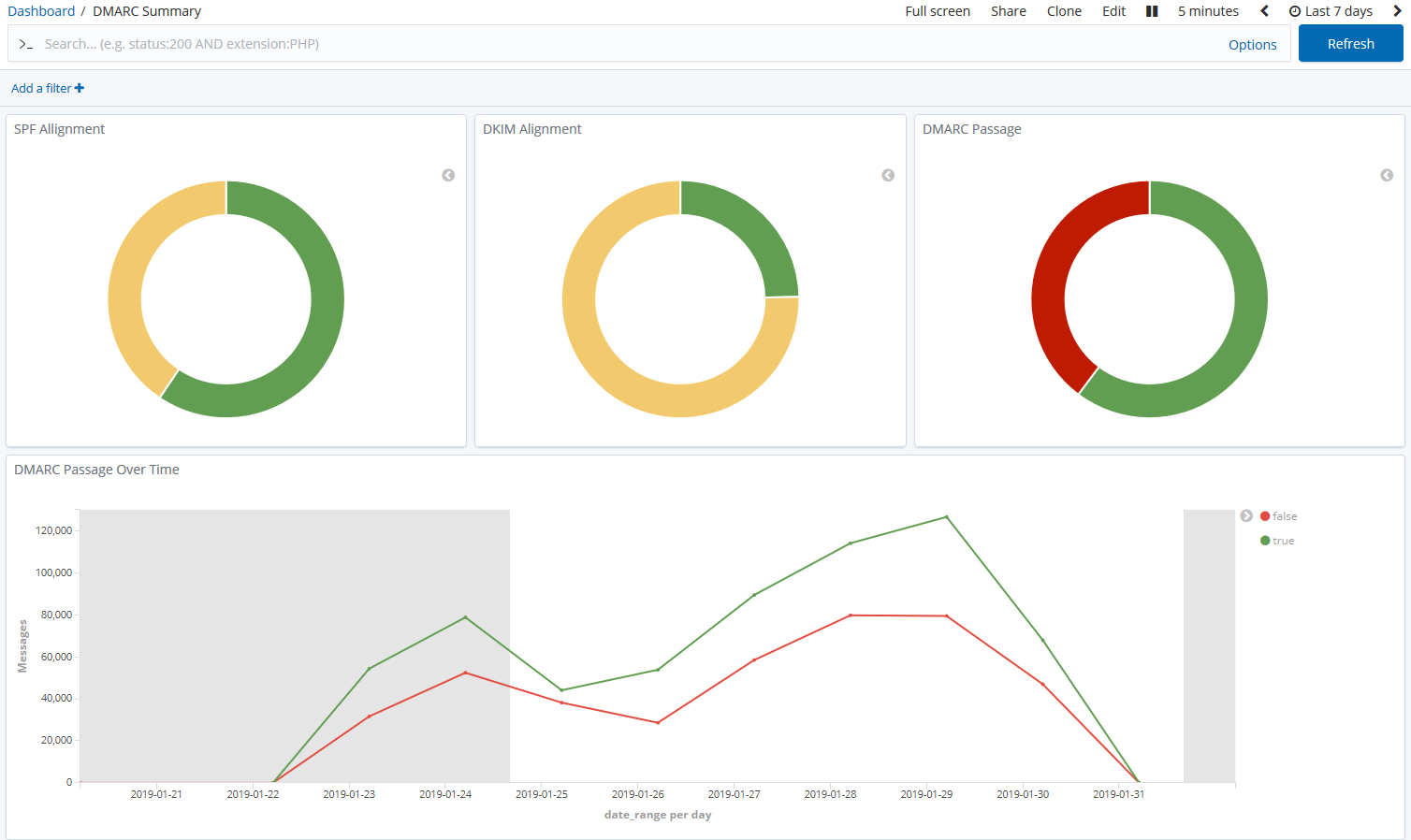
parsedmarc is a Python module and CLI utility for parsing DMARC
reports. When used with Elasticsearch and Kibana (or Splunk), it works
as a self-hosted open-source alternative to commercial DMARC report
processing services such as Agari Brand Protection, Dmarcian, OnDMARC,
ProofPoint Email Fraud Defense, and Valimail.
Note
Domain-based Message Authentication, Reporting, and Conformance (DMARC) is an email authentication protocol.
Sponsors
This is a project is maintained by one developer. Please consider sponsoring my work if you or your organization benefit from it.
Features
- Parses draft and 1.0 standard aggregate/rua DMARC reports
- Parses failure/ruf DMARC reports (formerly called forensic reports)
- Parses reports from SMTP TLS Reporting
- Can parse reports from an inbox over IMAP, Microsoft Graph, or Gmail API
- Transparently handles gzip or zip compressed reports
- Consistent data structures
- Simple JSON and/or CSV output
- Optionally email the results
- Optionally send the results to Elasticsearch, Opensearch, and/or Splunk, for use with premade dashboards
- Optionally send reports to Apache Kafka
Python Compatibility
This project supports the following Python versions, which are either actively maintained or are the default versions for RHEL or Debian.
| Version | Supported | Reason |
|---|---|---|
| < 3.6 | ❌ | End of Life (EOL) |
| 3.6 | ❌ | Used in RHEL 8, but not supported by project dependencies |
| 3.7 | ❌ | End of Life (EOL) |
| 3.8 | ❌ | End of Life (EOL) |
| 3.9 | ❌ | Used in Debian 11 and RHEL 9, but not supported by project dependencies |
| 3.10 | ✅ | Actively maintained |
| 3.11 | ✅ | Actively maintained; supported until June 2028 (Debian 12) |
| 3.12 | ✅ | Actively maintained; supported until May 2035 (RHEL 10) |
| 3.13 | ✅ | Actively maintained; supported until June 2030 (Debian 13) |
| 3.14 | ✅ | Supported (requires imapclient>=3.1.0) |