parsedmarc documentation - Open source DMARC report analyzer and visualizer




parsedmarc is a Python module and CLI utility for parsing DMARC reports.
When used with Elasticsearch and Kibana (or Splunk), it works as a self-hosted
open source alternative to commercial DMARC report processing services such
as Agari Brand Protection, Dmarcian, OnDMARC, ProofPoint Email Fraud Defense,
and Valimail.
Features
Parses draft and 1.0 standard aggregate/rua reports
Parses forensic/failure/ruf reports
Can parse reports from an inbox over IMAP
Transparently handles gzip or zip compressed reports
Consistent data structures
Simple JSON and/or CSV output
Optionally email the results
Optionally send the results to Elasticsearch and/or Splunk, for use with premade dashboards
Optionally send reports to Apache Kafka
Resources
DMARC guides
Demystifying DMARC - A complete guide to SPF, DKIM, and DMARC
SPF and DMARC record validation
If you are looking for SPF and DMARC record validation and parsing, check out the sister project, checkdmarc.
Lookalike domains
DMARC protects against domain spoofing, not lookalike domains. for open source lookalike domain monitoring, check out DomainAware.
CLI help
usage: parsedmarc [-h] [-c CONFIG_FILE] [--strip-attachment-payloads]
               [-o OUTPUT] [-n NAMESERVERS [NAMESERVERS ...]]
               [-t DNS_TIMEOUT] [-s] [--debug] [--log-file LOG_FILE] [-v]
               [file_path [file_path ...]]

Parses DMARC reports

positional arguments:
  file_path             one or more paths to aggregate or forensic report
                        files or emails

optional arguments:
  -h, --help            show this help message and exit
  -c CONFIG_FILE, --config-file CONFIG_FILE
                        A path to a configuration file (--silent implied)
  --strip-attachment-payloads
                        remove attachment payloads from forensic report output
  -o OUTPUT, --output OUTPUT
                        write output files to the given directory
  -n NAMESERVERS [NAMESERVERS ...], --nameservers NAMESERVERS [NAMESERVERS ...]
                        nameservers to query (default is Cloudflare's
                        nameservers)
  -t DNS_TIMEOUT, --dns_timeout DNS_TIMEOUT
                        number of seconds to wait for an answer from DNS
                        (default: 6.0)
  -s, --silent          only print errors and warnings
  --debug               print debugging information
  --log-file LOG_FILE   output logging to a file
  -v, --version         show program's version number and exit
Note
In parsedmarc 6.0.0, most CLI options were moved to a configuration file, described below.
Configuration file
parsedmarc can be configured by supplying the path to an INI file
parsedmarc -c /etc/parsedmarc.ini
For example
# This is an example comment

[general]
save_aggregate = True
save_forensic = True

[imap]
host = imap.example.com
user = dmarcresports@example.com
password = $uperSecure
watch = True

[elasticsearch]
hosts = 127.0.0.1:9200
ssl = False

[splunk_hec]
url = https://splunkhec.example.com
token = HECTokenGoesHere
index = email
The full set of configuration options are:
generalsave_aggregate- bool: Save aggregate report data to the Elasticsearch and/or Splunksave_forensic- bool: Save forensic report data to the Elasticsearch and/or Splunkstrip_attachment_payloads- bool: Remove attachment payloads from resultsoutput- str: Directory to place JSON and CSV files innameservers- str: A comma separated list of DNS resolvers (Default: Cloudflare’s public resolvers)dns_timeout- float: DNS timeout perioddebug- bool: Print debugging messagessilent- bool: Only print errors (Default: True)log_file- str: Write log messages to a file at this pathn_procs- int: Number of process to run in parallel when parsing in CLI mode (Default: 1)chunk_size- int: Number of files to give to each process when running in parallel. Setting this to a number larger than one can improve performance when processing thousands of files
imaphost- str: The IMAP server hostname or IP addressport- int: The IMAP server port (Default: 993)ssl- bool: Use an encrypted SSL/TLS connection (Default: True)skip_certificate_verification- bool: Skip certificate verification (not recommended)user- str: The IMAP userpassword- str: The IMAP passwordreports_folder- str: The IMAP folder where the incoming reports can be found (Default: INBOX)archive_folder- str: The IMAP folder to sort processed emails into (Default: Archive)watch- bool: Use the IMAPIDLEcommand to process messages as they arrivedelete- bool: Delete messages after processing them, instead of archiving themtest- bool: Do not move or delete messages
elasticsearchhosts- str: A comma separated list of hostnames and ports or URLs (e.g.127.0.0.1:9200orhttps://user:secret@localhost)Note
Special characters in the username or password must be URL encoded.
ssl- bool: Use an encrypted SSL/TLS connection (Default: True)cert_path- str: Path to a trusted certificatesindex_suffix- str: A suffix to apply to the index namesmonthly_indexes- bool: Use monthly indexes instead of daily indexes
splunk_hecurl- str: The URL of the Splunk HTTP Events Collector (HEC)token- str: The HEC tokenindex- str: The Splunk index to useskip_certificate_verification- bool: Skip certificate verification (not recommended)
kafkahosts- str: A comma separated list of Kafka hostsuser- str: The Kafka userpasssword- str: The Kafka passwordssl- bool: Use an encrypted SSL/TLS connection (Default: True)skip_certificate_verification- bool: Skip certificate verification (not recommended)aggregate_topic- str: The Kafka topic for aggregate reportsforensic_topic- str: The Kafka topic for forensic reports
smtphost- str: The SMTP hostnameport- int: The SMTP port (Default: 25)ssl- bool: Require SSL/TLS instead of using STARTTLSskip_certificate_verification- bool: Skip certificate verification (not recommended)user- str: the SMTP usernamepassword- str: the SMTP passwordfrom- str: The From header to use in the emailto- list: A list of email addresses to send tosubject- str: The Subject header to use in the email (Default: parsedmarc report)attachment- str: The ZIP attachment filenamesmessage- str: The email message (Default: Please see the attached parsedmarc report.)
Warning
It is strongly recommended to not use the nameservers setting.
By default, parsedmarc uses Cloudflare’s public resolvers,
which are much faster and more reliable than Google, Cisco OpenDNS, or
even most local resolvers.
The nameservers option should only be used if your network blocks DNS
requests to outside resolvers.
Warning
save_aggregate and save_forensic are separate options because
you may not want to save forensic reports (also known as failure reports)
to your Elasticsearch instance, particularly if you are in a
highly-regulated industry that handles sensitive data, such as healthcare
or finance. If your legitimate outgoing email fails DMARC, it is possible
that email may appear later in a forensic report.
Forensic reports contain the original headers of an email that failed a DMARC check, and sometimes may also include the full message body, depending on the policy of the reporting organization.
Most reporting organizations do not send forensic reports of any kind for privacy reasons. While aggregate DMARC reports are sent at least daily, it is normal to receive very few forensic reports.
An alternative approach is to still collect forensic/failure/ruf reports
in your DMARC inbox, but run parsedmarc with save_forensic = True
manually on a separate IMAP folder (using the reports_folder option),
after you have manually moved known samples you want to save to that
folder (e.g. malicious samples and non-sensitive legitimate samples).
Sample aggregate report output
Here are the results from parsing the example report from the dmarc.org wiki. It’s actually an older draft of the the 1.0 report schema standardized in RFC 7480 Appendix C. This draft schema is still in wide use.
parsedmarc produces consistent, normalized output, regardless of the report
schema.
JSON
{
  "xml_schema": "draft",
  "report_metadata": {
    "org_name": "acme.com",
    "org_email": "noreply-dmarc-support@acme.com",
    "org_extra_contact_info": "http://acme.com/dmarc/support",
    "report_id": "9391651994964116463",
    "begin_date": "2012-04-27 20:00:00",
    "end_date": "2012-04-28 19:59:59",
    "errors": []
  },
  "policy_published": {
    "domain": "example.com",
    "adkim": "r",
    "aspf": "r",
    "p": "none",
    "sp": "none",
    "pct": "100",
    "fo": "0"
  },
  "records": [
    {
      "source": {
        "ip_address": "72.150.241.94",
        "country": "US",
        "reverse_dns": "adsl-72-150-241-94.shv.bellsouth.net",
        "base_domain": "bellsouth.net"
      },
      "count": 2,
      "alignment": {
        "spf": true,
        "dkim": false,
        "dmarc": true
      },
      "policy_evaluated": {
        "disposition": "none",
        "dkim": "fail",
        "spf": "pass",
        "policy_override_reasons": []
      },
      "identifiers": {
        "header_from": "example.com",
        "envelope_from": "example.com",
        "envelope_to": null
      },
      "auth_results": {
        "dkim": [
          {
            "domain": "example.com",
            "selector": "none",
            "result": "fail"
          }
        ],
        "spf": [
          {
            "domain": "example.com",
            "scope": "mfrom",
            "result": "pass"
          }
        ]
      }
    }
  ]
}
CSV
xml_schema,org_name,org_email,org_extra_contact_info,report_id,begin_date,end_date,errors,domain,adkim,aspf,p,sp,pct,fo,source_ip_address,source_country,source_reverse_dns,source_base_domain,count,disposition,dkim_alignment,spf_alignment,policy_override_reasons,policy_override_comments,envelope_from,header_from,envelope_to,dkim_domains,dkim_selectors,dkim_results,spf_domains,spf_scopes,spf_results
draft,acme.com,noreply-dmarc-support@acme.com,http://acme.com/dmarc/support,9391651994964116463,2012-04-27 20:00:00,2012-04-28 19:59:59,,example.com,r,r,none,none,100,0,72.150.241.94,US,adsl-72-150-241-94.shv.bellsouth.net,bellsouth.net,2,none,fail,pass,,,example.com,example.com,,example.com,none,fail,example.com,mfrom,pass
Sample forensic report output
Thanks to Github user xennn for the anonymized forensic report email sample.
JSON
{
     "feedback_type": "auth-failure",
     "user_agent": "Lua/1.0",
     "version": "1.0",
     "original_mail_from": "sharepoint@domain.de",
     "original_rcpt_to": "peter.pan@domain.de",
     "arrival_date": "Mon, 01 Oct 2018 11:20:27 +0200",
     "message_id": "<38.E7.30937.BD6E1BB5@ mailrelay.de>",
     "authentication_results": "dmarc=fail (p=none, dis=none) header.from=domain.de",
     "delivery_result": "policy",
     "auth_failure": [
       "dmarc"
     ],
     "reported_domain": "domain.de",
     "arrival_date_utc": "2018-10-01 09:20:27",
     "source": {
       "ip_address": "10.10.10.10",
       "country": null,
       "reverse_dns": null,
       "base_domain": null
     },
     "authentication_mechanisms": [],
     "original_envelope_id": null,
     "dkim_domain": null,
     "sample_headers_only": false,
     "sample": "Received: from Servernameone.domain.local (Servernameone.domain.local [10.10.10.10])\n\tby  mailrelay.de (mail.DOMAIN.de) with SMTP id 38.E7.30937.BD6E1BB5; Mon,  1 Oct 2018 11:20:27 +0200 (CEST)\nDate: 01 Oct 2018 11:20:27 +0200\nMessage-ID: <38.E7.30937.BD6E1BB5@ mailrelay.de>\nTo: <peter.pan@domain.de>\nfrom: \"=?utf-8?B?SW50ZXJha3RpdmUgV2V0dGJld2VyYmVyLcOcYmVyc2ljaHQ=?=\" <sharepoint@domain.de>\nSubject: Subject\nMIME-Version: 1.0\nX-Mailer: Microsoft SharePoint Foundation 2010\nContent-Type: text/html; charset=utf-8\nContent-Transfer-Encoding: quoted-printable\n\n<html><head><base href=3D'\nwettbewerb' /></head><body><!DOCTYPE HTML PUBLIC \"-//W3C//DTD HTML 3.2//EN\"=\n><HTML><HEAD><META NAME=3D\"Generator\" CONTENT=3D\"MS Exchange Server version=\n 08.01.0240.003\"></html>\n",
     "parsed_sample": {
       "from": {
         "display_name": "Interaktive Wettbewerber-Übersicht",
         "address": "sharepoint@domain.de",
         "local": "sharepoint",
         "domain": "domain.de"
       },
       "to_domains": [
         "domain.de"
       ],
       "to": [
         {
           "display_name": null,
           "address": "peter.pan@domain.de",
           "local": "peter.pan",
           "domain": "domain.de"
         }
       ],
       "subject": "Subject",
       "timezone": "+2",
       "mime-version": "1.0",
       "date": "2018-10-01 09:20:27",
       "content-type": "text/html; charset=utf-8",
       "x-mailer": "Microsoft SharePoint Foundation 2010",
       "body": "<html><head><base href='\nwettbewerb' /></head><body><!DOCTYPE HTML PUBLIC \"-//W3C//DTD HTML 3.2//EN\"><HTML><HEAD><META NAME=\"Generator\" CONTENT=\"MS Exchange Server version 08.01.0240.003\"></html>",
       "received": [
         {
           "from": "Servernameone.domain.local Servernameone.domain.local 10.10.10.10",
           "by": "mailrelay.de mail.DOMAIN.de",
           "with": "SMTP id 38.E7.30937.BD6E1BB5",
           "date": "Mon, 1 Oct 2018 11:20:27 +0200 CEST",
           "hop": 1,
           "date_utc": "2018-10-01 09:20:27",
           "delay": 0
         }
       ],
       "content-transfer-encoding": "quoted-printable",
       "message-id": "<38.E7.30937.BD6E1BB5@ mailrelay.de>",
       "has_defects": false,
       "headers": {
         "Received": "from Servernameone.domain.local (Servernameone.domain.local [10.10.10.10])\n\tby  mailrelay.de (mail.DOMAIN.de) with SMTP id 38.E7.30937.BD6E1BB5; Mon,  1 Oct 2018 11:20:27 +0200 (CEST)",
         "Date": "01 Oct 2018 11:20:27 +0200",
         "Message-ID": "<38.E7.30937.BD6E1BB5@ mailrelay.de>",
         "To": "<peter.pan@domain.de>",
         "from": "\"Interaktive Wettbewerber-Übersicht\" <sharepoint@domain.de>",
         "Subject": "Subject",
         "MIME-Version": "1.0",
         "X-Mailer": "Microsoft SharePoint Foundation 2010",
         "Content-Type": "text/html; charset=utf-8",
         "Content-Transfer-Encoding": "quoted-printable"
       },
       "reply_to": [],
       "cc": [],
       "bcc": [],
       "attachments": [],
       "filename_safe_subject": "Subject"
     }
   }
CSV
feedback_type,user_agent,version,original_envelope_id,original_mail_from,original_rcpt_to,arrival_date,arrival_date_utc,subject,message_id,authentication_results,dkim_domain,source_ip_address,source_country,source_reverse_dns,source_base_domain,delivery_result,auth_failure,reported_domain,authentication_mechanisms,sample_headers_only
auth-failure,Lua/1.0,1.0,,sharepoint@domain.de,peter.pan@domain.de,"Mon, 01 Oct 2018 11:20:27 +0200",2018-10-01 09:20:27,Subject,<38.E7.30937.BD6E1BB5@ mailrelay.de>,"dmarc=fail (p=none, dis=none) header.from=domain.de",,10.10.10.10,,,,policy,dmarc,domain.de,,False
Bug reports
Please report bugs on the GitHub issue tracker
Installation
parsedmarc works with Python 3 only.
Note
If your system is behind a web proxy, you neeed to configure your system
to use that proxy. To do this, edit /etc/environment and add your
proxy details there, for example:
http_proxy=http://user:password@prox-server:3128
https_proxy=https://user:password@prox-server:3128
ftp_proxy=http://user:password@prox-server:3128
Or if no credentials are needed:
http_proxy=http://prox-server:3128
https_proxy=https://prox-server:3128
ftp_proxy=http://prox-server:3128
This will set the the proxy up for use system-wide, including for
parsedmarc.
Warning
If your mail server is Microsoft Exchange, ensure that it is patched to at least:
On Debian or Ubuntu systems, run:
sudo apt-get install -y python3-pip geoipupdate
On CentOS systems, run:
sudo yum install -y python34-setuptools GeoIP-Update
sudo easy_install-3.4 pip
sudo geoipupdate
Python 3 installers for Windows and macOS can be found at https://www.python.org/downloads/
Note
Windows users should also download a copy of Maxmind’s free
GeoLite2-Country.mmdb to C:\GeoIP\GeoLite2-Country.mmdb.
To install or upgrade to the latest stable release of parsedmarc on
macOS or Linux, run
sudo -H pip3 install -U parsedmarc
Or, install the latest development release directly from GitHub:
sudo -H pip3 install -U git+https://github.com/domainaware/parsedmarc.git
Note
On Windows, pip3 is pip, even with Python 3. So on Windows,
substitute pip as an administrator in place of sudo pip3, in the
above commands.
Installation using pypy3
For the best possible processing speed, consider using parsedmarc inside a pypy3
virtualenv. First, download the latest portable Linux version of pypy3. Extract it to
/opt/pypy3 (sudo mkdir /opt if /opt does not exist), then create a
symlink:
wget https://bitbucket.org/squeaky/portable-pypy/downloads/pypy3.5-7.0.0-linux_x86_64-portable.tar.bz2
tar -jxf pypy3.5-7.0.0-linux_x86_64-portable.tar.bz2
rm pypy3.5-6.0.0-linux_x86_64-portable.tar.bz2
sudo chown -R root:root pypy3.5-7.0.0-linux_x86_64-portable
sudo mv pypy3.5-7.0.0-linux_x86_64-portable /opt/pypy3
sudo ln -s /opt/pypy3/bin/pypy3 /usr/local/bin/pypy3
Install virtualenv on your system:
sudo apt-get install python3-pip
sudo -H pip3 install -U virtualenv
Uninstall any instance of parsedmarc that you may have installed globally
sudo -H pip3 uninstall -y parsedmarc
Next, create a pypy3 virtualenv for parsedmarc
sudo mkdir /opt/venvs
cd /opt/venvs
sudo -H pip3 install -U virtualenv
sudo virtualenv --download -p /usr/local/bin/pypy3 parsedmarc
sudo -H /opt/venvs/parsedmarc/bin/pip3 install -U parsedmarc
sudo ln -s /opt/venvs/parsedmarc/bin/parsedmarc /usr/local/bin/parsedmarc
To upgrade parsedmarc inside the virtualenv, run:
sudo -H /opt/venvs/parsedmarc/bin/pip3 install -U parsedmarc
Or, install the latest development release directly from GitHub:
sudo -H /opt/venvs/parsedmarc/bin/pip3 install -U git+https://github.com/domainaware/parsedmarc.git
Optional dependencies
If you would like to be able to parse emails saved from Microsoft Outlook
(i.e. OLE .msg files), install msgconvert:
On Debian or Ubuntu systems, run:
sudo apt-get install libemail-outlook-message-perl
Testing multiple report analyzers
If you would like to test parsedmarc and another report processing solution at the same time, you can have up to two mailto URIs each in the rua and ruf tags in your DMARC record, separated by commas.
Accessing an inbox using OWA/EWS
Some organisations do not allow IMAP, and only support Exchange Web Services (EWS)/Outlook Web Access (OWA). In that case, Davmail will need to be set up as a local EWS/OWA IMAP gateway. It can even work where Modern Auth/multi-factor authentication is required.
To do this, download the latest davmail-version.zip from
https://sourceforge.net/projects/davmail/files/
Extract the zip using the unzip command.
Install Java:
sudo apt-get install default-jre-headless
Configure Davmail by creating a davmail.properties file
# DavMail settings, see http://davmail.sourceforge.net/ for documentation

#############################################################
# Basic settings

# Server or workstation mode
davmail.server=true

# connection mode auto, EWS or WebDav
davmail.enableEws=auto

# base Exchange OWA or EWS url
davmail.url=https://outlook.office365.com/EWS/Exchange.asmx

# Listener ports
davmail.imapPort=1143

#############################################################
# Network settings

# Network proxy settings
davmail.enableProxy=false
davmail.useSystemProxies=false
davmail.proxyHost=
davmail.proxyPort=
davmail.proxyUser=
davmail.proxyPassword=

# proxy exclude list
davmail.noProxyFor=

# block remote connection to DavMail
davmail.allowRemote=false

# bind server sockets to the loopback address
davmail.bindAddress=127.0.0.1

# disable SSL for specified listeners
davmail.ssl.nosecureimap=true

# Send keepalive character during large folder and messages download
davmail.enableKeepalive=true

# Message count limit on folder retrieval
davmail.folderSizeLimit=0

#############################################################
# IMAP settings

# Delete messages immediately on IMAP STORE \Deleted flag
davmail.imapAutoExpunge=true

# Enable IDLE support, set polling delay in minutes
davmail.imapIdleDelay=1

# Always reply to IMAP RFC822.SIZE requests with Exchange approximate
# message size for performance reasons
davmail.imapAlwaysApproxMsgSize=true

# Client connection timeout in seconds - default 300, 0 to disable
davmail.clientSoTimeout=0

#############################################################
Running DavMail as a systemd service
Use systemd to run davmail as a service.
Create a system user
sudo useradd davmail -r -s /bin/false
Protect the davmail configuration file from prying eyes
sudo chown root:davmail /opt/davmail/davmail.properties
sudo chmod u=rw,g=r,o= /opt/davmail/davmail.properties
Create the service configuration file
sudo nano /etc/systemd/system/davmail.service
[Unit]
Description=DavMail gateway service
Documentation=https://sourceforge.net/projects/davmail/
Wants=network-online.target
After=syslog.target network.target

[Service]
ExecStart=/opt/davmail/davmail /opt/davmail/davmail.properties
User=davmail
Group=davmail
Restart=always
RestartSec=5m

[Install]
WantedBy=multi-user.target
Then, enable the service
sudo systemctl daemon-reload
sudo systemctl enable parsedmarc.service
sudo service davmail restart
Note
You must also run the above commands whenever you edit
davmail.service.
Warning
Always restart the service every time you upgrade to a new version of
davmail:
sudo service davmail restart
To check the status of the service, run:
service davmail status
Note
In the event of a crash, systemd will restart the service after 5 minutes, but the service davmail status command will only show the logs for the current process. To vew the logs for previous runs as well as the current process (newest to oldest), run:
journalctl -u davmail.service -r
Configuring parsedmarc for DavMail
Because you are interacting with DavMail server over the loopback
(i.e. 127.0.0.1), add the following options to parsedmarc.ini
config file:
[imap]
host=127.0.0.1
port=1143
ssl=False
watch=True
Elasticsearch and Kibana
Note
Splunk is also supported starting with parsedmarc 4.3.0
To set up visual dashboards of DMARC data, install Elasticsearch and Kibana.
Note
Elasticsearch and Kibana 6 or later are required
On Debian/Ubuntu based systems, run:
sudo apt-get install -y apt-transport-https
wget -qO - https://artifacts.elastic.co/GPG-KEY-elasticsearch | sudo apt-key add -
echo "deb https://artifacts.elastic.co/packages/7.x/apt stable main" | sudo tee -a /etc/apt/sources.list.d/elastic-7.x.list
sudo apt-get update
sudo apt-get install -y default-jre-headless elasticsearch kibana
For CentOS, RHEL, and other RPM systems, follow the Elastic RPM guides for Elasticsearch and Kibana.
Warning
The default JVM heap size for Elasticsearch is very small (1g), which will
cause it to crash under a heavy load. To fix this, increase the minimum and
maximum JVM heap sizes in /etc/elasticsearch/jvm.options to more
reasonable levels, depending on your server’s resources.
Make sure the system has at least 2 GB more RAM then the assigned JVM heap size.
Always set the minimum and maximum JVM heap sizes to the same value.
For example, to set a 4 GB heap size, set
-Xms4g
-Xmx4g
See https://www.elastic.co/guide/en/elasticsearch/reference/current/heap-size.html for more information.
sudo systemctl daemon-reload
sudo systemctl enable elasticsearch.service
sudo systemctl enable kibana.service
sudo service elasticsearch start
sudo service kibana start
Without the commercial X-Pack or ReadonlyREST products, Kibana does not have any authentication mechanism of its own. You can use nginx as a reverse proxy that provides basic authentication.
sudo apt-get install -y nginx apache2-utils
Or, on CentOS:
sudo yum install -y nginx httpd-tools
Create a directory to store the certificates and keys:
mkdir ~/ssl
cd ~/ssl
To create a self-signed certificate, run:
openssl req -x509 -nodes -days 365 -newkey rsa:4096 -keyout kibana.key -out kibana.crt
Or, to create a Certificate Signing Request (CSR) for a CA, run:
openssl req -newkey rsa:4096-nodes -keyout kibana.key -out kibana.csr
Fill in the prompts. Watch out for Common Name (e.g. server FQDN or YOUR domain name), which is the IP address or domain name that you will be hosting Kibana on. it is the most important field.
If you generated a CSR, remove the CSR after you have your certs
rm -f kibana.csr
Move the keys into place and secure them:
cd
sudo mv ssl /etc/nginx
sudo chown -R root:www-data /etc/nginx/ssl
sudo chmod -R u=rX,g=rX,o= /etc/nginx/ssl
Disable the default nginx configuration:
sudo rm /etc/nginx/sites-enabled/default
Create the web server configuration
sudo nano /etc/nginx/sites-available/kibana
server {
    listen 443 ssl http2;
    ssl_certificate /etc/nginx/ssl/kibana.crt;
    ssl_certificate_key /etc/nginx/ssl/kibana.key;
    ssl_session_timeout 1d;
    ssl_session_cache shared:SSL:50m;
    ssl_session_tickets off;


    # modern configuration. tweak to your needs.
    ssl_protocols TLSv1.2;
    ssl_ciphers 'ECDHE-ECDSA-AES256-GCM-SHA384:ECDHE-RSA-AES256-GCM-SHA384:ECDHE-ECDSA-CHACHA20-POLY1305:ECDHE-RSA-CHACHA20-POLY1305:ECDHE-ECDSA-AES128-GCM-SHA256:ECDHE-RSA-AES128-GCM-SHA256:ECDHE-ECDSA-AES256-SHA384:ECDHE-RSA-AES256-SHA384:ECDHE-ECDSA-AES128-SHA256:ECDHE-RSA-AES128-SHA256';
    ssl_prefer_server_ciphers on;

    # Uncomment this next line if you are using a signed, trusted cert
    #add_header Strict-Transport-Security "max-age=63072000; includeSubdomains; preload";
    add_header X-Frame-Options SAMEORIGIN;
    add_header X-Content-Type-Options nosniff;
    auth_basic "Login required";
    auth_basic_user_file /etc/nginx/htpasswd;

    location / {
        proxy_pass http://127.0.0.1:5601;
        proxy_set_header Host $host;
        proxy_set_header X-Real-IP $remote_addr;
        proxy_set_header X-Forwarded-For $proxy_add_x_forwarded_for;
    }
}

server {
    listen 80;
    return 301 https://$host$request_uri;
}
Enable the nginx configuration for Kibana:
sudo ln -s /etc/nginx/sites-available/kibana /etc/nginx/sites-enabled/kibana
Add a user to basic authentication:
sudo htpasswd -c /etc/nginx/htpasswd exampleuser
Where exampleuser is the name of the user you want to add.
Secure the permissions of the httpasswd file:
sudo chown root:www-data /etc/nginx/htpasswd
sudo chmod u=rw,g=r,o= /etc/nginx/htpasswd
Restart nginx:
sudo service nginx restart
Now that Elasticsearch is up and running, use parsedmarc to send data to
it.
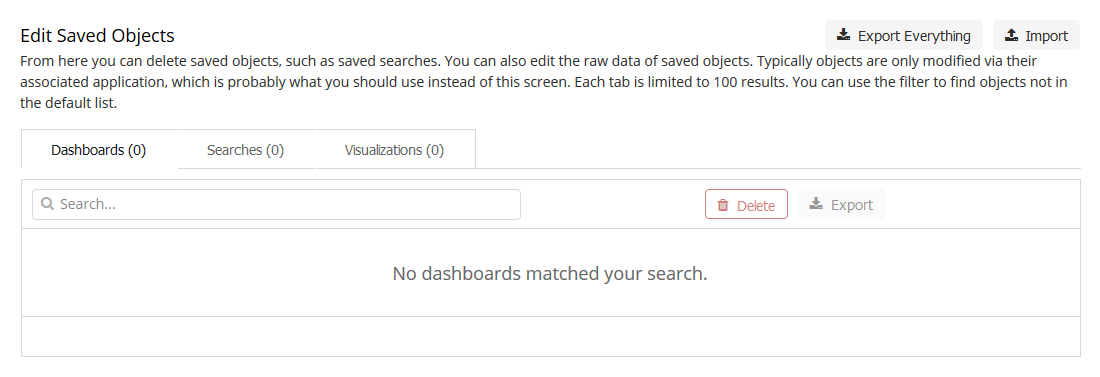
Download (right click the link and click save as) kibana_saved_objects.json.
Import kibana_saved_objects.json the Saved Objects tab of the management
page of Kibana.
It will give you the option to overwrite existing saved dashboards or visualizations, which could be used to restore them if you or someone else breaks them, as there are no permissions/access controls in Kibana without the commercial X-Pack.

Upgrading Kibana index patterns
parsedmarc 5.0.0 makes some changes to the way data is indexed in
Elasticsearch. if you are upgrading from a previous release of
parsedmarc, you need to complete the following steps to replace the
Kibana index patterns with versions that match the upgraded indexes:
Login in to Kibana, and click on Management
Under Kibana, click on Saved Objects
Check the checkboxes for the
dmarc_aggregateanddmarc_forensicindex patternsClick Delete
Click Delete on the conformation message
Download (right click the link and click save as) the latest version of kibana_saved_objects.json
Import
kibana_saved_objects.jsonby clicking Import from the Kibana Saved Objects page
Records retention
Starting in version 5.0.0, parsedmarc stores data in a separate
index for each day to make it easy to comply with records
retention regulations such as GDPR. For fore information,
check out the Elastic guide to managing time-based indexes efficiently.
Splunk
Starting in version 4.3.0 parsedmarc supports sending aggregate and/or
forensic DMARC data to a Splunk HTTP Event collector (HEC).
The project repository contains XML files for premade Splunk dashboards for aggregate and forensic DMARC reports.
Copy and paste the contents of each file into a separate Splunk dashboard XML editor.
Warning
Change all occurrences of index="email" in the XML to
match your own index name.
The Splunk dashboards display the same content and layout as the Kibana dashboards, although the Kibana dashboards have slightly easier and more flexible filtering options.
Running parsedmarc as a systemd service
Use systemd to run parsedmarc as a service and process reports as they
arrive.
Create a system user
sudo useradd parsedmarc -r -s /bin/false
Protect the parsedmarc configuration file from prying eyes
sudo chown root:parsedmarc /etc/parsedmarc.ini
sudo chmod u=rw,g=r,o= /etc/parsedmarc.ini
Create the service configuration file
sudo nano /etc/systemd/system/parsedmarc.service
[Unit]
Description=parsedmarc mailbox watcher
Documentation=https://domainaware.github.io/parsedmarc/
Wants=network-online.target
After=network.target network-online.target elasticsearch.service

[Service]
ExecStart=/usr/local/bin/parsedmarc -c /etc/parsedmarc.ini
User=parsedmarc
Group=parsedmarc
Restart=always
RestartSec=5m

[Install]
WantedBy=multi-user.target
Then, enable the service
sudo systemctl daemon-reload
sudo systemctl enable parsedmarc.service
sudo service parsedmarc restart
Note
You must also run the above commands whenever you edit
parsedmarc.service.
Warning
Always restart the service every time you upgrade to a new version of
parsedmarc:
sudo service parsedmarc restart
To check the status of the service, run:
service parsedmarc status
Note
In the event of a crash, systemd will restart the service after 10 minutes, but the service parsedmarc status command will only show the logs for the current process. To vew the logs for previous runs as well as the current process (newest to oldest), run:
journalctl -u parsedmarc.service -r
Using the Kibana dashboards
The Kibana DMARC dashboards are a human-friendly way to understand the results from incoming DMARC reports.
Note
The default dashboard is DMARC Summary. To switch between dashboards, click on the Dashboard link in the left side menu of Kibana.
DMARC Summary
As the name suggests, this dashboard is the best place to start reviewing your aggregate DMARC data.
Across the top of the dashboard, three pie charts display the percentage of alignment pass/fail for SPF, DKIM, and DMARC. Clicking on any chart segment will filter for that value.
Note
Messages should not be considered malicious just because they failed to pass DMARC; especially if you have just started collecting data. It may be a legitimate service that needs SPF and DKIM configured correctly.
Start by filtering the results to only show failed DKIM alignment. While DMARC passes if a message passes SPF or DKIM alignment, only DKIM alignment remains valid when a message is forwarded without changing the from address, which is often caused by a mailbox forwarding rule. This is because DKIM signatures are part of the message headers, whereas SPF relies on SMTP session headers.
Underneath the pie charts. you can see graphs of DMARC passage and message disposition over time.
Under the graphs you will find the most useful data tables on the dashboard. On the left, there is a list of organizations that are sending you DMARC reports. In the center, there is a list of sending servers grouped by the base domain in their reverse DNS. On the right, there is a list of email from domains, sorted by message volume.
By hovering your mouse over a data table value and using the magnifying glass icons, you can filter on our filter out different values. Start by looking at the Message Sources by Reverse DNS table. Find a sender that you recognize, such as an email marketing service, hover over it, and click on the plus (+) magnifying glass icon, to add a filter that only shows results for that sender. Now, look at the Message From Header table to the right. That shows you the domains that a sender is sending as, which might tell you which brand/business is using a particular service. With that information, you can contact them and have them set up DKIM.
Note
If you have a lot of B2C customers, you may see a high volume of emails as your domains coming from consumer email services, such as Google/Gmail and Yahoo! This occurs when customers have mailbox rules in place that forward emails from an old account to a new account, which is why DKIM authentication is so important, as mentioned earlier. Similar patterns may be observed with businesses who send from reverse DNS addressees of parent, subsidiary, and outdated brands.
Further down the dashboard, you can filter by source country or source IP address.
Tables showing SPF and DKIM alignment details are located under the IP address table.
Note
Previously, the alignment tables were included in a separate dashboard called DMARC Alignment Failures. That dashboard has been consolidated into the DMARC Summary dashboard. To view failures only, use the pie chart.
Any other filters work the same way. You can also add your own custom temporary filters by clicking on Add Filter at the upper right of the page.
DMARC Forensic Samples
The DMARC Forensic Samples dashboard contains information on DMARC forensic reports (also known as failure reports or ruf reports). These reports contain samples of emails that have failed to pass DMARC.
Note
Most recipients do not send forensic/failure/ruf reports at all to avoid privacy leaks. Some recipients (notably Chinese webmail services) will only supply the headers of sample emails. Very few provide the entire email.
DMARC Alignment Guide
DMARC ensures that SPF and DKM authentication mechanisms actually authenticate against the same domain that the end user sees.
A message passes a DMARC check by passing DKIM or SPF, as long as the related indicators are also in alignment.
DKIM |
SPF |
|
Passing |
The signature in the DKIM header is validated using a public key that is published as a DNS record of the domain name specified in the signature |
The mail server’s IP address is listed in the SPF record of the domain in the SMTP envelope’s mail from header |
Alignment |
The signing domain aligns with the domain in the message’s from header |
The domain in the SMTP envelope’s mail from header aligns with the domain in the message’s from header |
What if a sender won’t support DKIM/DMARC?
Some vendors don’t know about DMARC yet; ask about SPF and DKIM/email authentication.
Check if they can send through your email relays instead of theirs.
Do they really need to spoof your domain? Why not use the display name instead?
Worst case, have that vendor send email as a specific subdomain of your domain (e.g.
noreply@news.example.com), and then create separate SPF and DMARC records onnews.example.com, and setp=nonein that DMARC record.
Warning
Do not alter the p or sp values of the DMARC record on the
Top-Level Domain (TLD) – that would leave you vulnerable to spoofing of
your TLD and/or any subdomain.
What about mailing lists?
When you deploy DMARC on your domain, you might find that messages relayed by mailing lists are failing DMARC, most likely because the mailing list is spoofing your from address, and modifying the subject, footer, or other part of the message, thereby breaking the DKIM signature.
Mailing list list best practices
Ideally, a mailing list should forward messages without altering the headers or body content at all. Joe Nelson does a fantastic job of explaining exactly what mailing lists should and shouldn’t do to be fully DMARC compliant. Rather than repeat his fine work, here’s a summary:
Do
Retain headers from the original message
Add RFC 2369 List-Unsubscribe headers to outgoing messages, instead of adding unsubscribe links to the body
List-Unsubscribe: <https://list.example.com/unsubscribe-link>
Add RFC 2919 List-Id headers instead of modifying the subject
List-Id: Example Mailing List <list.example.com>
Modern mail clients and webmail services generate unsubscribe buttons based on these headers.
Do not
Remove or modify any existing headers from the original message, including From, Date, Subject, etc.
Add to or remove content from the message body, including traditional disclaimers and unsubscribe footers
In addition to complying with DMARC, this configuration ensures that Reply and Reply All actions work like they would with any email message. Reply replies to the message sender, and Reply All replies to the sender and the list.
Even without a subject prefix or body footer, mailing list users can still tell that a message came from the mailing list, because the message was sent to the mailing list post address, and not their email address.
Configuration steps for common mailing list platforms are listed below.
Mailman 2
Navigate to General Settings, and configure the settings below
Setting |
Value |
subject_prefix |
|
from_is_list |
No |
first_strip_reply_to |
No |
reply_goes_to_list |
Poster |
include_rfc2369_headers |
Yes |
include_list_post_header |
Yes |
include_sender_header |
No |
Navigate to Non-digest options, and configure the settings below
Setting |
Value |
msg_header |
|
msg_footer |
|
scrub_nondigest |
No |
Navigate to Privacy Options> Sending Filters, and configure the settings below
Setting |
Value |
dmarc_moderation_action |
Accept |
dmarc_quarentine_moderation_action |
Yes |
dmarc_none_moderation_action |
Yes |
Mailman 3
Navigate to Settings> List Identity
Make Subject prefix blank.
Navigate to Settings> Alter Messages
Configure the settings below
Setting |
Value |
Convert html to plaintext |
No |
Include RFC2369 headers |
Yes |
Include the list post header |
Yes |
Explicit reply-to address |
|
First strip replyo |
No |
Reply goes to list |
No munging |
Navigate to Settings> DMARC Mitigation
Configure the settings below
Setting |
Value |
DMARC mitigation action |
No DMARC mitigations |
DMARC mitigate unconditionally |
No |
Create a blank footer template for your mailing list to remove the message footer. Unfortunately, the Postorius mailing list admin UI will not allow you to create an empty template, so you’ll have to create one using the system’s command line instead, for example:
touch var/templates/lists/list.example.com/en/list:member:regular:footer
Where list.example.com the list ID, and en is the language.
Then restart mailman core.
Workarounds
If a mailing list must go against best practices and modify the message (e.g. to add a required legal footer), the mailing list administrator must configure the list to replace the From address of the message (also known as munging) with the address of the mailing list, so they no longer spoof email addresses with domains protected by DMARC.
Configuration steps for common mailing list platforms are listed below.
Mailman 2
Navigate to Privacy Options> Sending Filters, and configure the settings below
Setting |
Value |
dmarc_moderation_action |
Munge From |
dmarc_quarentine_moderation_action |
Yes |
dmarc_none_moderation_action |
Yes |
Note
Message wrapping could be used as the DMARC mitigation action instead. In that case, the original message is added as an attachment to the mailing list message, but that could interfere with inbox searching, or mobile clients.
On the other hand, replacing the From address might cause users to accidentally reply to the entire list, when they only intended to reply to the original sender.
Choose the option that best fits your community.
Mailman 3
In the DMARC Mitigations tab of the Settings page, configure the settings below
Setting |
Value |
DMARC mitigation action |
Replace From: with list address |
DMARC mitigate unconditionally |
No |
Note
Message wrapping could be used as the DMARC mitigation action instead. In that case, the original message is added as an attachment to the mailing list message, but that could interfere with inbox searching, or mobile clients.
On the other hand, replacing the From address might cause users to accidentally reply to the entire list, when they only intended to reply to the original sender.
LISTSERV
LISTSERV 16.0-2017a and higher will rewrite the From header for domains that enforce with a DMARC quarantine or reject policy.
Some additional steps are needed for Linux hosts.
API
A Python package for parsing DMARC reports
-
exception
parsedmarc.InvalidAggregateReport[source]¶ Raised when an invalid DMARC aggregate report is encountered
-
exception
parsedmarc.InvalidForensicReport[source]¶ Raised when an invalid DMARC forensic report is encountered
-
parsedmarc.email_results(results, host, mail_from, mail_to, port=0, ssl=False, user=None, password=None, subject=None, attachment_filename=None, message=None, ssl_context=None)[source]¶ Emails parsing results as a zip file
- Parameters
results (OrderedDict) – Parsing results
host – Mail server hostname or IP address
mail_from – The value of the message from header
mail_to – A list of addresses to mail to
port (int) – Port to use
ssl (bool) – Require a SSL connection from the start
user – An optional username
password – An optional password
subject – Overrides the default message subject
attachment_filename – Override the default attachment filename
message – Override the default plain text body
ssl_context – SSL context options
-
parsedmarc.extract_xml(input_)[source]¶ Extracts xml from a zip or gzip file at the given path, file-like object, or bytes.
- Parameters
input – A path to a file, a file like object, or bytes
- Returns
The extracted XML
- Return type
str
-
parsedmarc.get_dmarc_reports_from_inbox(host=None, user=None, password=None, connection=None, port=None, ssl=True, ssl_context=None, move_supported=None, reports_folder='INBOX', archive_folder='Archive', delete=False, test=False, nameservers=None, dns_timeout=6.0, strip_attachment_payloads=False, results=None)[source]¶ Fetches and parses DMARC reports from sn inbox
- Parameters
host – The mail server hostname or IP address
user – The mail server user
password – The mail server password
connection – An IMAPCLient connection to reuse
port – The mail server port
ssl (bool) – Use SSL/TLS
ssl_context (SSLContext) – A SSL context
move_supported – Indicate if the IMAP server supports the MOVE command
if None) ((autodetect) –
reports_folder – The IMAP folder where reports can be found
archive_folder – The folder to move processed mail to
delete (bool) – Delete messages after processing them
test (bool) – Do not move or delete messages after processing them
nameservers (list) – A list of DNS nameservers to query
dns_timeout (float) – Set the DNS query timeout
strip_attachment_payloads (bool) – Remove attachment payloads from
report results (forensic) –
results (dict) – Results from the previous run
- Returns
Lists of
aggregate_reportsandforensic_reports- Return type
OrderedDict
-
parsedmarc.get_imap_capabilities(server)[source]¶ Returns a list of an IMAP server’s capabilities
- Parameters
server (imapclient.IMAPClient) – An instance of imapclient.IMAPClient
Returns (list): A list of capabilities
-
parsedmarc.get_report_zip(results)[source]¶ Creates a zip file of parsed report output
- Parameters
results (OrderedDict) – The parsed results
- Returns
zip file bytes
- Return type
bytes
-
parsedmarc.parse_aggregate_report_file(_input, nameservers=None, dns_timeout=2.0, parallel=False)[source]¶ Parses a file at the given path, a file-like object. or bytes as a aggregate DMARC report
- Parameters
_input – A path to a file, a file like object, or bytes
nameservers (list) – A list of one or more nameservers to use
public DNS resolvers by default) ((Cloudflare's) –
dns_timeout (float) – Sets the DNS timeout in seconds
parallel (bool) – Parallel processing
- Returns
The parsed DMARC aggregate report
- Return type
OrderedDict
-
parsedmarc.parse_aggregate_report_xml(xml, nameservers=None, timeout=2.0, parallel=False)[source]¶ Parses a DMARC XML report string and returns a consistent OrderedDict
- Parameters
xml (str) – A string of DMARC aggregate report XML
nameservers (list) – A list of one or more nameservers to use
public DNS resolvers by default) ((Cloudflare's) –
timeout (float) – Sets the DNS timeout in seconds
parallel (bool) – Parallel processing
- Returns
The parsed aggregate DMARC report
- Return type
OrderedDict
-
parsedmarc.parse_forensic_report(feedback_report, sample, msg_date, nameservers=None, dns_timeout=2.0, strip_attachment_payloads=False, parallel=False)[source]¶ Converts a DMARC forensic report and sample to a
OrderedDict- Parameters
feedback_report (str) – A message’s feedback report as a string
sample (str) – The RFC 822 headers or RFC 822 message sample
msg_date (str) – The message’s date header
nameservers (list) – A list of one or more nameservers to use
public DNS resolvers by default) ((Cloudflare's) –
dns_timeout (float) – Sets the DNS timeout in seconds
strip_attachment_payloads (bool) – Remove attachment payloads from
report results (forensic) –
parallel (bool) – Parallel processing
- Returns
A parsed report and sample
- Return type
OrderedDict
-
parsedmarc.parse_report_email(input_, nameservers=None, dns_timeout=2.0, strip_attachment_payloads=False, parallel=False)[source]¶ Parses a DMARC report from an email
- Parameters
input – An emailed DMARC report in RFC 822 format, as bytes or a string
nameservers (list) – A list of one or more nameservers to use
dns_timeout (float) – Sets the DNS timeout in seconds
strip_attachment_payloads (bool) – Remove attachment payloads from
report results (forensic) –
parallel (bool) – Parallel processing
- Returns
report_type:aggregateorforensicreport: The parsed report
- Return type
OrderedDict
-
parsedmarc.parse_report_file(input_, nameservers=None, dns_timeout=2.0, strip_attachment_payloads=False, parallel=False)[source]¶ Parses a DMARC aggregate or forensic file at the given path, a file-like object. or bytes
- Parameters
input – A path to a file, a file like object, or bytes
nameservers (list) – A list of one or more nameservers to use
public DNS resolvers by default) ((Cloudflare's) –
dns_timeout (float) – Sets the DNS timeout in seconds
strip_attachment_payloads (bool) – Remove attachment payloads from
report results (forensic) –
parallel (bool) – Parallel processing
- Returns
The parsed DMARC report
- Return type
OrderedDict
-
parsedmarc.parsed_aggregate_reports_to_csv(reports)[source]¶ Converts one or more parsed aggregate reports to flat CSV format, including headers
- Parameters
reports – A parsed aggregate report or list of parsed aggregate reports
- Returns
Parsed aggregate report data in flat CSV format, including headers
- Return type
str
-
parsedmarc.parsed_forensic_reports_to_csv(reports)[source]¶ Converts one or more parsed forensic reports to flat CSV format, including headers
- Parameters
reports – A parsed forensic report or list of parsed forensic reports
- Returns
Parsed forensic report data in flat CSV format, including headers
- Return type
str
-
parsedmarc.save_output(results, output_directory='output')[source]¶ Save report data in the given directory
- Parameters
results (OrderedDict) – Parsing results
output_directory – The patch to the directory to save in
-
parsedmarc.watch_inbox(host, username, password, callback, port=None, ssl=True, ssl_context=None, reports_folder='INBOX', archive_folder='Archive', delete=False, test=False, wait=30, nameservers=None, dns_timeout=6.0, strip_attachment_payloads=False)[source]¶ Use an IDLE IMAP connection to parse incoming emails, and pass the results to a callback function
- Parameters
host – The mail server hostname or IP address
username – The mail server username
password – The mail server password
callback – The callback function to receive the parsing results
port – The mail server port
ssl (bool) – Use SSL/TLS
ssl_context (SSLContext) – A SSL context
reports_folder – The IMAP folder where reports can be found
archive_folder – The folder to move processed mail to
delete (bool) – Delete messages after processing them
test (bool) – Do not move or delete messages after processing them
wait (int) – Number of seconds to wait for a IMAP IDLE response
nameservers (list) – A list of one or more nameservers to use
public DNS resolvers by default) ((Cloudflare's) –
dns_timeout (float) – Set the DNS query timeout
strip_attachment_payloads (bool) – Replace attachment payloads in
report samples with None (forensic) –
parsedmarc.elastic
-
exception
parsedmarc.elastic.AlreadySaved[source]¶ Raised when a report to be saved matches an existing report
-
parsedmarc.elastic.create_indexes(names, settings=None)[source]¶ Create Elasticsearch indexes
- Parameters
names (list) – A list of index names
settings (dict) – Index settings
-
parsedmarc.elastic.migrate_indexes(aggregate_indexes=None, forensic_indexes=None)[source]¶ Updates index mappings
- Parameters
aggregate_indexes (list) – A list of aggregate index names
forensic_indexes (list) – A list of forensic index names
-
parsedmarc.elastic.save_aggregate_report_to_elasticsearch(aggregate_report, index_suffix=None, monthly_indexes=False)[source]¶ Saves a parsed DMARC aggregate report to ElasticSearch
- Parameters
aggregate_report (OrderedDict) – A parsed forensic report
index_suffix (str) – The suffix of the name of the index to save to
monthly_indexes (bool) – Use monthly indexes instead of daily indexes
- Raises
-
parsedmarc.elastic.save_forensic_report_to_elasticsearch(forensic_report, index_suffix=None, monthly_indexes=False)[source]¶ Saves a parsed DMARC forensic report to ElasticSearch
- Parameters
forensic_report (OrderedDict) – A parsed forensic report
index_suffix (str) – The suffix of the name of the index to save to
monthly_indexes (bool) – Use monthly indexes instead of daily indexes
- Raises
-
parsedmarc.elastic.set_hosts(hosts, use_ssl=False, ssl_cert_path=None)[source]¶ Sets the Elasticsearch hosts to use
- Parameters
hosts (str) – A single hostname or URL, or list of hostnames or URLs
use_ssl (bool) – Use a HTTPS connection to the server
ssl_cert_path (str) – Path to the certificate chain
parsedmarc.splunk
-
class
parsedmarc.splunk.HECClient(url, access_token, index, source='parsedmarc', verify=True, timeout=60)[source]¶ A client for a Splunk HTTP Events Collector (HEC)
parsedmarc.utils
Utility functions that might be useful for other projects
-
parsedmarc.utils.convert_outlook_msg(msg_bytes)[source]¶ Uses the
msgconvertPerl utility to convert an Outlook MS file to standard RFC 822 format- Parameters
msg_bytes (bytes) – the content of the .msg file
- Returns
A RFC 822 string
-
parsedmarc.utils.decode_base64(data)[source]¶ Decodes a base64 string, with padding being optional
- Parameters
data – A base64 encoded string
- Returns
The decoded bytes
- Return type
bytes
-
parsedmarc.utils.get_base_domain(domain, use_fresh_psl=False)[source]¶ Gets the base domain name for the given domain
Note
Results are based on a list of public domain suffixes at https://publicsuffix.org/list/public_suffix_list.dat.
- Parameters
domain (str) – A domain or subdomain
use_fresh_psl (bool) – Download a fresh Public Suffix List
- Returns
The base domain of the given domain
- Return type
str
-
parsedmarc.utils.get_filename_safe_string(string)[source]¶ Converts a string to a string that is safe for a filename :param string: A string to make safe for a filename :type string: str
- Returns
A string safe for a filename
- Return type
str
-
parsedmarc.utils.get_ip_address_country(ip_address, parallel=False)[source]¶ Uses the MaxMind Geolite2 Country database to return the ISO code for the country associated with the given IPv4 or IPv6 address
- Parameters
ip_address (str) – The IP address to query for
parallel (bool) – Parallel processing
- Returns
And ISO country code associated with the given IP address
- Return type
str
-
parsedmarc.utils.get_ip_address_info(ip_address, cache=None, nameservers=None, timeout=2.0, parallel=False)[source]¶ Returns reverse DNS and country information for the given IP address
- Parameters
ip_address (str) – The IP address to check
cache (ExpiringDict) – Cache storage
nameservers (list) – A list of one or more nameservers to use
public DNS resolvers by default) ((Cloudflare's) –
timeout (float) – Sets the DNS timeout in seconds
parallel (bool) – parallel processing
- Returns
ip_address,reverse_dns- Return type
OrderedDict
-
parsedmarc.utils.get_reverse_dns(ip_address, cache=None, nameservers=None, timeout=2.0)[source]¶ Resolves an IP address to a hostname using a reverse DNS query
- Parameters
ip_address (str) – The IP address to resolve
cache (ExpiringDict) – Cache storage
nameservers (list) – A list of one or more nameservers to use
public DNS resolvers by default) ((Cloudflare's) –
timeout (float) – Sets the DNS query timeout in seconds
- Returns
The reverse DNS hostname (if any)
- Return type
str
-
parsedmarc.utils.human_timestamp_to_datetime(human_timestamp, to_utc=False)[source]¶ Converts a human-readable timestamp into a Python
DateTimeobject- Parameters
human_timestamp (str) – A timestamp string
to_utc (bool) – Convert the timestamp to UTC
- Returns
The converted timestamp
- Return type
DateTime
-
parsedmarc.utils.human_timestamp_to_timestamp(human_timestamp)[source]¶ Converts a human-readable timestamp into a into a UNIX timestamp
- Parameters
human_timestamp (str) – A timestamp in YYYY-MM-DD HH:MM:SS` format
- Returns
The converted timestamp
- Return type
float
-
parsedmarc.utils.is_outlook_msg(content)[source]¶ Checks if the given content is a Outlook msg OLE file
- Parameters
content – Content to check
- Returns
A flag the indicates if a file is a Outlook MSG file
- Return type
bool
-
parsedmarc.utils.parse_email(data, strip_attachment_payloads=False)[source]¶ A simplified email parser
- Parameters
data – The RFC 822 message string, or MSG binary
strip_attachment_payloads (bool) – Remove attachment payloads
Returns (dict): Parsed email data
-
parsedmarc.utils.query_dns(domain, record_type, cache=None, nameservers=None, timeout=2.0)[source]¶ Queries DNS
- Parameters
domain (str) – The domain or subdomain to query about
record_type (str) – The record type to query for
cache (ExpiringDict) – Cache storage
nameservers (list) – A list of one or more nameservers to use
public DNS resolvers by default) ((Cloudflare's) –
timeout (float) – Sets the DNS timeout in seconds
- Returns
A list of answers
- Return type
list
-
parsedmarc.utils.timestamp_to_datetime(timestamp)[source]¶ Converts a UNIX/DMARC timestamp to a Python
DateTimeobject- Parameters
timestamp (int) – The timestamp
- Returns
The converted timestamp as a Python
DateTimeobject- Return type
DateTime
-
parsedmarc.utils.timestamp_to_human(timestamp)[source]¶ Converts a UNIX/DMARC timestamp to a human-readable string
- Parameters
timestamp – The timestamp
- Returns
The converted timestamp in
YYYY-MM-DD HH:MM:SSformat- Return type
str